
AerationAI-SND
Site-Specific Low-DO Nitrogen-Removal Software for Existing Plant Infrastructure
AerationAI-SND extends the AerationAI technology foundation to support simultaneous nitrification and denitrification under carefully managed low-dissolved-oxygen conditions.
It combines facility-specific aeration prediction, trusted operational information, biological-process evaluation, engineering safeguards, and governed operational use to help facilities pursue improved nitrogen removal and aeration efficiency while protecting biological treatment performance.
Predictive Aeration · Biological Protection · Governed Low-DO Operation
1. Why Low-DO Simultaneous Nitrification and Denitrification?
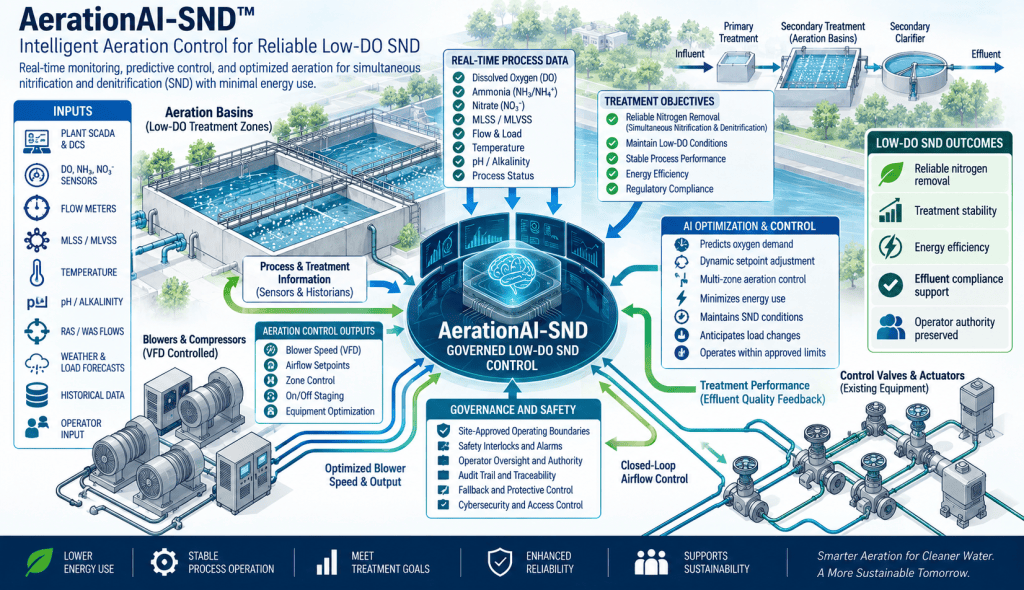
Simultaneous nitrification and denitrification—SND—creates conditions that can support aerobic ammonia oxidation and oxygen-limited nitrate reduction within the same biological treatment environment.
Under appropriate operating conditions, SND can improve nitrogen removal while reducing the aeration required compared with conventional operation at higher dissolved oxygen levels.
The Energy Opportunity
Aeration is typically one of the largest energy demands in biological wastewater treatment.
Operating with more aeration than the process requires can increase blower energy consumption while reducing the oxygen-limited conditions needed for effective denitrification.
AerationAI-SND addresses this problem by seeking the appropriate oxygen condition for reliable treatment rather than simply maintaining an unnecessarily high DO target.
Potential energy savings depend on the individual facility, including its baseline operation, process configuration, aeration equipment, biological conditions, instrumentation, and existing control strategy.
The objective is not minimum airflow. The objective is the aeration required for reliable nitrogen removal—no more and no less.
The Nitrogen-Removal Opportunity
Conventional biological nitrogen removal often uses separate aerobic and anoxic environments.
SND can create opportunities for nitrification and denitrification to occur concurrently where the biological process, carbon availability, operating conditions, and treatment configuration are suitable.
This can improve process flexibility and reduce unnecessary aeration while preserving the biological conditions required for treatment.
Not Simply “Lower DO”
AerationAI-SND is not designed to force dissolved oxygen to the lowest possible concentration.
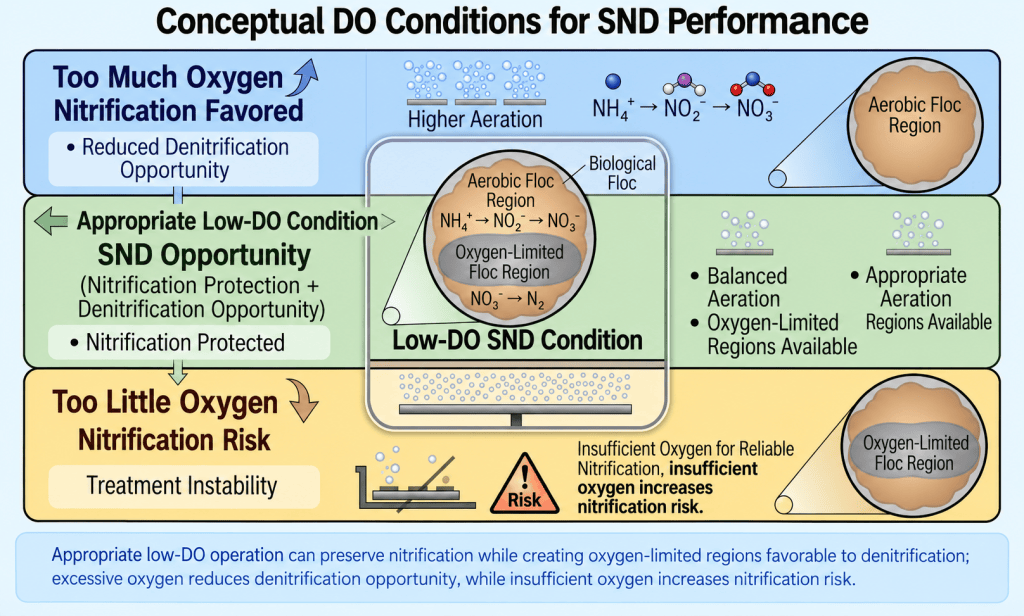
Excessive oxygen limitation can reduce the reliability of nitrification, destabilize biological treatment, increase the risk of ammonia breakthrough, and jeopardize permit compliance.
AerationAI-SND instead seeks a site-appropriate and governable low-DO condition that balances:
Nitrification Protection ↔ Denitrification Opportunity
Energy optimization remains subordinate to biological stability, effluent performance, and approved operating requirements.
2. The Low-DO SND Control Challenge
Low-DO nitrogen removal presents a more demanding control problem than conventional aeration.
The useful operating region can be relatively narrow, process response may be delayed, biological requirements change with operating conditions, and measurements become increasingly important as the process approaches sensitive operating boundaries.
A Narrow, Site-Specific Operating Region
There is no universal low-DO operating condition suitable for every wastewater treatment plant.
Appropriate operation depends on factors such as:
- Process configuration
- Treatment objectives
- Influent characteristics
- Biological condition
- Temperature
- Carbon availability
- Mixing and aeration characteristics
- Instrumentation
- Operating history
AerationAI-SND therefore uses site-specific engineering and biological boundaries rather than applying a universal low-DO target.
Reliable Information Becomes More Important
Low-DO operation places greater demands on instrumentation and process interpretation.
Measurement uncertainty, fouling, calibration condition, spatial variability, and delayed process response can become significant relative to the operating range.
AerationAI-SND therefore evaluates information quality and process context rather than relying on any single measurement as an unquestioned control signal.
Biological Conditions Continue to Change
The oxygen conditions appropriate for nitrogen removal can change with loading, temperature, biomass condition, seasonal operation, hydraulic conditions, treatment objectives, and other plant-specific factors.
AerationAI-SND is designed to adapt to these changing conditions while protecting biological performance.
Low-DO SND requires predictive control, trusted operational information, biological safeguards, and governed authority working together.
3. Compatibility With Existing Plant Infrastructure
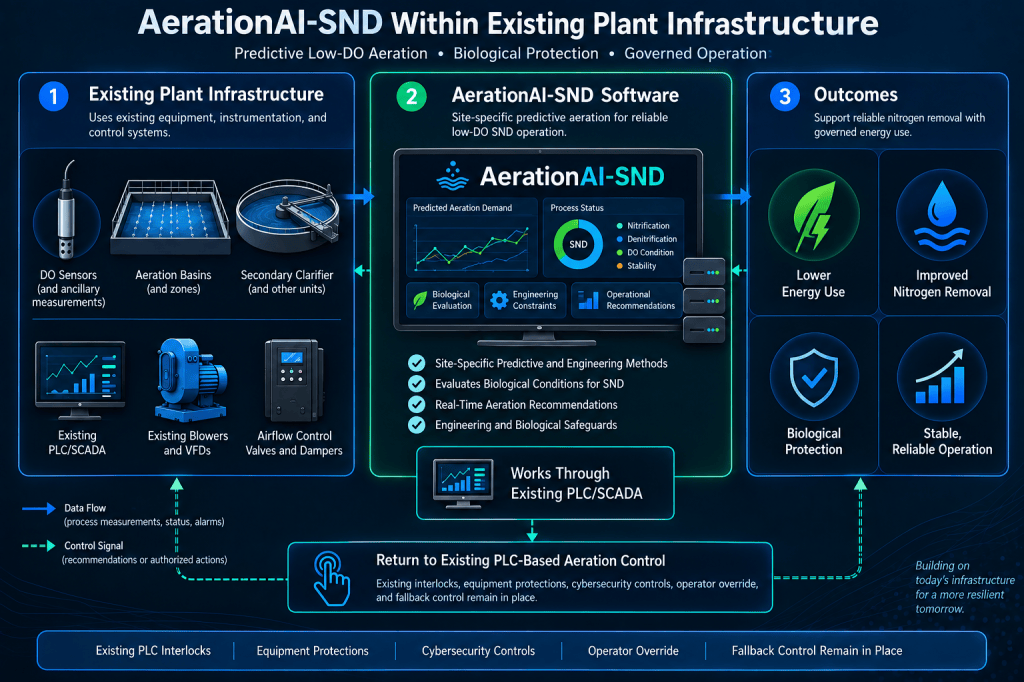
AerationAI-SND is designed to operate through suitable existing plant systems, which may include:
- Process instrumentation
- PLC and SCADA systems
- Plant historians and operational databases
- Blowers and variable-frequency drives
- Airflow-control valves and dampers
- Aeration basins
- Existing biological-treatment processes
- Existing plant alarms, interlocks, and control systems
New process hardware is normally not required when suitable instrumentation, operational information, connectivity, and control interfaces are already available.
Where information or instrumentation gaps exist, they are identified during the initial facility assessment.
The objective is to add an Engineering Intelligence supervisory layer without requiring wholesale replacement of the plant’s existing automation or treatment infrastructure.
4. Beyond a Single DO Measurement
Conventional aeration control often relies heavily on measured dissolved oxygen as the primary indication of process condition. For governed low-DO operation, however, a single DO measurement may not provide sufficient information to determine whether biological and treatment conditions remain appropriate.
AerationAI-SND therefore evaluates DO within a broader context that includes process conditions, biological treatment requirements, aeration capability, information quality, and treatment response. This provides a more complete basis for determining whether low-DO operation should be maintained, adjusted, restricted, or returned toward a more conservative condition.
Where physical measurements become uncertain, validated alternative information may support monitoring or restricted supervisory operation, subject to site-approved safeguards and the intended level of operational authority.
DO remains important—but it is evaluated within the broader biological and engineering context of the process.
5. What AerationAI-SND Is
AerationAI-SND is a facility-specific Engineering Intelligence application for evaluating and managing aeration to support reliable low-DO simultaneous nitrification and denitrification.
Rather than treating low DO as a universal setpoint, it evaluates changing treatment requirements, available operational information, biological conditions, process response, engineering constraints, and approved operational authority.
Its objective is to identify and support aeration conditions appropriate for the facility while protecting nitrification, treatment stability, equipment, and effluent performance.
6. What AerationAI-SND Does
AerationAI-SND translates available plant information into facility-specific aeration recommendations and governed operational actions through four high-level functions.
Understand the Current and Anticipated Condition
AerationAI-SND uses available plant and operating data to characterize current conditions and anticipate changes in treatment requirements.
Determine Appropriate Aeration
Proprietary facility-specific predictive and engineering methods determine the aeration appropriate for reliable low-DO biological treatment as operating conditions change.
Apply Engineering and Biological Safeguards
Proposed recommendations are evaluated against approved treatment requirements, equipment limitations, operational information quality, biological safeguards, operating boundaries, and facility authority.
Recommend or Govern Action
Depending on the approved deployment stage, AerationAI-SND can provide operator recommendations or bounded supervisory actions while treatment, equipment, energy, and effluent performance are continuously monitored.
Understand. Predict. Protect. Govern.
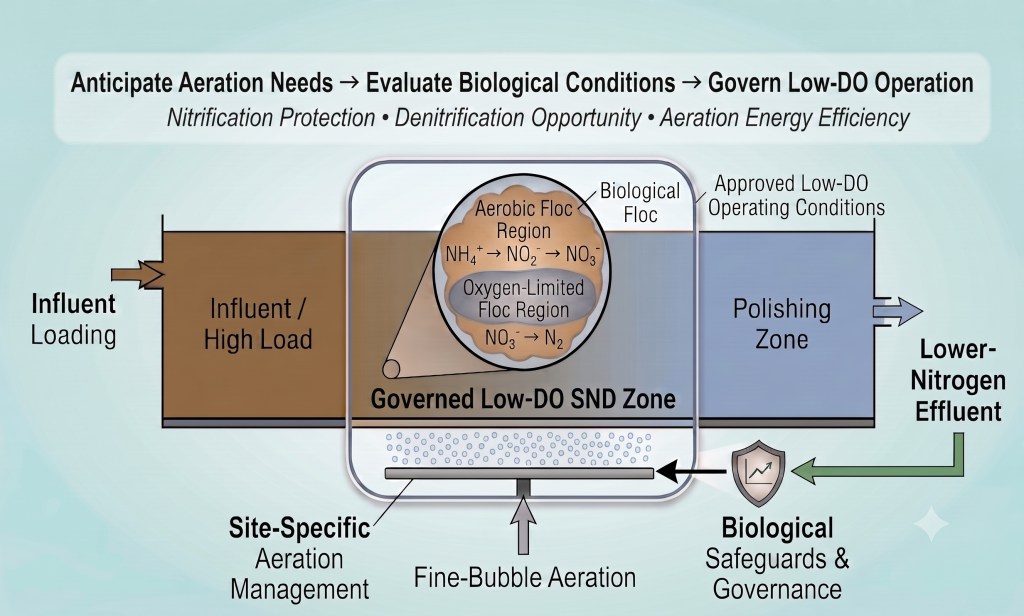
Anticipate Aeration Needs → Evaluate Biological Conditions → Govern Low-DO Operation
Nitrification Protection · Denitrification Opportunity · Aeration Energy Efficiency
7. Core AerationAI-SND Capabilities
AerationAI-SND combines predictive aeration, trusted operational information, biological process evaluation, engineering constraints, and governed supervisory operation to support low-DO simultaneous nitrification and denitrification.
Site-Specific Predictive Aeration
Estimates changing aeration requirements using facility-specific operating conditions, process behavior, loading, equipment response, and available biological information rather than relying solely on a fixed DO setpoint.
Biological-Process Evaluation
Evaluates whether current and anticipated conditions remain consistent with nitrification protection, denitrification opportunity, treatment stability, and the intended low-DO operating envelope.
Trusted Operational Information and Process Verification
Assesses the reliability and relevance of available measurements and operating signals before using them for consequential decisions, while considering process-response behavior and measurement uncertainty.
Engineering and Biological Safeguards
Applies site-specific operating limits, biological protection criteria, equipment constraints, information-confidence requirements, and other approved safeguards before recommendations or actions are advanced.
Governed Supervisory Operation
Generates recommendations or, where specifically authorized, bounded supervisory actions within approved operating limits, existing control protections, cybersecurity requirements, and facility authority.
8. Advantages and Benefits of AerationAI-SND
AerationAI-SND combines facility-specific predictive aeration, biological-process evaluation, trusted operational information, engineering safeguards, and governed low-DO operation to support reliable nitrogen removal while improving aeration efficiency. Rather than pursuing low DO or minimum airflow as objectives themselves, AerationAI-SND seeks the aeration conditions appropriate for treatment requirements, biological stability, changing operating conditions, and facility-specific constraints.
Reduce Aeration Energy While Protecting Treatment
AerationAI-SND supports lower aeration where biological conditions and treatment requirements permit, reducing unnecessary energy use while maintaining the oxygen required for reliable treatment and biological stability.
Improve Nitrogen Removal
AerationAI-SND supports operating conditions that can promote simultaneous nitrification and denitrification where the biological process, carbon availability, facility configuration, and other treatment conditions are suitable.
Protect Nitrification Under Low-DO Conditions
Low-DO operation can increase the risk of insufficient oxygen for ammonia oxidation. AerationAI-SND evaluates biological and operating conditions to protect reliable nitrification while preserving opportunities for denitrification.
Improve Stability Near Sensitive Biological Boundaries
Predictive aeration, process-response evaluation, trusted operational information, and facility-specific safeguards help reduce unnecessary oscillation and support stable operation within the facility’s validated low-DO operating region.
Respond to Changing Biological and Operating Conditions
AerationAI-SND evaluates changing loading, temperature, biological conditions, equipment operation, treatment response, and other facility-specific factors so aeration can adapt as nitrogen-removal requirements and operating conditions change.
Use Existing Plant Information and Infrastructure Effectively
AerationAI-SND is designed to work with suitable existing instrumentation, PLC/SCADA systems, historians, aeration equipment, and biological treatment infrastructure while identifying material information, instrumentation, or integration gaps that could affect implementation.
Enable Progressive, Governed Low-DO Operation
AerationAI-SND can progress from Historical Analysis through Shadow Mode and Advisory Operation to, where validated and specifically authorized, Governed Control. Operational authority expands only as biological performance, information confidence, safeguards, facility readiness, and authorization justify it.
Performance, nitrogen-removal, and energy benefits are facility-specific and should be established through documented validation.
9. Better Nitrogen Removal With Governed Energy Use
AerationAI-SND is designed to help facilities pursue the biological and energy advantages of low-DO operation without treating reduced oxygen concentration as an objective by itself.
Reduced Aeration Demand
Supports lower aeration where biological conditions and treatment requirements permit, reducing unnecessary energy use.
Improved Nitrogen-Removal Opportunity
Maintains operating conditions that can support simultaneous nitrification and denitrification where the facility configuration and biological process are suitable.
Nitrification Protection
Evaluates biological and operating conditions to reduce the risk of excessive oxygen limitation and loss of reliable ammonia oxidation.
More Stable Low-DO Operation
Uses predictive methods, process-response evaluation, and safeguards to reduce unnecessary oscillation and improve operation near sensitive biological boundaries.
Efficient Use of Existing Instrumentation
Uses available plant information and validated relationships where suitable, while keeping instrumentation requirements specific to the facility and intended level of authority.
Governed Operational Authority
Allows facilities to begin with analysis or recommendations and expand authority only after performance, readiness, and operating safeguards have been demonstrated.
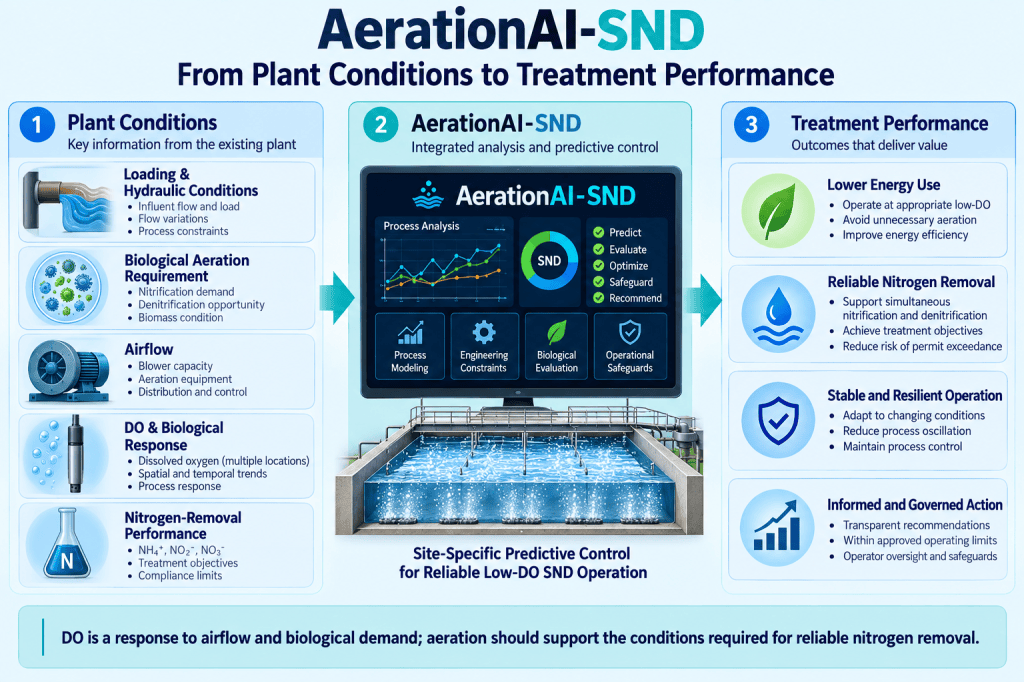
10. From Plant Conditions to Low-DO Treatment Performance
Low-DO SND performance depends on the complete biological and aeration process—not DO alone.
The operational relationship can be communicated publicly as:
Loading & Hydraulic Conditions
→ Biological Aeration Requirement
→ Airflow
→ DO & Biological Response
→ Nitrogen-Removal Performance
AerationAI-SND evaluates these relationships within the context of facility-specific treatment objectives and operating constraints.
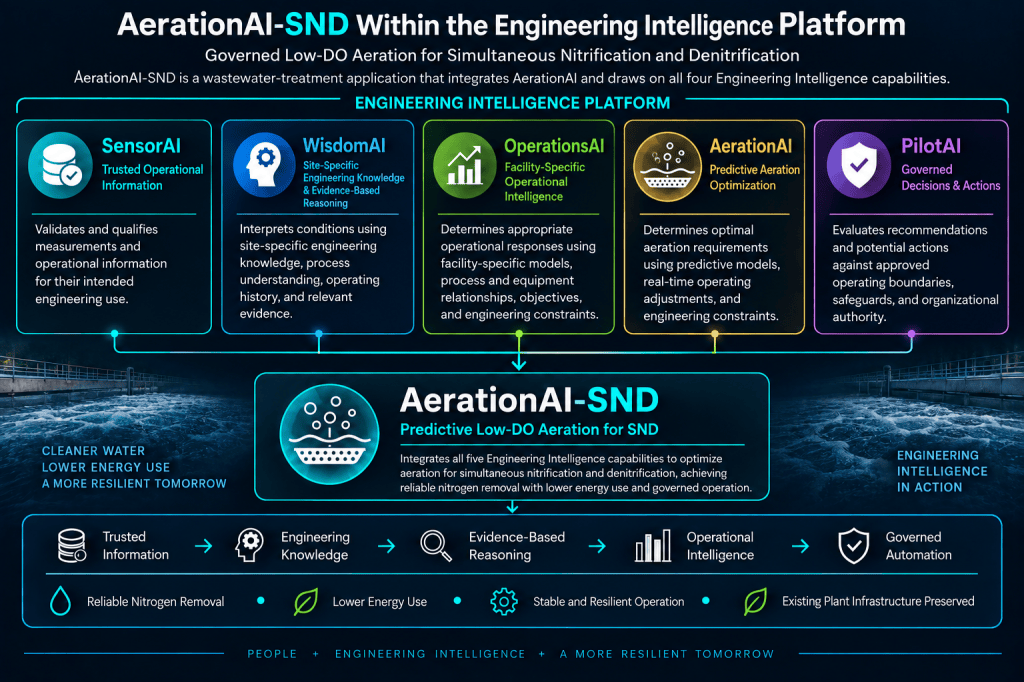
11. AerationAI-SND Within the Engineering Intelligence Platform
AerationAI-SND is built on McC AI Group’s proprietary, patent-pending Engineering Intelligence Platform.
The platform provides complementary capabilities for trusted operational information, site-specific engineering knowledge and evidence-based reasoning, facility-specific operational intelligence, and governed decisions and actions.
SensorAI™ — Trusted Operational Information
Determines whether measurements and operational information are sufficiently reliable, timely, representative, and appropriate for their intended engineering or operational use.
WisdomAI™ — Site-Specific Engineering Knowledge & Evidence-Based Reasoning
Applies site-specific engineering knowledge, approved practices, operating history, applicable requirements, and relevant evidence to interpret conditions, evaluate operational significance, and support evidence-based reasoning.
OperationsAI™ — Facility-Specific Operational Intelligence
Uses trusted operational information, facility-specific operational models and methods, operating objectives, process and equipment relationships, and engineering constraints to determine appropriate operational responses under current and anticipated conditions.
PilotAI™ — Governed Decisions & Actions
Evaluates whether a recommendation or action may be modified, constrained, held, blocked, escalated, authorized, or executed within approved operating boundaries and organizational authority.
Engineering Intelligence Architecture
Trusted Information → Engineering Knowledge → Evidence-Based Reasoning → Operational Intelligence → Governed Automation
Runtime Pathway
SensorAI → WisdomAI → OperationsAI → PilotAI
12. Performance Validation Before Expanding Authority
AerationAI-SND should progress toward operational authority only after its facility-specific performance has been evaluated under relevant operating conditions.
Validation may include comparison of predicted and observed process behavior, assessment of information reliability, evaluation of biological response, confirmation of engineering constraints and safeguards, and review of treatment performance.
Progression is based on demonstrated performance and facility readiness—not simply elapsed time.
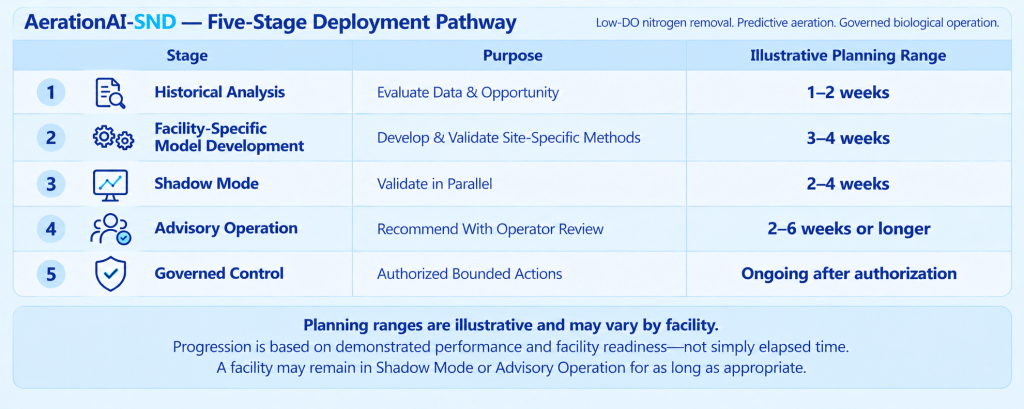
AerationAI-SND requires additional facility-specific evaluation because low-DO operation must demonstrate not only reliable aeration performance, but also protection of biological treatment and nitrogen-removal objectives before operational authority is expanded.
13. Governance and Deployment Safeguards
AerationAI-SND is designed to support low-DO operation without removing the protections already governing plant operation.
Governed Operation With Existing Plant Controls
AerationAI-SND operates as a supervisory Engineering Intelligence capability and does not require elimination of the facility’s existing PLC-based aeration-control strategy.
Existing PLC interlocks, equipment protections, cybersecurity controls, fallback provisions, and operator override remain in place.
Authorized personnel can pause AerationAI-SND, reject recommendations, restrict operational authority, override governed actions, and return operation to approved existing plant control according to the site configuration.
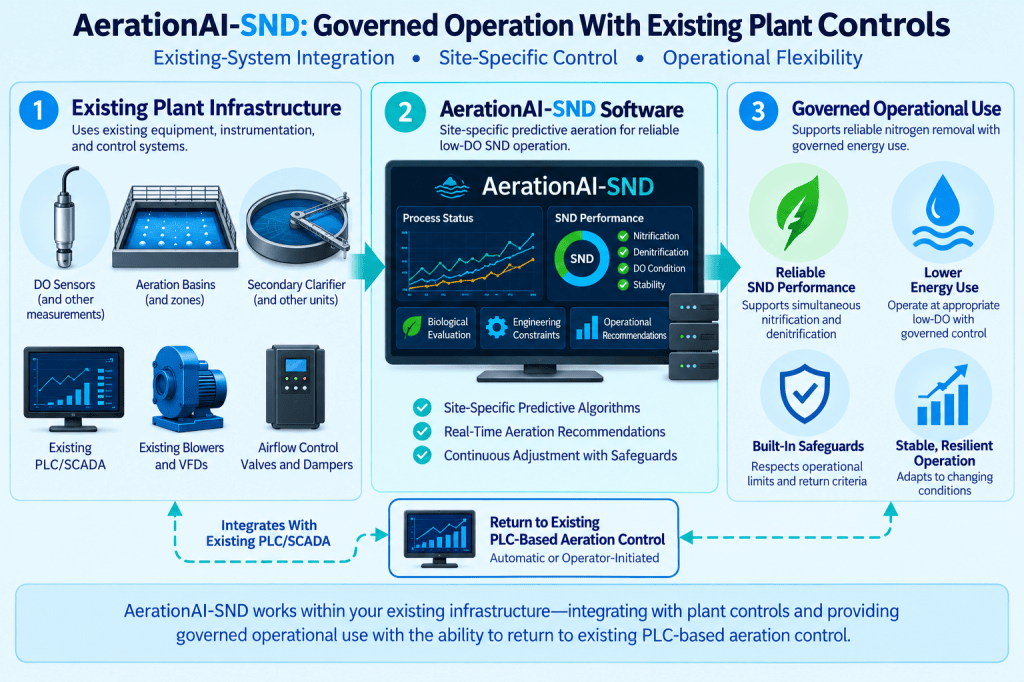
Existing PLC Interlocks · Equipment Protections · Cybersecurity Controls · Operator Override · Fallback Control Remain in Place
Continuous Performance Evaluation
Operational performance, information quality, biological response, treatment performance, and applicable constraints can continue to be evaluated after deployment.
Where required conditions are no longer satisfied, operational authority can be restricted and operation returned toward an approved fallback condition.
Treatment performance, biological protection, equipment protection, and operator authority remain ahead of energy optimization.
Secure Industrial Deployment
AerationAI-SND can be configured for deployment in a manner consistent with facility IT/OT and cybersecurity requirements.
Its essential monitoring, prediction, evaluation, optimization, and governed operational functions can be implemented within an approved local computing environment without inherently requiring external cloud processing or unrestricted plant-control access.
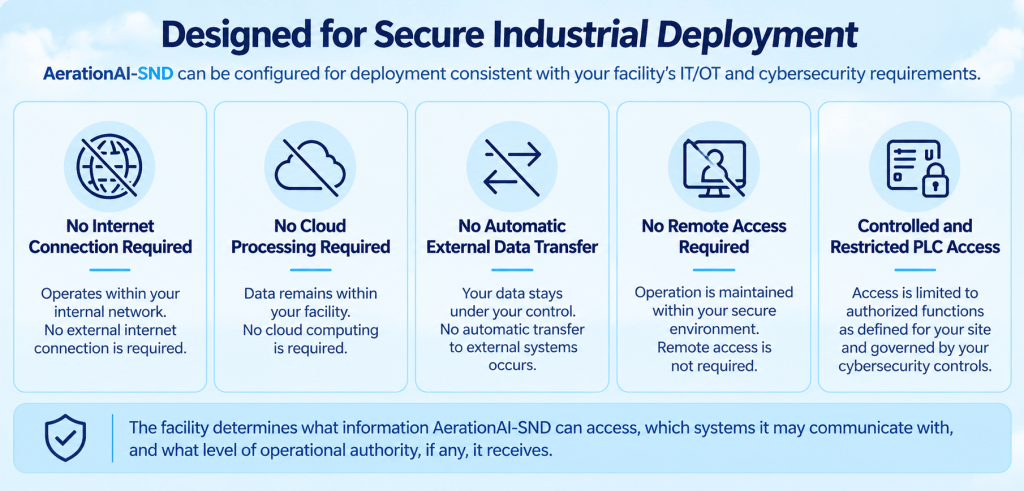
The specific cybersecurity architecture is established for each facility according to its existing IT/OT environment, cybersecurity requirements, integration architecture, and intended level of operational authority.
14. Proprietary Technology and Intellectual Property
AerationAI-SND incorporates proprietary and patent-pending technologies for facility-specific aeration management supporting simultaneous nitrification and denitrification under low-DO operating conditions.
AerationAI-SND extends the AerationAI technology foundation with specialized capabilities to evaluate and manage aeration within facility-specific biological, process, equipment, and operational constraints.
Its protected technical value lies in integrating facility-specific process information, biological treatment requirements, aeration management, engineering constraints, and governed decision-making to support reliable, low-DO nitrogen removal operation.
Additional implementation methods, facility-specific models, biological and process-response methods, configuration practices, validation procedures, and deployment methodologies remain proprietary.
15. AerationAI-SND Technology Evaluation
An initial AerationAI-SND evaluation examines whether the facility’s biological process, aeration system, treatment objectives, operational information, and existing controls provide a suitable basis for evaluating low-DO simultaneous nitrification and denitrification.
Evaluation may consider:
- Treatment Objectives — Nitrogen-removal requirements, effluent objectives, existing operating strategy, and performance priorities.
- Biological and Process Conditions — Process configuration, loading, temperature, carbon availability, biomass conditions, current DO operation, and evidence of potential SND conditions.
- Aeration System — Blowers, airflow distribution, control valves, diffusers, aeration zones, existing control strategy, and equipment constraints.
- Operational Information — Available DO, airflow, influent, treatment-performance, equipment-status, and other relevant operational information.
- Implementation Environment — Existing PLC/SCADA infrastructure, historian availability, connectivity, cybersecurity requirements, operating procedures, and organizational readiness.
16. Performance Qualification and Implementation Readiness
Before AerationAI-SND is relied upon for consequential operational use, its facility-specific implementation should be qualified for the intended purpose and level of operational authority.
Implementation readiness is evaluated through four areas:
a. Facility and Process Assessment
Confirm treatment configuration, biological process characteristics, aeration infrastructure, treatment objectives, existing operating practices, and relevant equipment limitations.
b. SND Readiness Assessment
Evaluate whether facility-specific biological and operating conditions provide an appropriate technical basis for low-DO SND evaluation, including nitrification protection and potential denitrification opportunity.
c. Information and Integration Assessment
Confirm the availability, reliability, relevance, and integration of required operational information and determine how AerationAI-SND can interface with existing plant systems while preserving established protections.
d. Pilot Validation
Evaluate facility-specific predictions, recommendations, biological response, treatment performance, safeguards, and operational behavior through historical analysis, facility-specific model development, Shadow Mode, and Advisory Operation before any expansion of operational authority.
Performance claims should be based on documented, facility-specific validation.
PREDICT the Requirement → VALIDATE the Information → PROTECT the Biology → GOVERN the Action
17. Technology and Deployment Partnerships
AerationAI-SND can be evaluated, validated, and deployed through collaboration with wastewater treatment facilities, engineering organizations, control-system integrators, technology providers, research organizations, and qualified implementation partners.
Potential partners may include utilities, industrial wastewater facilities, consulting engineers, control-system integrators, engineering contractors, research organizations, and qualified technology partners.
Each engagement is structured around the facility’s nitrogen-removal objectives, biological process, aeration infrastructure, existing controls, available operational information, engineering and biological constraints, cybersecurity requirements, and approved level of operational authority.
18. Explore AerationAI-SND for Your Facility
Facilities interested in AerationAI-SND can begin with a focused evaluation of existing biological treatment conditions, aeration operation, available historical information, instrumentation, nitrogen-removal objectives, and existing control infrastructure.
Where the facility provides an appropriate technical basis, historical plant information can be used to evaluate potential SND opportunity and demonstrate how AerationAI-SND would assess changing conditions and develop facility-specific aeration recommendations before any operational authority is considered.
The initial discussion can help determine whether a more detailed facility evaluation, historical demonstration, or pilot validation is appropriate.
Understand the facility. Validate the opportunity. Protect the biology. Govern the operation.
 McC AI Group, Inc.