

PilotAI
Providing Governed Intelligence for Engineering Intelligence.
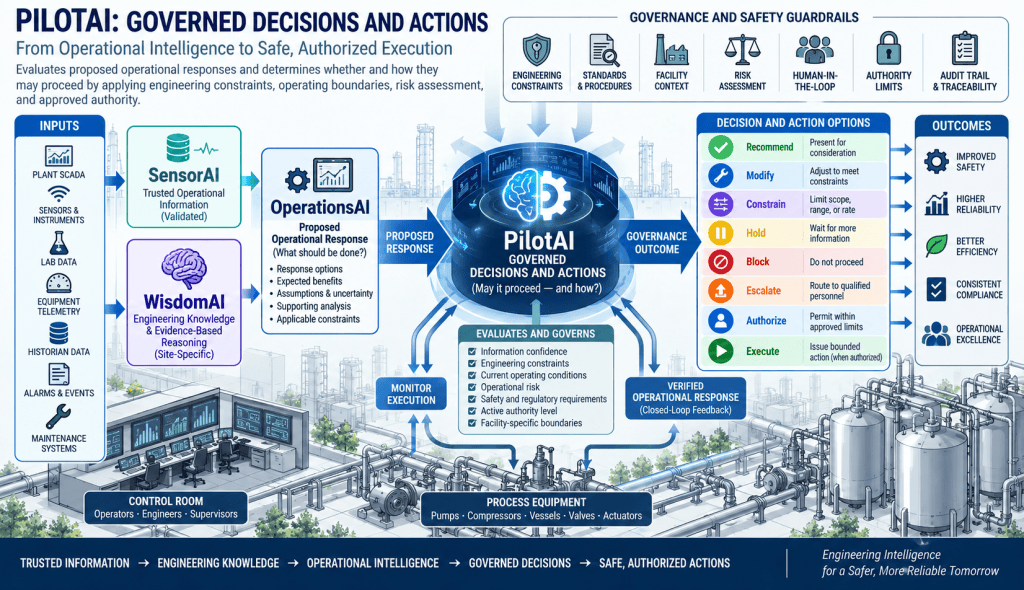
PilotAI is the governed decision-and-action module of McC AI Group’s Engineering Intelligence Platform. It evaluates whether and how a proposed operational response may proceed by considering the confidence supporting the decision, current facility conditions, engineering constraints, operating boundaries, operational risk, safeguards, and approved organizational authority.
PilotAI separates analytical capability from operational authority. A technically supported recommendation does not automatically become an authorized action.
Depending on the application, deployment stage, and approved authority, PilotAI may recommend, modify, constrain, hold, block, escalate, authorize, or execute a proposed response within defined boundaries.
PilotAI is designed to complement operators, engineers, automation systems, existing control protections, and organizational governance—not replace them. Human oversight, intervention authority, facility-approved boundaries, cybersecurity requirements, and organizational accountability remain integral throughout deployment.
Governed Authority · Transparent Decisions · Bounded Actions · Accountable Automation
1. The Decision-to-Action Challenge
Critical infrastructure increasingly uses sensors, analytics, predictive models, optimization, artificial intelligence, digital twins, and advanced control systems to understand facility conditions and identify potential operational responses.
But determining a technically appropriate response is not the same as determining whether that response should be allowed to influence physical operation.
A Recommendation Is Not an Authorization
A recommendation may be technically reasonable yet inappropriate for execution because the supporting information is uncertain, a required condition has not been verified, equipment is unavailable, a constraint would be exceeded, an operating mode has changed, or the required authority has not been granted.
Problem: Analytical systems can generate recommendations without establishing whether those recommendations are sufficiently supported, permitted, and safe to influence facility operation.
Operational Authority May Not Match Information Confidence
A recommendation can depend on measurements, inferred conditions, predictive models, engineering interpretations, or other information with varying levels of confidence.
The consequence of uncertainty also varies. Information sufficient for monitoring may not be sufficient for an automated equipment change.
Problem: Operational authority can become inappropriate when the confidence supporting a decision is not matched to the consequence and reversibility of the proposed action.
Engineering Constraints Must Remain Enforceable
Operational responses must remain within applicable equipment, process, safety, environmental, regulatory, maintenance, and organizational boundaries.
Optimization or predicted performance improvement does not override these constraints.
Problem: A mathematically attractive or operationally beneficial response can still be unacceptable if engineering constraints and safeguards are not evaluated before action.
Facility and Operating Context Can Change What Is Permitted
The same proposed action may be appropriate at one facility but inappropriate at another. It may even change within the same facility depending on equipment availability, operating mode, maintenance status, environmental conditions, process state, or current risk.
Problem: Generalized automation can apply a response without sufficiently accounting for the facility-specific condition under which that response is being considered.
Time-Critical Conditions Require Governed Intervention
Some abnormal conditions require timely intervention. Waiting too long may allow a manageable condition to escalate, while acting too aggressively or on insufficient information can create a different risk.
Problem: Facilities need a way to support timely intervention without abandoning engineering constraints, confidence requirements, safeguards, or human authority.
Automation Authority Must Be Able to Decrease
An automated system may operate acceptably under normal conditions but may encounter degraded instrumentation, unexpected equipment responses, changing process conditions, communication problems, or an emerging constraint.
Problem: Operational authority that can increase but cannot rapidly decrease creates unnecessary risk when the conditions supporting automation deteriorate.
Decisions and Actions Require Accountability
For consequential decisions, personnel may need to know what information was available, which constraints applied, what authority was active, why an action was permitted or blocked, who intervened, and what happened afterward.
Problem: Automation without a traceable decision and authority basis can weaken engineering review, organizational accountability, and trust.
[FIGURE 2 — Why Recommendations Need Governance]
Location: Here, after the seven problem statements.
Optional new figure. Generate only if the section needs visual relief after page layout is established.
2. From Operational Intelligence to Governed Decisions and Actions
Within Engineering Intelligence, each module answers a different question.
SensorAI: Can the operational information be trusted for its intended use?
WisdomAI: What do the conditions and available evidence mean?
OperationsAI: What is the appropriate operational response?
PilotAI: May that response proceed—and how?
PilotAI therefore begins where operational-response determination ends. It receives a proposed operational response together with the trusted information, engineering basis, assumptions, constraints, uncertainty, operating context, and other evidence needed to evaluate whether and how that response may proceed.
PilotAI does not assume that a recommendation from OperationsAI, optimization software, a predictive model, a digital twin, or another approved system automatically has operational authority.
It evaluates the recommendation against the conditions required for its use.
Operational Intelligence → Governance Evaluation → Governed Decision → Authorized Bounded Action, Where Permitted
[FIGURE 3 — From Operational Intelligence to Governed Action]
Location: Immediately here, before Section 3.
New figure recommended.
3. What PilotAI Is
PilotAI is the Governed Decisions & Actions module of McC AI Group’s Engineering Intelligence Platform.
It provides the governance layer between a proposed operational response and its permitted operational use.
PilotAI evaluates whether the information, engineering basis, operating context, constraints, safeguards, risk, and authority supporting a proposed response are sufficient for the intended level of action.
Depending on the result, PilotAI can allow the recommendation to remain advisory, modify or constrain it, hold it pending additional information, block it, escalate it for qualified review, authorize it within defined limits, or execute it where bounded operational authority has been specifically granted.
Beyond Recommendation Generation
PilotAI is not primarily a recommendation-generation engine. OperationsAI and approved analytical systems can determine potential operational responses.
PilotAI addresses the separate governance question:
Under the current conditions, with the available evidence and active authority, what is permitted to happen next?
Beyond Binary Approval or Rejection
Operational governance is not limited to “yes” or “no.”
A response that should not proceed exactly as proposed may still be suitable after modification, restriction, additional verification, human review, or a reduction in authority.
This enables PilotAI to govern operational use proportionately rather than treating every uncertainty or constraint as requiring either unrestricted execution or complete rejection.
4. What PilotAI Does
PilotAI transforms a proposed operational response into a governed decision and, where authorized, a bounded operational action.
Confidence-Conditioned Decision Authorization
Evaluates whether the information and engineering basis supporting the proposed response are sufficiently reliable for the intended use and level of authority.
Facility-Specific Governance
Evaluates the proposed response within the actual facility, asset, process, operating mode, equipment condition, maintenance state, environmental condition, and organizational context.
Engineering-Constraint Enforcement
Applies applicable engineering constraints, equipment limits, process envelopes, safety requirements, environmental and regulatory obligations, maintenance restrictions, rate-of-change limits, interlocks, and other approved boundaries.
Authority Assessment
Determines what level of operational authority is active for the specific decision, asset, condition, user or system role, and deployment stage.
Decision and Action Governance
Determines whether the proposed response should be:
Recommend · Modify · Constrain · Hold · Block · Escalate · Authorize · Execute
Execution Monitoring
Where an action is authorized and executed, PilotAI can evaluate command acceptance, equipment response, process response, constraint compliance, unexpected outcomes, and whether additional intervention or fallback is required.
Authority Restriction and Fallback
When information quality, operating conditions, equipment response, or risk no longer support the active authority level, PilotAI can restrict or withdraw authority and support an approved fallback response.
Decision and Action Traceability
Preserves the supporting information, engineering basis, constraints, authority level, decision outcome, human intervention, executed action, and available operational response for review and accountability.
[FIGURE 4 — PilotAI Governance Outcomes]
Location: Immediately after Decision and Action Governance, or at the end of Section 4 if the WordPress layout is cleaner.
New figure recommended.
5. How PilotAI Works
PilotAI applies a structured governance process between operational intelligence and permitted action. The process keeps the proposed response connected to the information, engineering basis, constraints, authority, and operational context that determine whether and how it may proceed.
[FIGURE 5 — How PilotAI Works]
Location: Here, immediately after the introduction and before Step 1.
New figure recommended.
Receive the Proposed Operational Response
PilotAI receives a proposed operational response from OperationsAI or another approved analytical, optimization, supervisory, or organizational system.
The response remains associated with its supporting operational information, engineering interpretation, objectives, assumptions, constraints, uncertainty, and required review.
Evaluate Supporting Confidence and Context
PilotAI determines whether the information and engineering basis are sufficiently reliable and applicable for the proposed use.
Evaluation may consider the facility, asset, process condition, physical location, operating mode, equipment availability, maintenance status, environmental condition, information confidence, operational risk, and organizational requirements.
Apply Engineering and Governance Boundaries
The proposed response is evaluated against approved engineering constraints, equipment limits, process envelopes, safety requirements, environmental and regulatory obligations, maintenance restrictions, interlocks, rate-of-change limits, organizational policies, authority limits, and fallback expectations.
Determine the Permitted Governance Outcome
PilotAI determines whether the proposed response should be recommended, modified, constrained, held, blocked, escalated, authorized, or executed.
The outcome depends on the available evidence, current operating condition, consequence of error, active safeguards, and approved authority.
5. Recommend or Act Within Approved Authority
In advisory operation, PilotAI presents the governed recommendation and its decision basis to authorized personnel.
Where bounded operational authority has been validated and specifically approved, PilotAI may permit or issue defined supervisory actions through approved facility interfaces.
Authorized personnel retain visibility and applicable intervention or override authority.
6. Monitor Execution and Operational Response
When an action is implemented, PilotAI can evaluate whether:
- the command was accepted;
- the intended equipment state occurred;
- the process responded as expected;
- applicable constraints remained satisfied;
- new risks emerged; and
- further action, escalation, or fallback is required.
7. Restrict or Regress Authority When Needed
If supporting confidence declines, operating conditions become unstable, constraints are approached or violated, equipment fails to respond as expected, or new risk emerges, PilotAI can become more restrictive.
Depending on the approved implementation, it may hold additional actions, reduce authority, return to advisory operation, request human intervention, block further commands, or support approved fallback logic.
8. Record the Decision and Outcome
PilotAI preserves the information and engineering basis supporting the decision, applied constraints, active authority, governance outcome, human approvals or overrides, executed action, operational response, and any escalation or fallback.
These records support engineering review, governance refinement, organizational learning, auditability, and continuous improvement.
Evaluate → Constrain → Govern → Authorize → Act → Verify
6. Core PilotAI Capabilities
PilotAI combines decision governance, bounded operational authority, execution monitoring, fallback protection, and traceability so that operational responses can influence facility operation only to the extent justified by evidence, engineering constraints, safeguards, risk, and approved authority.
Confidence-Conditioned Operational Authority
PilotAI evaluates the confidence supporting a proposed operational response before granting operational authority.
Confidence may reflect the reliability of operational information, completeness of applicable engineering knowledge, consistency of the engineering interpretation, performance of facility-specific operational models and methods, historical validation, availability of required safeguards, and consequence of error.
A recommendation suitable for operator consideration may not be suitable for automatic execution.
Operational authority should never exceed the confidence supporting the decision.
[FIGURE 6 — Confidence-Conditioned Operational Authority]
Location: Immediately here.
New figure strongly recommended.
Facility-Specific Operational Governance
PilotAI applies governance according to the specific facility, asset, process, location, operating mode, equipment condition, maintenance condition, environmental condition, and organizational environment.
This prevents a generally reasonable response from being treated as automatically permissible under every facility condition.
Engineering and Operating-Boundary Enforcement
PilotAI evaluates proposed actions against defined engineering, equipment, process, safety, environmental, regulatory, maintenance, and organizational boundaries.
Optimization, speed, or efficiency does not override applicable safeguards or approved constraints.
Real-Time Governed Intervention
Where authorized, PilotAI can support timely intervention as facility conditions change.
Intervention may include alerts, governed recommendations, restricted operating modes, bounded supervisory adjustments, temporary authority reduction, escalation, prevention of unsupported commands, or transition toward an approved fallback condition.
Progressive Governed Authority
PilotAI enables organizations to expand operational authority progressively rather than move directly from manual or advisory operation to broad autonomous control.
Authority can also decrease whenever confidence, operating conditions, safeguards, or risk no longer support the current level.
Execution Verification
PilotAI can evaluate whether an authorized action was actually implemented and whether the expected operational response occurred.
This closes an important gap between command issued and desired facility state achieved.
Decision and Action Auditability
PilotAI maintains a traceable relationship among the proposed response, supporting evidence, applicable constraints, active authority, governance outcome, action, human intervention, and observed result.
7. Governed Operational Authority
PilotAI is designed to strengthen operational governance rather than create uncontrolled automation.
Defined Authority
Each implementation establishes which decisions PilotAI may evaluate, recommend, modify, constrain, authorize, execute, or block.
Authority can differ by facility, asset, process, operating mode, condition, decision type, and deployment stage.
Human and Organizational Authority
Qualified personnel retain responsibility according to approved organizational roles.
Depending on the implementation and authority level, authorized personnel may approve, reject, modify, pause, override, restrict, or withdraw PilotAI operational authority.
Existing Protections Remain in Place
Existing PLC/DCS interlocks, equipment protections, safety systems, control safeguards, cybersecurity requirements, and approved fallback provisions remain integral to the operational architecture.
PilotAI does not replace deterministic safety systems or required equipment protections.
Controlled Access
Operational authority and access to infrastructure information are managed according to organizational roles, cybersecurity requirements, facility policies, system architecture, and approved responsibilities.
Safe Restriction and Fallback
If conditions supporting an authorized action deteriorate, PilotAI can become more conservative rather than continuing operation under assumptions that are no longer valid.
An approved fallback may include returning authority to personnel, existing supervisory logic, existing PLC/DCS control, a restricted operating state, or another facility-defined safe or protective condition.
Authority is conditional, bounded, reviewable, and withdrawable.
8. PilotAI Governance Outcomes
PilotAI supports more than binary approval or rejection.
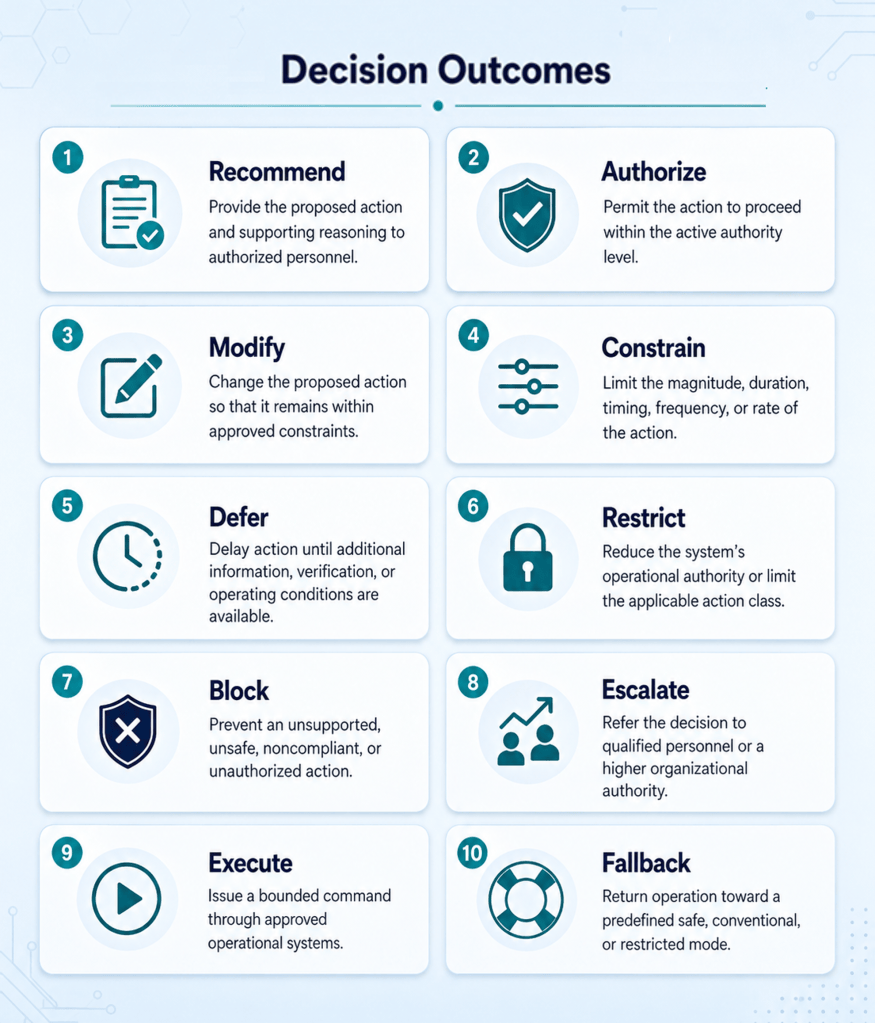
Recommend
Present the response for authorized human consideration without granting execution authority.
Modify
Change the proposed response so that it better satisfies the applicable engineering or governance requirements.
Constrain
Limit the magnitude, rate, duration, equipment scope, operating range, or other characteristics of the response.
Hold
Prevent progression until additional information, verification, operating stability, or required review becomes available.
Block
Prevent a response from proceeding when required conditions, constraints, safeguards, or authority are not satisfied.
Escalate
Route the decision to qualified personnel or a higher organizational authority when the condition exceeds the approved scope.
Authorize
Permit a defined response within explicitly approved boundaries without implying unrestricted operational authority.
Execute
Where specifically validated and authorized, permit or issue the bounded operational action through an approved facility interface.
The governance outcome can change as information confidence, operating conditions, risk, or authority changes.
9. Illustrative Operating Scenarios
The following scenarios illustrate how PilotAI may govern operational responses. Actual implementation depends on facility configuration, engineering validation, approved authority, cybersecurity requirements, safeguards, and organizational governance.
Recommendation Supported by Insufficient Information
OperationsAI identifies a potentially beneficial equipment adjustment, but SensorAI indicates that a critical measurement is no longer sufficiently reliable for automated use.
PilotAI may retain the recommendation for review while holding or blocking automated execution until adequate information or qualified review is available.
Proposed Response Outside an Engineering Boundary
An optimization method identifies a response that could improve performance, but the proposed change would exceed an approved equipment or process constraint.
PilotAI prevents the response from proceeding as proposed. Depending on the implementation, it may constrain the response, request an alternative from OperationsAI, or escalate the decision.
Emerging Risk Requiring Timely Intervention
An operating condition approaches a facility-defined risk boundary.
PilotAI evaluates the proposed operational response, supporting confidence, applicable constraints, equipment condition, safeguards, and active authority. It may recommend intervention, authorize a bounded response, restrict other actions, escalate the condition, or invoke approved fallback logic.
Unexpected Response After an Authorized Action
A bounded action is authorized, but the equipment or process does not respond as expected.
PilotAI identifies the discrepancy between commanded and observed state and can hold further action, reduce authority, escalate for review, or initiate an approved fallback.
Similar Facilities With Different Boundaries
Two facilities use similar equipment but have different configurations, operating histories, constraints, or approved procedures.
PilotAI applies the governance boundaries established for each facility rather than assuming the same action has equal authority at both locations.
Authority Regression
PilotAI has bounded operational authority during normal conditions, but a required instrument becomes unreliable or a key piece of equipment becomes unavailable.
PilotAI reduces its operational authority to the level supported by the remaining information, safeguards, and operating condition.
These scenarios illustrate the central PilotAI principle:
A technically appropriate response becomes an operational action only when the conditions required for that authority are satisfied.
10. Integration With Existing Facility Systems
PilotAI is designed to complement suitable existing operational, automation, information, and governance systems rather than require wholesale replacement.
Depending on the application, PilotAI may interface with SensorAI, WisdomAI, OperationsAI, PLC/DCS systems, SCADA platforms, operational historians, equipment controllers, alarm-management systems, maintenance and asset-management systems, laboratory or process-information systems, approved supervisory applications, and organizational governance systems.
Integration scope depends on the facility architecture, available information, control interfaces, cybersecurity requirements, operational risk, engineering constraints, safeguards, approved authority, and organizational readiness.
Decision and Action Outputs May Include
- Governed operator recommendations
- Decision-authorization status
- Constraint and boundary notifications
- Hold or block status
- Restricted-authority indications
- Escalation requirements
- Bounded supervisory actions
- Fallback or protective responses
- Action and authority explanations
- Execution-verification status
- Decision and action records
- Information for engineering review and continuous improvement
PilotAI adds governed operational authority to the broader Engineering Intelligence architecture without eliminating the facility’s existing control protections or organizational authority.
11. Progressive Deployment and Operational Authority
PilotAI should be introduced progressively because operational authority should expand only after the required information quality, decision performance, engineering safeguards, organizational readiness, and governance have been demonstrated.
Historical Analysis — Evaluate Decisions, Constraints & Opportunity
Historical information is used to identify important operational decisions, recurring conditions, response patterns, engineering constraints, existing safeguards, decision consequences, and potential PilotAI applications.
Shadow Mode — Validate in Parallel
PilotAI evaluates proposed operational responses alongside existing facility operation without affecting physical equipment or processes.
Governance outcomes can be compared with actual operator, engineering, and control-system decisions.
Advisory Operation — Recommend With Operator Review
PilotAI provides governed recommendations, constraint assessments, authority status, verification requests, and escalation information for review by authorized personnel.
Personnel retain responsibility for deciding whether and how recommendations are implemented.
Governed Control — Authorized Bounded Actions
Following documented validation and explicit facility authorization, PilotAI may receive bounded authority for defined decisions, assets, operating modes, conditions, and action types.
Existing protections, operator visibility, cybersecurity requirements, intervention capability, and approved fallback remain in place.
Authority may expand, remain unchanged, or decrease according to demonstrated performance and current conditions.
Progression is based on demonstrated performance, information confidence, engineering validation, organizational readiness, and explicit facility authorization—not simply elapsed time.
Facilities can obtain value without proceeding to Governed Control.
[FIGURE 7 — Progressive Expansion and Regression of Operational Authority]
Location: Immediately here, after the four deployment stages.
Adapt or regenerate from the established phased-deployment visual. Include both expansion and regression of authority.
12. Advantages and Benefits of PilotAI
PilotAI strengthens the transition from operational intelligence to operational use by applying engineering constraints, confidence requirements, facility context, safeguards, organizational authority, and execution verification before and after consequential actions.
Reduce the Risk of Uncontrolled Automation
Proposed operational responses are evaluated before they are permitted to influence physical equipment or processes.
Strengthen Engineering and Operational Safeguards
PilotAI consistently applies defined engineering constraints, equipment limitations, operating boundaries, safety requirements, environmental obligations, and organizational governance.
Improve Decision Consistency
Approved governance rules and authority boundaries can be applied more consistently across personnel, shifts, assets, operating conditions, and facilities.
Support Timely but Governed Intervention
PilotAI can support timely response to changing or abnormal conditions while maintaining restrictions appropriate to information confidence, consequence, risk, and authority.
Improve Human–Machine Collaboration
Operators and engineers retain visibility and applicable intervention authority while receiving transparent governance outcomes and the engineering basis supporting them.
Strengthen Accountability and Auditability
Decision records can show what information was available, which constraints applied, what authority was active, why an action was permitted or restricted, what was executed, and what operational response followed.
Improve Operational Resilience
PilotAI can reduce authority, hold or block additional actions, escalate decisions, and support approved fallback when information quality, equipment response, operating conditions, or risk become unfavorable.
Benefits and performance are facility- and application-specific and should be established through appropriate evaluation and documented validation. PilotAI operates within defined engineering constraints, safeguards, information-quality requirements, cybersecurity requirements, organizational governance, and authorized operational boundaries.
13. PilotAI Within the Engineering Intelligence Platform
PilotAI is one of four core modules of McC AI Group’s Engineering Intelligence Platform. It provides the governance function that determines whether and how operational intelligence may progress toward an authorized decision or physical action.
[FIGURE 8 — PilotAI Within the Engineering Intelligence Platform]
Location: Immediately here, before the four module descriptions.
New figure recommended. Top row: SensorAI, WisdomAI, OperationsAI. PilotAI featured below.
SensorAI™ — Trusted Operational Information
Determines whether measurements and operational information are sufficiently reliable, timely, representative, and appropriate for their intended engineering or operational use.
WisdomAI™ — Site-Specific Engineering Knowledge & Evidence-Based Reasoning
Applies site-specific engineering knowledge, approved practices, operating history, applicable requirements, and relevant evidence to interpret conditions, evaluate operational significance, and support evidence-based reasoning.
OperationsAI™ — Facility-Specific Operational Intelligence
Uses trusted operational information, facility-specific operational models and methods, operating objectives, process and equipment relationships, and engineering constraints to determine appropriate operational responses under current and anticipated conditions.
PilotAI™ — Governed Decisions & Actions
Evaluates whether a recommendation or action may be modified, constrained, held, blocked, escalated, authorized, or executed within approved operating boundaries and organizational authority.
Engineering Intelligence Architecture
Trusted Information → Engineering Knowledge → Evidence-Based Reasoning → Operational Intelligence → Governed Automation
Runtime Pathway
SensorAI → WisdomAI → OperationsAI → PilotAI
The Module Boundary
WisdomAI asks: What do the conditions and available evidence mean?
OperationsAI asks: What is the appropriate operational response?
PilotAI asks: May that response proceed—and how?
PilotAI therefore governs operational authority without assuming responsibility for information validation, engineering interpretation, or determination of the operational response.
14. Proprietary Technology and Intellectual Property
PilotAI incorporates proprietary and patent-pending technologies for governed decision-making, bounded operational authority, constraint enforcement, execution monitoring, fallback, auditability, and progressive operational authorization within Engineering Intelligence applications.
Its proprietary technical value extends beyond generating recommendations or applying static rules. PilotAI provides an integrated governance architecture for determining whether, when, and to what extent a proposed operational response may influence physical facility operation.
Protected capabilities may include confidence-conditioned authorization, facility-specific governance, engineering-constraint enforcement, bounded operational authority, mode-dependent governance, action modification and restriction, command blocking, escalation and qualified-review routing, authority regression, fallback management, execution monitoring, decision and action traceability, and progressive governed authority.
Specific algorithms, governance logic, authority structures, validation methods, configuration practices, and implementation techniques remain proprietary.
15. PilotAI Technology Evaluation
An initial PilotAI evaluation examines the facility’s operational decisions, control architecture, engineering constraints, safeguards, authority structure, governance requirements, cybersecurity requirements, and potential applications for governed operational intelligence.
Decision and Authority Assessment
Identify important operational decisions and determine which are currently manual, advisory, automated, or inconsistently governed.
Evaluate the consequence, reversibility, timing requirements, current responsibility, and potential authority associated with each decision.
Engineering-Boundary Assessment
Identify applicable engineering constraints, equipment limits, process envelopes, safety requirements, environmental and regulatory obligations, maintenance restrictions, interlocks, rate limits, and fallback requirements.
Information and Integration Assessment
Evaluate whether the operational information, engineering knowledge, operational models, system interfaces, and communications needed to support the proposed use are sufficiently available and reliable.
Governance and Organizational Assessment
Evaluate personnel roles, approval authority, intervention and override requirements, cybersecurity, access controls, decision accountability, fallback responsibility, and organizational readiness.
The evaluation establishes where PilotAI may provide value and what must be demonstrated before any operational authority is considered.
16. Performance Qualification and Implementation Readiness
PilotAI performance and implementation readiness should be established using actual facility information, operational responses, engineering constraints, safeguards, control architecture, qualified review, and prospective validation.
Qualification may consider information confidence, correctness of governance outcomes, constraint enforcement, identification of unsupported actions, authority selection, execution verification, fallback behavior, cybersecurity integration, operator usability, and performance across representative normal, abnormal, and degraded conditions.
Historical Governance Evaluation
Evaluate historical decisions and operating conditions to determine how PilotAI would have interpreted authority, constraints, and potential governance outcomes.
Shadow Validation
Evaluate PilotAI prospectively alongside actual operation without permitting it to affect the physical process.
Advisory Validation
Evaluate governed recommendations and authority assessments with authorized personnel responsible for implementation decisions.
Governed-Control Qualification
Where bounded operational authority is proposed, validate the defined actions, operating conditions, constraints, safeguards, execution monitoring, fallback behavior, intervention capability, cybersecurity, and authority limits before authorization.
Operational authority should not expand merely because a deployment stage has been completed.
Performance Before Authority
Authority should expand only when documented evidence, information confidence, engineering validation, operational performance, organizational readiness, and explicit facility authorization support the proposed scope.
Performance claims should be based on documented, facility-specific validation.
17. Technology and Deployment Partnerships
PilotAI can be evaluated, validated, and deployed through collaboration with facility operators, engineering organizations, control-system integrators, equipment and technology providers, cybersecurity specialists, and qualified implementation partners.
Potential collaborators can include municipal and industrial facilities, consulting engineers, control-system integrators, equipment manufacturers, engineering contractors, research organizations, and qualified technology and commercialization partners.
Each engagement is structured around the facility’s operational decisions, existing automation and information systems, engineering constraints, safeguards, cybersecurity requirements, governance structure, organizational authority, and approved scope of Engineering Intelligence use.
18. Explore PilotAI for Your Facility
Organizations interested in PilotAI can begin with a focused evaluation of operational decisions, engineering constraints, existing safeguards, automation and control architecture, information confidence, organizational authority, cybersecurity requirements, and priority governance applications.
The evaluation can identify where confidence-conditioned authority, constraint enforcement, decision governance, execution verification, authority regression, or fallback management could strengthen operational safety, reliability, consistency, resilience, and accountability.
Implementation can then proceed progressively through Historical Analysis, Shadow Mode, Advisory Operation, and, where validated and specifically authorized, Governed Control.
A facility can obtain significant value from PilotAI in shadow or advisory operation without granting automated operational authority.
As performance and organizational readiness are demonstrated, operational authority may be expanded only within documented engineering boundaries and explicitly approved scope.
Evaluate the response. Enforce the boundaries. Match authority to evidence. Govern the action. Verify the outcome.
Decision Outcomes
PilotAI supports a broader range of decision outcomes than simple approval or rejection.
Built for Governed Operational Authority
PilotAI is designed to strengthen operational governance rather than create uncontrolled automation.
Defined Authority
Each implementation establishes which decisions PilotAI may:
- Evaluate
- Recommend
- Authorize
- Modify
- Execute
- Block
Authority can differ by:
- Facility
- Asset
- Process
- Operating mode
- User role
- Decision type
- Risk level
- Deployment stage
Enforced Engineering Constraints
PilotAI evaluates proposed actions against approved engineering and operational boundaries.
Optimization does not override:
- Safety
- Treatment requirements
- Equipment protection
- Regulatory obligations
- Environmental performance
- Organizational policy
Human Oversight and Intervention
Authorized personnel retain visibility into PilotAI decisions and actions.
Depending on implementation, they may:
- Approve
- Reject
- Modify
- Pause
- Override
- Withdraw authority
- Return to an approved fallback mode
Transparent Decision Basis
PilotAI preserves traceability between the proposed action and the:
- Supporting information
- Engineering knowledge
- Applied constraints
- Assumptions
- Authority level
- Decision outcome
Safe Restriction and Fallback
When information quality declines, operating conditions become uncertain, or required constraints are not satisfied, PilotAI can reduce authority and direct the system toward an approved restricted or fallback condition.
Controlled Access
Operational authority and access to sensitive infrastructure information can be managed according to:
- Organizational role
- Facility
- Asset
- Command type
- Cybersecurity requirements
- Approved responsibilities
Governed intelligence requires defined authority, enforced constraints, transparent reasoning, and qualified human oversight.
Real-Time Intervention and Fallback
PilotAI can intervene before a condition becomes a larger operational problem, but only within approved authority.
Preventive Intervention
When a condition approaches an operating boundary, PilotAI may:
- Alert personnel
- Recommend a corrective action
- Constrain a pending change
- Reduce operational authority
- Authorize a bounded adjustment
Protective Intervention
When risk increases, PilotAI may:
- Block further optimization
- Restrict equipment movement
- Return to a conservative operating mode
- Escalate to authorized personnel
- Activate approved fallback logic
Execution Monitoring
PilotAI can confirm whether an authorized action produced the expected operational response.
A discrepancy between the commanded action and the measured result may trigger:
- An alert
- Additional verification
- Authority reduction
- Command suspension
- Fallback
- Maintenance review
Authority Regression
Operational authority is not one-way.
PilotAI may automatically or manually return to a lower authority level when:
- Sensor confidence declines
- Process stability deteriorates
- Equipment response becomes abnormal
- A constraint is violated
- Model performance degrades
- Required approvals are withdrawn
- Regulatory or organizational conditions change
Progressive autonomy must remain reversible.
Illustrative Operating Scenarios
The following scenarios illustrate how PilotAI may support governed decisions and actions. Actual implementation depends on facility configuration, engineering review, approved authority, and organizational governance.
Recommendation Supported by Insufficient Information
An optimization system proposes an equipment or process adjustment, but SensorAI indicates that a critical measurement has become unreliable.
PilotAI determines that the supporting confidence is insufficient for automated execution.
The recommendation may remain visible to the operator, but PilotAI can:
- Restrict authority
- Request additional verification
- Require human review
- Prevent execution
Proposed Action Outside an Operating Boundary
A predictive model recommends an adjustment that could improve efficiency, but the action exceeds an equipment limit or violates an approved process envelope.
PilotAI blocks the action as proposed.
It may:
- Identify a bounded alternative
- Reduce the magnitude
- Delay the action
- Refer the decision to authorized personnel
Real-Time Response to an Emerging Risk
An operating condition begins moving toward a facility-defined risk boundary.
PilotAI evaluates:
- Available information
- Engineering guidance
- Equipment status
- Operating mode
- Active authority level
It may issue an alert, recommend intervention, authorize a bounded action, restrict further changes, or return the process toward an approved condition.
Site-Specific Difference Between Similar Facilities
Two facilities use similar equipment but have different configurations, operating histories, and approved procedures.
PilotAI applies the governance rules and operating boundaries appropriate to each site rather than authorizing the same response automatically.
Unexpected Equipment Response
PilotAI authorizes a bounded equipment adjustment, but the measured response differs from the expected result.
PilotAI may:
- Stop additional commands
- Reduce authority
- Alert personnel
- Initiate fallback
- Request maintenance review
Progressive Expansion of Operational Authority
PilotAI first operates in shadow mode, recording how it would evaluate proposed decisions.
After successful validation, it progresses to advisory operation and later receives limited authority for a defined asset or operating condition.
Broader authority is considered only after demonstrated performance and explicit organizational approval.
PilotAI separates analytical recommendations from operational authority and acts only within validated, site-approved boundaries.
Integration With Existing Operational and Control Systems
PilotAI is designed to complement existing automation, operational, and governance systems rather than require wholesale replacement.
Depending on the implementation, PilotAI may connect with:
- SensorAI trusted operational information
- WisdomAI engineering knowledge and guidance
- PLC systems
- Distributed control systems
- SCADA platforms
- Operational historians
- Equipment controllers
- Alarm-management systems
- Computerized maintenance-management systems
- Enterprise asset-management systems
- Laboratory and process-information systems
- Approved procedures and operating narratives
- Regulatory and organizational requirements
- Cybersecurity and access-control systems
- Existing supervisory and optimization applications
Integration scope depends on:
- Control architecture
- Cybersecurity requirements
- Available instrumentation
- Data quality
- Operational risk
- Approved authority
- Organizational readiness
Decision and Action Outputs May Include
- Governed operator recommendations
- Decision-authorization status
- Constraint and boundary alerts
- Restricted-authority indications
- Escalation recommendations
- Bounded supervisory commands
- Intervention or fallback actions
- Action explanations
- Authority-level status
- Decision and action records
- Information for review and continuous improvement
PilotAI adds governed operational authority to the systems already monitoring and controlling the facility.
Governed Deployment Pathway
PilotAI is introduced incrementally so that decision quality, operational safety, governance, and organizational confidence can be validated before authority is expanded.
1. Decision-Authority Assessment
The organization identifies:
- Priority decisions
- Operational risks
- Applicable engineering constraints
- Current control responsibilities
- Approved personnel roles
- Potential PilotAI use cases
2. Governance-Boundary Configuration
The initial implementation defines:
- Facilities
- Assets
- Operating modes
- Decision types
- Engineering constraints
- Intervention conditions
- Authority limits
- Fallback expectations
3. Shadow Operation
PilotAI evaluates proposed decisions in parallel with existing operations without affecting the process or equipment.
Its authorization outcomes, restrictions, and supporting explanations are compared with operator and engineering decisions.
4. Advisory Operation
Personnel determines whether and how each recommendation should be implemented.
PilotAI provides transparent recommendations and governance assessments for review by authorized personnel.
5. Limited Operational Authority
Following successful validation and explicit approval, PilotAI may receive bounded authority for the following:
- Decisions
- Assets
- Operating conditions
- Intervention types
- Time periods
Operators retain visibility and override authority.
6. Expanded Governed Autonomy
Authority may expand gradually across additional assets, facilities, operating modes, or decision types after:
- Demonstrated performance
- Engineering review
- Governance approval
- Organizational readiness
- Explicit site authorization
Progression is not automatic.
PilotAI may remain at a limited stage or return to a more restrictive mode whenever information quality, operating conditions, organizational requirements, or risk justify reduced authority.
Operational authority expands only as evidence, confidence, governance, and site authorization justify it.
Operational and Organizational Value
Safer Transition From Insight to Action
PilotAI helps organizations move from analytical recommendations toward operational use without bypassing engineering constraints or organizational authority.
More Consistent Operational Governance
Approved engineering boundaries, procedures, operating limits, and authority rules can be applied more consistently across:
- Personnel
- Shifts
- Assets
- Facilities
- Operating conditions
Faster Response to Emerging Conditions
PilotAI supports timely intervention while preserving restrictions appropriate to the level of confidence and risk.
Reduced Risk of Uncontrolled Automation
Recommendations are evaluated before they are permitted to affect equipment or processes.
Improved Human–Machine Collaboration
Operators and engineers receive transparent decision guidance while retaining review, intervention, and override authority.
Stronger Accountability
Decision records can show:
- What information was available
- Which engineering knowledge applied
- Which constraints governed the action
- What authority level was active
- Why an action was authorized or blocked
- What result followed
Greater Operational Resilience
PilotAI can restrict authority, support fallback operation, and escalate decisions when information quality or operating conditions become uncertain.
Practical Modernization
PilotAI is designed to build upon existing:
- PLC and SCADA systems
- Equipment controllers
- Optimization tools
- Operational procedures
- Human expertise
Progressive Path Toward Governed Autonomy
Organizations can advance from shadow evaluation to advisory operation and bounded control without immediately committing to unrestricted autonomous operation.
PilotAI Within the Engineering Intelligence Platform
PilotAI is the governed decision-and-action module within McC AI Group’s proprietary, patent-pending Engineering Intelligence Platform.
SensorAI: Trusted Operational Information
SensorAI validates, supplements, and monitors operational information from sensors, assets, equipment, and facility systems.
It helps determine:
- What is occurring
- Which information is reliable
- How confidently that information may be used
SensorAI produces trusted operational information.
WisdomAI: Trusted Engineering Knowledge
WisdomAI interprets trusted operational information using:
- Site-specific knowledge
- Approved practices
- Engineering standards
- Operating history
- Facility context
- Explainable reasoning
It helps determine what the condition means and what response should be considered.
WisdomAI synthesizes trusted engineering knowledge.
PilotAI: Governed Decisions and Actions
PilotAI evaluates whether and how a proposed decision may be acted upon within:
- Confidence requirements
- Engineering constraints
- Operating boundaries
- Site-approved authority
PilotAI executes governed engineering decisions and actions.
The platform progression is:
Raw Sensor Data → Trusted Operational Information → Trusted Engineering Knowledge → Governed Decisions and Actions
Proprietary Technology and Intellectual Property
PilotAI incorporates advanced proprietary decision-governance, bounded-authority, execution-control, fallback, auditability, and progressive-autonomy algorithms protected through published and pending patent applications.
Its technical architecture may include proprietary methods for:
- Confidence-driven decision authorization
- Site-aware governance
- Decision-to-action separation
- Engineering-constraint enforcement
- Bounded operational authority
- Mode-dependent control
- Real-time intervention
- Command modification and restriction
- Safe command blocking
- Escalation and human-review routing
- Authority regression
- Fallback control
- Execution monitoring
- Decision and action logging
- Progressive governed autonomy
The protected value of PilotAI lies not in generating recommendations alone, but in the integrated governance pathway that determines whether, when, and to what extent a proposed engineering action may influence physical operation.
The applicable patent application number and title should be added after final confirmation.
Performance Qualification
PilotAI’s value depends on:
- Quality of operational information
- Completeness of engineering knowledge
- Definition of constraints
- System integration
- Governance configuration
- Organizational readiness
- Qualified human participation
- Validation of decision outcomes
- Appropriate cybersecurity controls
No decision or action should receive authority beyond the level supported by validated evidence, engineering review, and site approval.
PilotAI should not be presented as eliminating professional responsibility or organizational accountability.
Governed autonomy begins with trusted information, explainable engineering knowledge, enforced boundaries, and accountable human authority.
Evaluate PilotAI for Your Organization
PilotAI implementation begins with an assessment of the organization’s operational decisions, control systems, engineering constraints, authority structure, governance requirements, and priority intervention use cases.
Decision-Authority Assessment
Identify decisions that are currently:
- Manual
- Advisory
- Automated
- Inconsistently governed
Evaluate the operational consequence of each decision.
Engineering-Boundary Assessment
Define applicable:
- Equipment limits
- Process envelopes
- Safety requirements
- Rate-of-change restrictions
- Operating modes
- Intervention conditions
- Fallback expectations
Human-Authority and Governance Review
Identify:
- Personnel roles
- Approval requirements
- Escalation pathways
- Override responsibilities
- Organizational policies
- Authority limits
Focused PilotAI Evaluation
Select a defined:
- Decision
- Asset
- Process
- Intervention
- Operating condition
for shadow evaluation and advisory validation.
Limited-Authority Deployment
Establish a bounded implementation in which PilotAI may recommend or authorize only clearly defined actions under approved conditions.
Enterprise Governed-Autonomy Strategy
Develop a long-term approach for expanding governed authority across additional:
- Facilities
- Assets
- Decision types
- Operating modes
while preserving organizational control.
Technology and Deployment Partnerships
McC AI Group welcomes discussions with:
- Utilities
- Industrial facilities
- Infrastructure owners
- Consulting engineers
- Control-system integrators
- Automation providers
- Equipment manufacturers
- Research organizations
- Engineering contractors
- Qualified technology partners
Each engagement is structured around the organization’s facilities, operational risks, existing systems, engineering constraints, governance requirements, and approved level of operational authority.
Define the authority. Enforce the boundaries. Validate every decision. Advance toward autonomy with confidence.
 McC AI Group, Inc.