
WisdomAI
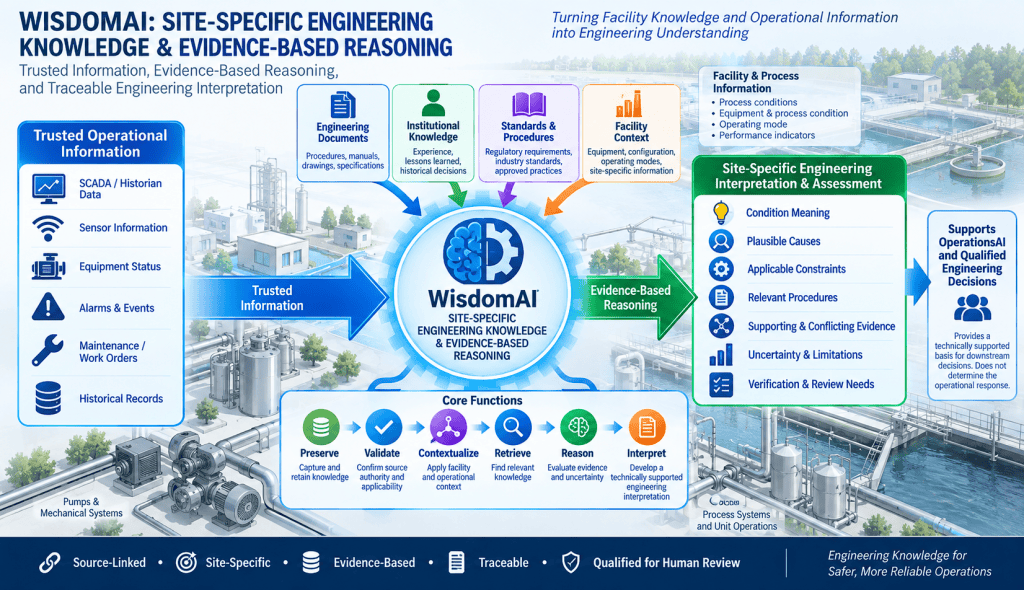
Site-Specific Engineering Knowledge & Evidence-Based Reasoning
WisdomAI connects applicable engineering knowledge with the facility’s equipment, configuration, operating history, procedures, standards, constraints, and validated expertise. Using this foundation together with trusted operational information and relevant evidence, WisdomAI interprets current and emerging conditions, evaluates their engineering and operational significance, identifies applicable requirements and constraints, and provides a technically supported basis for downstream decisions.
WisdomAI is designed to complement experienced engineers, operators, technicians, and maintenance personnel—not replace them. It strengthens access to validated knowledge while preserving source traceability, qualified human review, organizational authority, and accountability.
Preserved Knowledge · Site-Specific Context · Evidence-Based Reasoning · Traceable Engineering Interpretation
1. The Engineering-Knowledge Challenge
Critical infrastructure organizations depend on knowledge accumulated through years of engineering, operation, maintenance, troubleshooting, regulatory compliance, and incident response.
Yet much of this knowledge remains fragmented across personnel, documents, databases, operating systems, facility records, and individual experience.
The challenge is not simply finding information. It is determining which knowledge applies, whether it remains valid, what the available evidence means under current conditions, and how that knowledge should support engineering decisions.
Loss of Institutional Knowledge
Experienced engineers, operators, technicians, maintenance personnel, and safety specialists often possess practical knowledge that is not fully documented.
This may include equipment behavior under unusual conditions, recurring failure patterns, troubleshooting methods, historical operating decisions, facility-specific workarounds, lessons learned from incidents, safety practices, and knowledge of modified or obsolete systems.
Problem: Critical engineering knowledge can disappear when the people who hold it retire, transfer, or leave the organization.
Fragmented Engineering Information
Relevant information may be distributed across procedures, engineering manuals, drawings and specifications, maintenance records, inspection reports, historian data, laboratory records, incident investigations, corrective-action records, permits, regulatory documents, vendor information, training materials, and individual experience.
Problem: Personnel may spend substantial time locating and reconciling information before they can evaluate the engineering problem itself.
Knowledge Without Facility Context
A procedure, standard, manufacturer recommendation, engineering reference, or industry practice may be technically valid but inappropriate for a particular facility, asset, operating mode, or process condition.
Application can depend on equipment configuration, process objectives, permit requirements, facility history, current operating conditions, asset condition, maintenance status, physical location, existing safeguards, and approved organizational practices.
Problem: Information can be technically correct in general yet inappropriate for a particular facility or operating condition.
Outdated, Conflicting, or Unqualified Knowledge
Engineering information may remain accessible after it has been superseded. Different sources may contain conflicting instructions, obsolete equipment information, inconsistent terminology, missing revision history, unapproved practices, incomplete assumptions, or unverified recommendations.
Problem: Finding information does not establish that the information is current, authoritative, applicable, or appropriate for its intended engineering use.
Difficulty Interpreting Current Conditions
Measurements, alarms, equipment status, process behavior, maintenance condition, and operating history do not explain themselves.
Personnel must relate current operational information to applicable engineering knowledge, facility configuration, historical behavior, relevant requirements, and other available evidence.
Problem: Operational information may show what is happening without establishing what the condition means or why it may be occurring.
Inconsistent Engineering Interpretation
Different personnel may interpret the same condition differently because they use different sources, assumptions, experience, historical knowledge, or reasoning processes.
Problem: Important engineering interpretations can depend excessively on who is available, what information they know about, and how they evaluate the evidence.
Limited Traceability of Engineering Guidance
Traditional search systems and generic AI tools may provide information or plausible answers without clearly establishing which sources apply, what assumptions were made, whether conflicting evidence exists, or where qualified engineering review is required.
Problem: A plausible answer is not necessarily a traceable or technically defensible engineering basis for a consequential decision.
Knowledge That Is Difficult to Apply at the Point of Need
Engineering information may exist but may not be readily connected to the specific equipment, process area, operating condition, maintenance activity, abnormal event, or physical location where it is needed.
Problem: Knowledge has limited operational value if personnel cannot retrieve and interpret the appropriate information in the context of the actual facility condition.
Engineering information becomes valuable only when it is preserved, validated, contextualized, understood, and applied correctly.
2. From Operational Information to Trusted Engineering Knowledge
Operational information can show what is happening.
Engineering knowledge is needed to understand:
- What the condition may mean
- Why it may be occurring
- Which engineering relationships apply
- Which requirements and constraints are relevant
- What evidence supports or contradicts an interpretation
- What information is missing
- What additional verification may be required
- When qualified review or escalation is necessary
WisdomAI supports this transformation by organizing, validating, contextualizing, and applying facility-specific engineering knowledge together with trusted operational information and relevant evidence.
Rather than functioning as a document-search system or generic AI assistant, WisdomAI helps determine what knowledge applies, what the evidence supports, what assumptions or uncertainties remain, and what engineering interpretation can be technically supported.

3. What WisdomAI Is
WisdomAI is the Site-Specific Engineering Knowledge and Evidence-Based Reasoning module of McC AI Group’s Engineering Intelligence Platform.
It preserves, validates, contextualizes, retrieves, and applies engineering knowledge so that trusted operational information can be interpreted within the facility’s actual equipment, process, operating, regulatory, maintenance, safety, and organizational context.
WisdomAI is designed to make the engineering basis for interpretation visible by connecting its engineering interpretation with relevant sources, evidence, assumptions, constraints, limitations, validation status, and qualified human review.
Beyond Document Search
Traditional search systems can retrieve documents or passages. Personnel must still determine whether the retrieved information is current, applicable, authoritative, complete, approved, relevant to the specific asset, and appropriate to the current condition.
WisdomAI connects retrieved knowledge with facility context, operational conditions, approved procedures, source authority, engineering relationships, and relevant evidence.
Beyond a Generic AI Assistant
Generic AI systems may not understand an organization’s equipment, facility configuration, operating history, modifications, permits, procedures, approved practices, safety boundaries, engineering constraints, or organizational authority.
WisdomAI is grounded in validated organizational knowledge and facility-specific context.
General industry information is therefore not treated as automatically applicable to every facility, process, asset, or operating condition.
4. What WisdomAI Does
WisdomAI transforms trusted operational information and applicable engineering knowledge into site-specific engineering understanding and technically supported engineering interpretation.
Knowledge Preservation
Preserves engineering documents, operating history, validated institutional knowledge, lessons learned, and facility-specific expertise.
Knowledge Qualification
Helps distinguish current and validated knowledge from outdated, conflicting, incomplete, unverified, superseded, or contextually inappropriate information.
Site-Specific Contextualization
Connects engineering knowledge with the relevant facility, equipment, process, physical location, operating condition, history, and applicable requirements.
Evidence-Based Condition Assessment
Uses trusted operational information, facility-specific engineering knowledge, operating history, applicable requirements, and relevant evidence to evaluate abnormal or changing conditions.
WisdomAI compares plausible explanations, examines supporting and conflicting evidence, identifies missing information and important assumptions, and considers applicable engineering constraints and historical experience.
The result is a technically supported assessment with traceable evidence, identified uncertainties, and areas requiring qualified human review rather than an unsupported diagnosis.
Observe the Condition → Retrieve Applicable Knowledge → Compare Plausible Causes → Evaluate Evidence & Uncertainty → Support Engineering Assessment
Early Issue Identification
Helps identify emerging or significant conditions and evaluates their potential engineering and operational significance using relevant facility knowledge and available evidence.
Decision Support
Provides technically supported interpretation, applicable constraints, supporting evidence, identified uncertainties, and structured considerations that can inform downstream engineering and operational decisions.
Traceability and Review
Preserves source visibility, applicable context, assumptions, limitations, validation status, and qualified human authority.
5. How WisdomAI Works
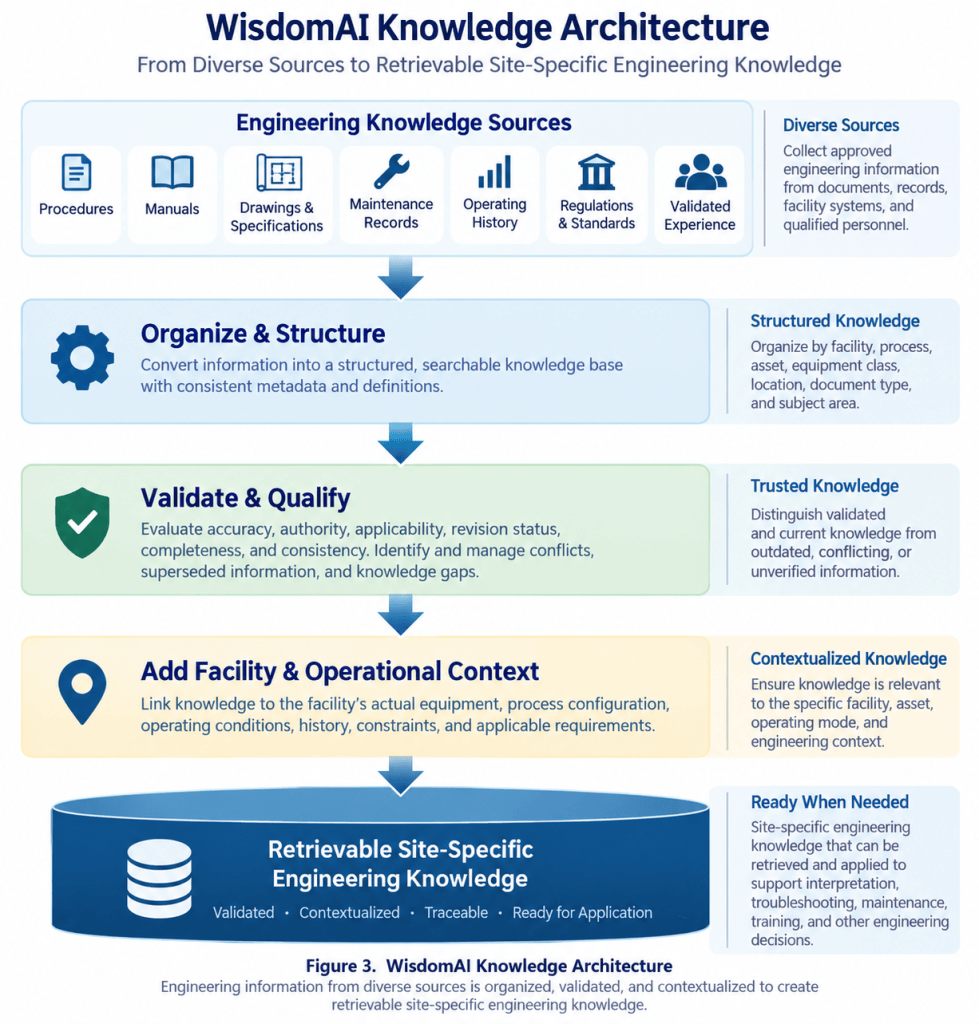
WisdomAI transforms fragmented engineering information and validated experience into site-specific engineering knowledge that can be applied to current facility conditions. The process preserves source traceability, facility context, evidence, and qualified human review throughout.
Preserve Engineering Knowledge
Approved knowledge is collected from engineering documents, operational records, facility systems, and qualified personnel.
Knowledge sources may include procedures, manuals, drawings, specifications, maintenance records, inspection reports, incident investigations, engineering studies, regulatory information, training materials, facility modifications, and validated institutional experience.
Knowledge contributed by personnel remains associated with its source, context, reviewer, and validation status.
Digitize and Organize
Engineering information is converted into structured, retrievable knowledge.
Depending on the application, knowledge can be associated with the organization, facility, process, treatment train, asset, equipment class, physical location, operating mode, failure condition, procedure, applicable requirement, revision status, and source authority.
Validate and Qualify the Knowledge
WisdomAI helps determine whether information is approved, current, superseded, incomplete, conflicting, unverified, restricted, or applicable only under defined conditions.
Qualified personnel retain responsibility for review, approval, revision, restriction, rejection, and revalidation.
Add Facility and Operational Context
WisdomAI relates knowledge to the facility, equipment, process, location, operating history, and current condition to which it applies.
Context may include operating mode, equipment status, sensor confidence, maintenance condition, process loading, environmental conditions, facility configuration, permit requirements, known hazards, and previous incidents.
Retrieve Applicable Knowledge
When a condition or engineering question arises, WisdomAI retrieves relevant knowledge from validated sources.
Retrieval can consider facility, asset, operating condition, physical location, user role, current process state, applicable requirements, historical similarity, source authority, and validation status.
Apply Evidence-Based Reasoning
WisdomAI evaluates trusted operational information and applicable knowledge together.
It can support condition interpretation, comparison of plausible causes, historical comparison, identification of applicable constraints, evaluation of supporting and conflicting evidence, identification of missing information, and determination of areas requiring qualified review.
Deliver Site-Specific Engineering Interpretation
WisdomAI provides site-specific engineering interpretation appropriate to the facility, asset, location, operating mode, user role, current condition, and applicable authority.
The interpretation can identify relevant procedures, engineering considerations, plausible causes, required inspections or verification, applicable requirements, historical experience, safety considerations, and escalation needs.
Preserve Traceability and Human Review
Engineering interpretation remains connected to supporting sources, assumptions, constraints, evidence, limitations, and validation status.
Qualified personnel retain authority to accept, modify, restrict, reject, escalate, or require additional validation.
Preserve. Validate. Contextualize. Reason. Interprete.
6. Core WisdomAI Capabilities
WisdomAI combines complementary capabilities to preserve, qualify, contextualize, and apply engineering knowledge, enabling facility conditions to be interpreted with relevant evidence and a technically supported engineering basis.
Site-Specific Knowledge Preservation and Retrieval
WisdomAI captures and preserves institutional knowledge developed through facility operation, engineering experience, maintenance, troubleshooting, inspection, modification, and incident response.
Preserved knowledge remains connected to its source, applicable facility, asset or process, operating condition, validation status, revision history, and qualified reviewer.
Knowledge Digitization, Validation, and Retrieval
WisdomAI converts approved engineering documents and records into structured, retrievable knowledge while preserving source authority, revision status, validation status, and applicability.
It helps distinguish trusted current knowledge from superseded information, draft or unapproved material, conflicting guidance, incomplete records, and experience that has not yet been sufficiently validated.
Evidence-Based Condition Assessment
WisdomAI brings together trusted operational information, applicable engineering knowledge, facility history, and relevant evidence to evaluate abnormal or changing conditions.
Rather than assuming a single cause, it can compare plausible explanations, identify supporting and conflicting evidence, expose missing information, and qualify uncertainty.
Source-Linked Engineering Interpretation
WisdomAI connects engineering interpretation with the sources, evidence, assumptions, constraints, and limitations that support it.
The objective is not merely to provide an answer. It is to provide a visible and technically supportable engineering basis.
Location-Aware O&M and Emergency Knowledge Support
WisdomAI connects engineering knowledge with the physical context of facilities, assets, and locations.
Authorized personnel can access applicable procedures, drawings, maintenance history, known hazards, isolation requirements, emergency guidance, nearby assets, access limitations, and escalation pathways relevant to the actual equipment or area involved.
7. The WisdomAI Knowledge Foundation
Trusted engineering knowledge should be technically valid, site-specific, accessible, traceable, and appropriate to the current condition.
WisdomAI brings together four complementary knowledge functions.
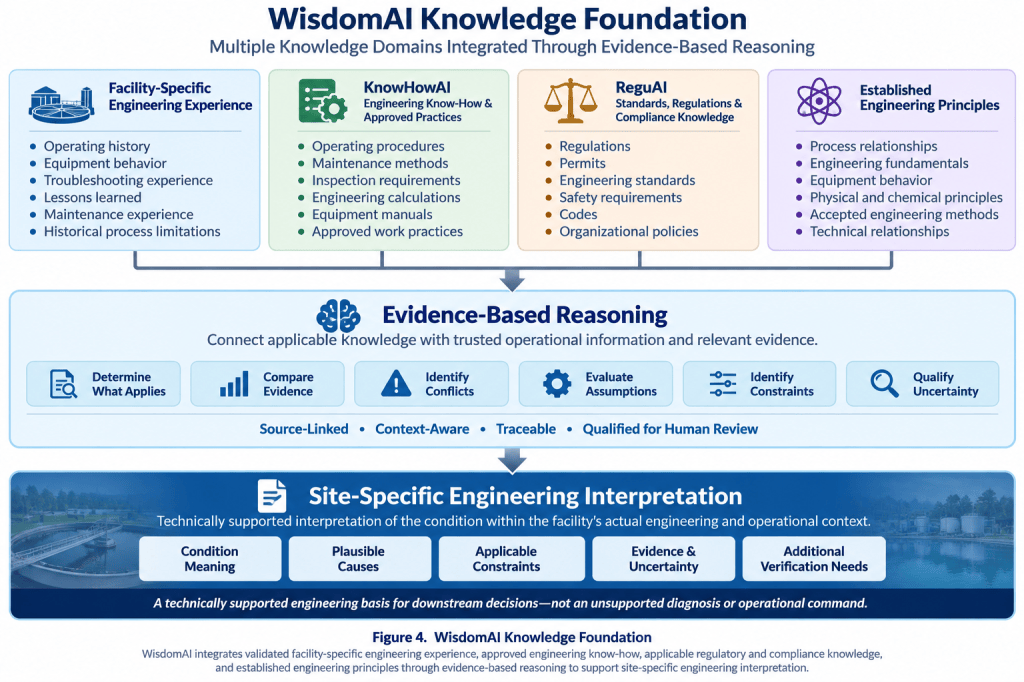
Facility-Specific Engineering Experience
Preserves validated institutional experience, historical observations, lessons learned, and facility-specific operating knowledge.
Examples can include recurring equipment behavior, site-specific troubleshooting experience, seasonal operating patterns, historical process limitations, lessons from previous incidents, and facility-specific maintenance practices.
Experience is not automatically treated as authoritative. It is documented, contextualized, reviewed, and validated before being treated as trusted engineering knowledge.
KnowHowAI — Engineering Know-How and Approved Practices
KnowHowAI organizes practical engineering methods, operating procedures, maintenance knowledge, and approved work practices.
It can include standard operating procedures, maintenance instructions, inspection requirements, troubleshooting methods, engineering calculations, equipment manuals, approved work practices, and training materials.
ReguAI — Standards, Regulations, and Compliance Knowledge
ReguAI connects engineering interpretation with applicable regulations, permits, standards, safety requirements, engineering codes, organizational policies, and compliance obligations.
It helps identify which formal requirements may apply to a facility, asset, activity, condition, or engineering decision.
Evidence-Based Reasoning — Engineering Interpretation
Engineering Reasoning connects trusted operational information with facility-specific engineering experience, KnowHowAI, ReguAI, and established engineering principles.
It helps determine which knowledge applies, how different sources relate, where conflicts exist, which assumptions matter, what evidence is missing, and when qualified review is required.
Facility-specific experience provides context. KnowHowAI provides practical methods. ReguAI provides formal requirements. Evidence-Based Reasoning connects them into technically supported engineering interpretation.
8. Evidence-Based Reasoning
WisdomAI is designed to make the basis of engineering interpretation visible. Depending on the use case, its reasoning may include three connected stages:
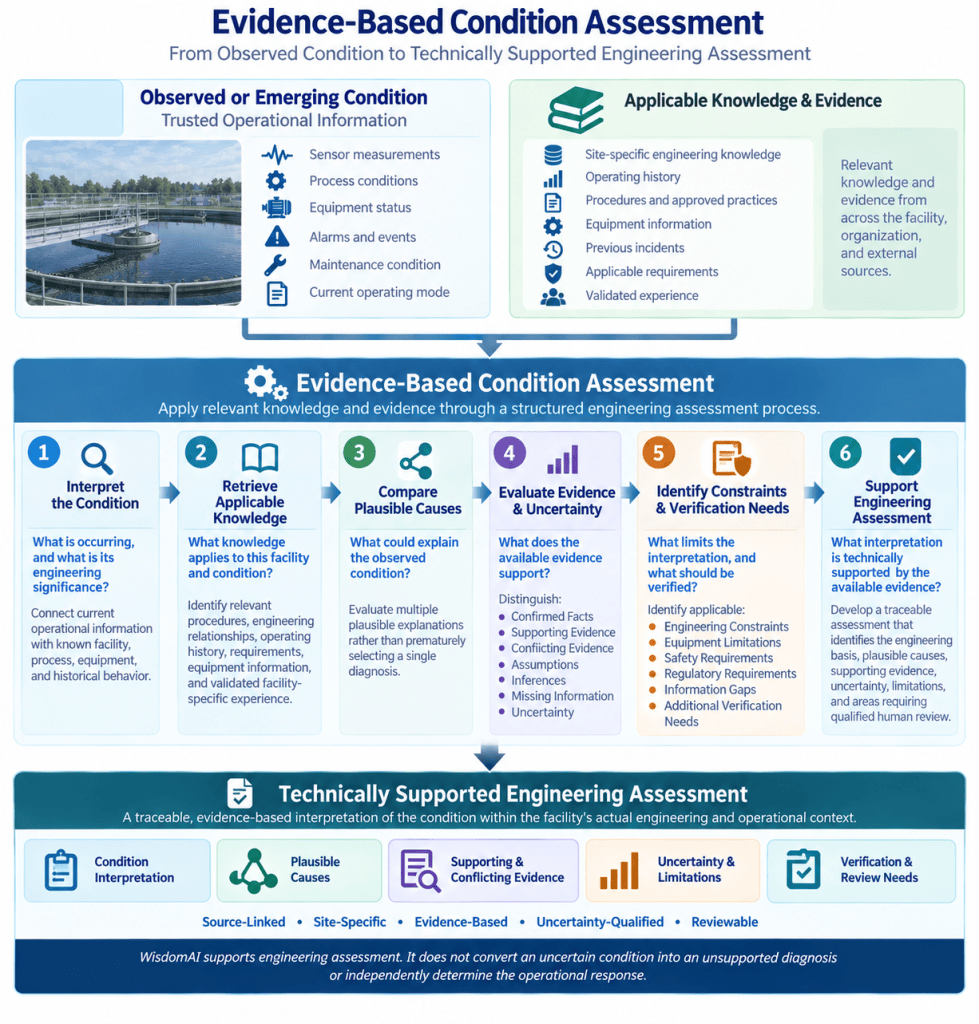
Interpret the Condition
Condition Interpretation: Connect current operational information with known process, equipment, or facility behavior.
Historical Comparison: Compare the current condition with previous incidents, maintenance events, process responses, and similar operating conditions.
Cause Comparison: Evaluate multiple possible explanations for an abnormal condition without presenting an unsupported diagnosis as certain.
Evaluate the Evidence and Constraints
Evidence Evaluation: Distinguish among:
- Confirmed facts
- Assumptions
- Inferences
- Missing information
- Conflicting evidence
- Low-confidence knowledge
Constraint Identification: Identify applicable engineering, operating, safety, equipment, regulatory, and organizational constraints.
Counterfactual Review: Consider how the interpretation might change under different assumptions, operating modes, or site conditions.
Explain the Engineering Basis
Source-Linked Explanation: Connect the engineering interpretation with supporting documents, records, expert knowledge, operating history, and applicable standards. The explanation should identify:
- Engineering basis
- Supporting and conflicting evidence
- Key assumptions
- Applicable constraints
- Important uncertainties and limitations
- Information requiring additional verification
- Areas requiring qualified human review
The objective is not merely to produce an answer. It is intended to show the engineering basis, evidence, applicability, uncertainty, and limitations that support the interpretation.
9. Governed Knowledge Use
WisdomAI is designed to strengthen the controlled and responsible use of engineering knowledge rather than create an unrestricted information repository.
Traceable Sources
Engineering knowledge and engineering interpretation remain associated with the documents, records, standards, facility information, operating history, or validated expertise that support them.
Validated and Current Knowledge
Engineering knowledge can be evaluated for accuracy, applicability, revision status, organizational approval, source authority, and facility relevance.
Information that has not been sufficiently validated should not be treated as equivalent to approved engineering knowledge.
Identification of Conflicts and Limitations
WisdomAI can identify information that is inconsistent, outdated, incomplete, conflicting, or insufficiently validated.
Material conflicts or limitations can be identified for qualified review rather than silently treated as resolved.
Site-Specific Applicability
Engineering information is considered in relation to the facility, process, asset, operating condition, applicable requirements, and organizational context in which it may be used.
General engineering information, industry practices, or historical experience should not be assumed to apply automatically to every facility or condition.
Human and Organizational Authority
Qualified personnel retain responsibility for the review, approval, modification, restriction, rejection, and escalation of engineering knowledge and engineering interpretation as required by the organization.
WisdomAI does not replace professional judgment, engineering responsibility, or organizational authority.
Controlled Access and Knowledge Lifecycle
Access to engineering knowledge can be managed according to organizational roles, facilities, assets, security requirements, information sensitivity, and applicable obligations.
Organizations retain responsibility for maintaining knowledge through appropriate review, revision, revalidation, approval, and supersession processes.
Trusted engineering knowledge is traceable, validated, context-specific, current, and governed by qualified human authority.
10. Illustrative Operating Scenarios
Preserving Institutional Knowledge
WisdomAI can preserve validated facility-specific experience by connecting contributed knowledge with the facilities, assets, processes, operating conditions, historical records, sources, and qualified reviewers to which it applies.
This helps retain valuable knowledge through retirement, personnel turnover, organizational change, and knowledge transfer.
Evaluating Abnormal Conditions
When an unexpected process or equipment condition occurs, WisdomAI can bring together trusted operational information, applicable procedures, equipment documentation, maintenance history, previous incidents, operating experience, and relevant constraints.
It can compare plausible contributing factors, identify information gaps and conflicting evidence, and support appropriate verification and qualified engineering assessment without presenting unsupported conclusions as certain.
Supporting Maintenance Decisions
When equipment performance changes or recurring abnormalities are identified, WisdomAI can connect asset history, inspection and maintenance records, manufacturer information, facility-specific experience, and current operating conditions.
This provides a stronger engineering basis for inspection, troubleshooting, maintenance planning, and corrective-action evaluation.
Supporting Location-Aware Operation and Maintenance
For a specific facility, process area, or asset, WisdomAI can provide authorized personnel with relevant procedures, drawings, maintenance history, operating requirements, known hazards, and applicable restrictions.
Supporting Emergency and Abnormal-Condition Response
During an abnormal or emergency condition, WisdomAI can help authorized personnel identify applicable procedures, facility and asset information, known hazards, operating constraints, relevant historical experience, and established communication or escalation pathways.
WisdomAI supports access to validated, context-appropriate engineering knowledge while preserving established emergency procedures and organizational authority.
Supporting Training and Knowledge Transfer
WisdomAI can help personnel understand not only established procedures and requirements but also the facility context, operating history, evidence, and engineering considerations associated with them.
11. Advantages and Benefits of WisdomAI
WisdomAI strengthens engineering decision support by preserving facility-specific knowledge, validating and contextualizing sources, applying evidence-based reasoning, and making the basis of engineering interpretation visible.
Its value lies not simply in finding information, but in helping personnel determine which knowledge applies, what the evidence supports, what remains uncertain, and where qualified review is required.
Preserve Institutional Knowledge
WisdomAI helps retain validated engineering and operational expertise that could otherwise be lost through retirement, turnover, reorganization, or personnel shortages.
Improve Access to Relevant Engineering Knowledge
Personnel can retrieve knowledge associated with the specific facility, asset, process, condition, location, and engineering question rather than searching independently across disconnected information sources.
Improve Consistency of Engineering Interpretation
Validated knowledge, applicable requirements, facility context, operating history, and relevant evidence can be evaluated through a more structured and repeatable engineering framework.
Strengthen Troubleshooting and Maintenance Decisions
WisdomAI connects current conditions with equipment history, inspection and maintenance records, applicable procedures, facility-specific experience, and other relevant evidence to strengthen the technical basis for troubleshooting and maintenance evaluation.
Improve Training and Knowledge Transfer
Personnel can access not only procedures and requirements but also the historical context, engineering basis, lessons learned, and facility-specific considerations associated with them.
Strengthen Emergency and Abnormal-Condition Preparedness
Context-aware access to approved procedures, asset information, hazards, historical experience, applicable constraints, and escalation pathways can strengthen preparedness for abnormal and emergency conditions.
Improve Knowledge Governance and Organizational Resilience
WisdomAI improves visibility into which knowledge is current, which sources are approved, where conflicts or gaps exist, what requires review, and who has authority to approve or modify engineering knowledge.
Benefits are organization- and facility-specific and should be established through appropriate evaluation and documented validation. WisdomAI operates within defined source authority, knowledge-governance requirements, engineering constraints, access controls, cybersecurity requirements, and qualified human review.
12. WisdomAI Within the Engineering Intelligence Platform
WisdomAI is one of four core modules of McC AI Group’s Engineering Intelligence Platform. It provides the site-specific engineering knowledge and evidence-based reasoning needed to interpret facility conditions and establish a technically supported foundation for downstream operational intelligence and governed decisions.
SensorAI™ — Trusted Operational Information
Determines whether measurements and operational information are sufficiently reliable, timely, representative, and appropriate for their intended engineering or operational use.
WisdomAI™ — Site-Specific Engineering Knowledge & Evidence-Based Reasoning
Applies site-specific engineering knowledge, approved practices, operating history, applicable requirements, and relevant evidence to interpret conditions, evaluate operational significance, and support evidence-based reasoning.
OperationsAI™ — Facility-Specific Operational Intelligence
Uses trusted operational information, facility-specific operational models and methods, operating objectives, process and equipment relationships, and engineering constraints to determine appropriate operational responses under current and anticipated conditions.
PilotAI™ — Governed Decisions & Actions
Evaluates whether a recommendation or action may be modified, constrained, held, blocked, escalated, authorized, or executed within approved operating boundaries and organizational authority.
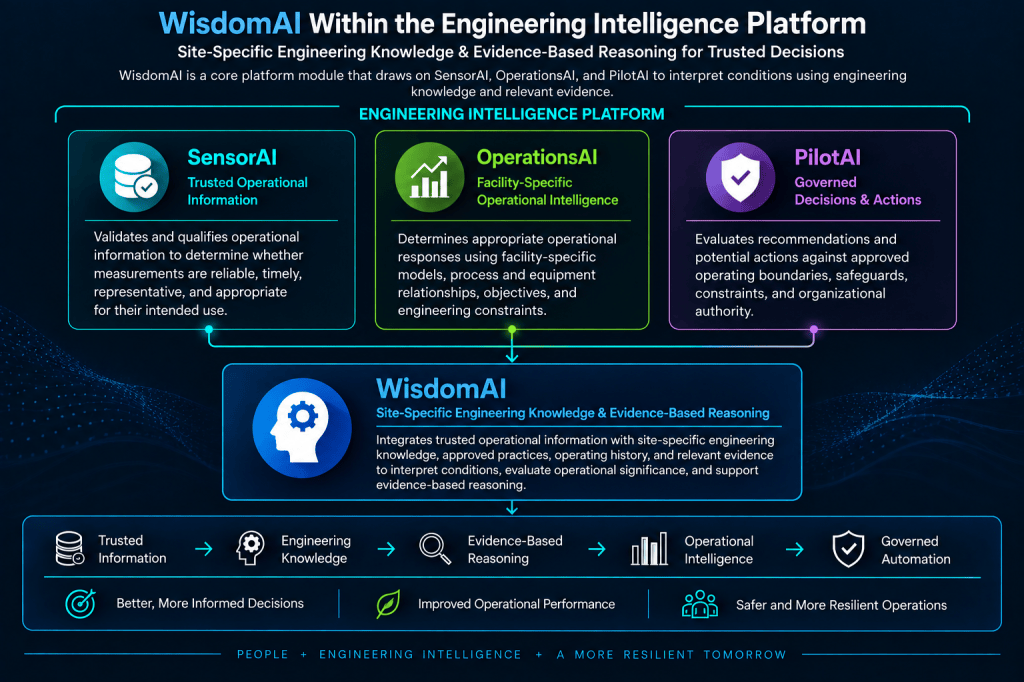
Engineering Intelligence Architecture
Trusted Information → Engineering Knowledge → Evidence-Based Reasoning → Operational Intelligence → Governed Automation
Runtime Pathway
SensorAI → WisdomAI → OperationsAI → PilotAI
The Module Boundary
WisdomAI asks: What do the conditions and available evidence mean?
OperationsAI asks: What is the appropriate operational response?
PilotAI asks: May that response proceed—and how?
WisdomAI therefore supports technically grounded interpretation without assuming responsibility for operational optimization, determination of operating targets, or authorization of control actions.
13. Proprietary Technology and Intellectual Property
WisdomAI incorporates proprietary and patent-pending technologies to preserve, qualify, contextualize, retrieve, and apply engineering knowledge within facility-specific Engineering Intelligence applications.
WisdomAI is designed to connect applicable engineering knowledge with facility-specific context, trusted operational information, operating history, procedures, requirements, constraints, and validated expertise to support evidence-based engineering reasoning.
Its proprietary technical value extends beyond document storage, information retrieval, or generic AI assistance. WisdomAI provides an Engineering Intelligence capability to transform fragmented engineering information and organizational knowledge into site-specific engineering knowledge that supports the interpretation of facility conditions and provides a technically supported basis for engineering and operational decisions.
WisdomAI preserves the basis for its engineering interpretation through source traceability, applicable context, relevant constraints, knowledge governance, and qualified human review.
Specific algorithms, knowledge structures, reasoning methods, validation logic, configuration practices, and implementation techniques remain proprietary.
14. WisdomAI Technology Evaluation
An initial WisdomAI evaluation examines the organization’s engineering knowledge, knowledge risks, operational priorities, existing information systems, and opportunities to strengthen engineering interpretation, knowledge continuity, and evidence-based decision support.
Evaluation may consider knowledge risks, including vulnerable expertise, fragmented information, critical knowledge gaps, repetitive troubleshooting needs, and knowledge-transfer risks.
It may examine knowledge sources, including procedures, manuals, drawings, records, permits, standards, engineering studies, operating history, and validated institutional knowledge.
It also evaluates priority applications, such as troubleshooting, maintenance, abnormal-condition assessment, regulatory guidance, training, and other engineering use cases.
Existing document systems, asset-management platforms, maintenance systems, historians, GIS, operational databases, and engineering workflows can be considered together with knowledge governance, including ownership, approval authority, access control, revision management, cybersecurity, and long-term knowledge maintenance.
15. Performance Qualification and Implementation Readiness
WisdomAI performance and implementation readiness should be established using actual organizational knowledge sources, facility context, qualified review, and prospective evaluation rather than assuming that unvalidated documents or generic engineering information are suitable for operational use.
Qualification may consider source quality, completeness, applicability, revision status, traceability, facility context, knowledge gaps, contextual relevance, usefulness of engineering interpretation, qualified-user review, integration requirements, and validation across representative use cases.
Knowledge and Source Assessment
Evaluate available engineering knowledge sources and identify material knowledge gaps, fragmented information, vulnerable expertise, conflicting information, outdated sources, and knowledge-transfer risks that could affect the intended application.
Facility and Context Assessment
Evaluate facility configuration, assets, processes, operating conditions, organizational practices, applicable requirements, engineering constraints, and other contextual information needed to determine where and how engineering knowledge applies.
Governance and Integration Assessment
Evaluate source authority, revision status, applicability, approval requirements, access controls, cybersecurity requirements, knowledge ownership, and interfaces with existing facility information systems.
Pilot Validation
Establish a focused facility-specific use case and evaluate WisdomAI using approved knowledge sources, representative engineering questions or operating conditions, source traceability, contextual relevance, evidence-based assessment, usefulness of engineering interpretation, and qualified human review.
Following successful validation, WisdomAI use can expand according to demonstrated performance, governance requirements, organizational readiness, and approved scope.
WisdomAI should not assume that knowledge, procedures, engineering relationships, historical experience, or validated engineering knowledge from one organization or facility automatically applies to another.
Performance claims should be based on documented, organization- and facility-specific validation.
PRESERVE the Knowledge → VALIDATE the Sources → INTERPRET the Condition → SUPPORT the Decision
16. Technology and Deployment Partnerships
WisdomAI can be evaluated, validated, and deployed through collaboration with facility operators, engineering organizations, knowledge owners, technology providers, and qualified implementation partners.
Potential collaborators include municipal and industrial facilities, consulting engineers, control-system integrators, equipment manufacturers, engineering contractors, research organizations, and qualified technology and commercialization partners.
Each engagement is structured around the organization’s facilities, engineering knowledge sources, operational priorities, existing information systems, governance requirements, cybersecurity requirements, knowledge ownership, and approved scope of Engineering Intelligence use.
17. Explore WisdomAI for Your Facility
Organizations interested in WisdomAI can begin with a focused evaluation of engineering knowledge sources, facility context, vulnerable expertise, knowledge gaps, existing information systems, governance requirements, and priority engineering use cases.
The evaluation can identify where knowledge preservation, source validation, contextual retrieval, evidence-based reasoning, or location-aware engineering knowledge support could strengthen engineering interpretation, troubleshooting, maintenance, training, emergency preparedness, and organizational continuity.
Implementation can then proceed through focused pilot validation using approved knowledge sources, representative engineering questions or operating conditions, facility-specific context, source traceability, evidence-based assessment, and qualified human review.
As performance and organizational readiness are demonstrated, WisdomAI can be expanded to additional facilities, assets, knowledge domains, and approved applications.
Preserve the knowledge. Validate the sources. Interpret the condition. Support the decision.
 McC AI Group, Inc.