

Engineering Intelligence
Trusted Decisions for Critical Infrastructure
Engineering Intelligence is the discipline of generating trusted decisions for critical infrastructure.
A trusted decision is supported by verified information, grounded in domain knowledge, produced through transparent reasoning, and constrained by enforceable governance.
Engineering Intelligence brings together engineering principles, operational information, human expertise, advanced algorithms, artificial intelligence, and governance within a unified framework for decision-making.
Its purpose is not simply to automate more decisions.
Its purpose is to make engineering decisions more trustworthy, explainable, accountable, and appropriate for the systems they affect.
Verified Information. Domain Knowledge. Transparent Reasoning. Governance.
Why Engineering Intelligence Is Needed
Critical infrastructure is becoming more complex, interconnected, automated, and data-intensive.
Water and wastewater facilities, energy systems, transportation infrastructure, manufacturing operations, and environmental systems increasingly rely on sensors, automation, advanced analytics, artificial intelligence, and digital decision-support tools.
These technologies provide powerful capabilities. Yet they do not, by themselves, answer a fundamental engineering question:
How can an organization determine whether an operational decision can be trusted?
Many current practices address individual parts of this challenge effectively. The limitation is that sensing, engineering knowledge, analytics, AI, automation, and organizational authority are often implemented through separate systems and processes.
Engineering Intelligence provides a framework for bringing them together.
Data Is Not Automatically Trusted Information
Modern facilities can generate enormous quantities of operational data, but measurements may be affected by sensor drift, fouling, calibration errors, communication failures, missing information, equipment malfunction, changing conditions, or limitations in the instrumentation itself.
A sophisticated algorithm cannot compensate for every form of unreliable input.
Engineering Intelligence therefore distinguishes between raw operational data and trusted operational information. Information must be evaluated, validated, qualified, and placed in context before it becomes an appropriate basis for consequential engineering decisions.
Artificial Intelligence Requires Engineering Context
Artificial intelligence and machine learning can identify patterns, estimate difficult-to-measure variables, detect anomalies, forecast changing conditions, and optimize complex systems.
These capabilities can be highly valuable.
However, predictive accuracy alone does not establish that a result is physically reasonable, operationally appropriate, consistent with engineering principles, compatible with equipment limitations, compliant with regulatory requirements, or suitable for operational execution.
Engineering Intelligence, therefore, treats AI as an enabling technology rather than as the source of engineering authority.
Engineering Knowledge Is Often Fragmented
Critical engineering knowledge may be distributed across design documents, operating procedures, calculations, regulations, standards, equipment manuals, historical records, maintenance experience, operator practices, institutional memory, and the expertise of individual professionals.
As personnel retire, transfer, or leave an organization, valuable site-specific knowledge may be lost.
Engineering Intelligence treats knowledge as an operational resource that should be preserved, organized, retrieved, and applied when decisions must be made.ting, organizing, retrieving, and applying engineering knowledge when decisions must be made.
Automation and Optimization Need Reasoning and Governance
PLC, SCADA, DCS, and other industrial automation systems are highly effective at monitoring processes and executing predefined control logic.
As advanced analytics and AI become more involved in operational decisions, additional questions become necessary:
- Why is this action appropriate?
- What information supports it?
- What engineering knowledge was applied?
- What assumptions and constraints were considered?
- How reliable is the supporting information?
- Does the system have authority to take the action?
Engineering Intelligence expands the decision framework beyond execution alone.
It also treats optimization as bounded engineering optimization. Recommendations must remain within appropriate engineering, equipment, safety, operational, regulatory, and organizational constraints.
The Missing Integration
The limitation of current practice is not that sensing, engineering, artificial intelligence, automation, or human expertise are individually inadequate.
Each provides essential capabilities.
The larger problem is that these capabilities are often fragmented.
A facility may have:
- sensors without systematic validation;
- data without engineering context;
- AI without transparent reasoning;
- optimization without explicit engineering guardrails;
- knowledge without systematic preservation; and
- automation without adaptive governance.
Engineering Intelligence provides the integration needed to transform these separate capabilities into a coherent framework for trusted engineering decisions.
Verified Information + Domain Knowledge + Transparent Reasoning + Governance → Trusted Engineering Decisions
The Engineering Intelligence Architecture
Engineering Intelligence is organized around four integrated elements.
1. Verified Information
Reliable engineering decisions begin with a factual baseline.
Sensor measurements, operational data, calculated variables, equipment conditions, historical records, and other information sources must be evaluated for accuracy, relevance, timeliness, traceability, and reliability before they are relied upon for consequential decisions.
This may involve signal validation, sensor-confidence evaluation, cross-checking, reconciliation, virtual sensing, plausibility assessment, uncertainty characterization, equipment-condition evaluation, and contextual interpretation.
The objective: What information can be trusted for this decision?
2. Domain Knowledge
Data requires context.
Engineering principles, physical and biological processes, scientific theory, process models, equipment behavior, operating experience, regulatory requirements, approved procedures, standards, and site-specific knowledge provide the framework needed to interpret information correctly.
Domain Knowledge helps determine what a condition means, what consequences may follow, and which responses are technically appropriate.
The objective: What does the information mean in this engineering context?
3. Transparent Reasoning
Engineering recommendations must be understandable and traceable.
Engineering Intelligence is designed to expose the information, assumptions, engineering relationships, alternatives, uncertainties, constraints, and reasoning supporting important recommendations rather than relying solely on opaque algorithmic outputs.
Transparent Reasoning does not require every computational method to be simple. It requires the decision process to provide sufficient explanation and traceability for appropriate engineering review.
The objective: Why is this decision justified?
4. Governance
Technically sound reasoning must still operate within defined authority.
Governance establishes decision rights, operating boundaries, approval requirements, escalation pathways, intervention provisions, fallback strategies, human oversight, accountability, and documentation requirements.
Governance becomes part of the decision architecture itself, ensuring that recommendations and actions remain within approved engineering, operational, organizational, safety, and regulatory boundaries.
The objective: May this decision be acted upon, under what conditions, and by whom?
How the Four Elements Work Together
The four elements form a connected engineering decision framework.
- Verified Information asks: What is happening?
- Domain Knowledge asks: What does it mean?
- Transparent Reasoning asks: What should be considered, and why?
- Governance asks: What may be done?
Together, they establish the basis for trusted engineering decisions.
Reliable information without engineering knowledge may be misunderstood. Engineering knowledge applied to unreliable information may produce an inappropriate conclusion. A technically sound conclusion without transparent reasoning may be difficult to review or defend. A well-reasoned recommendation without governance may be acted upon outside appropriate authority.
Engineering Intelligence therefore treats trust as a property of the whole decision process, not merely of one model, algorithm, dataset, or control system.
From Data to Trusted Action
Engineering Intelligence transforms operational conditions through a progression of increasing engineering context and decision responsibility:
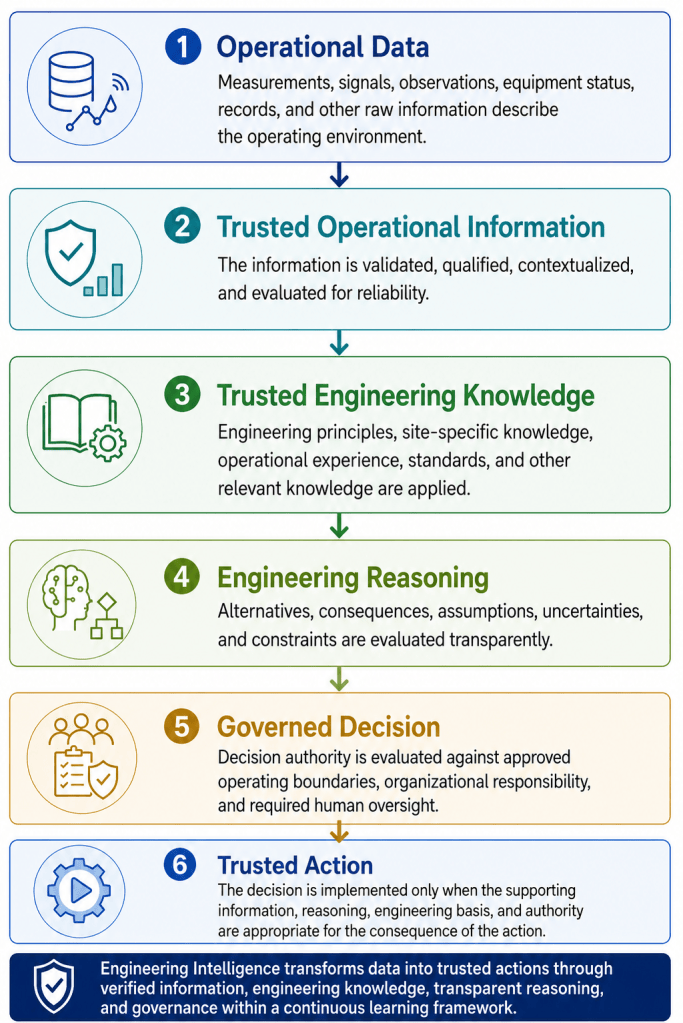
A trusted action is taken only when the supporting information, engineering basis, reasoning, constraints, and authority are appropriate for the consequence of the action.
A Broader Engineering Discipline
Engineering Intelligence Is More Than Artificial Intelligence
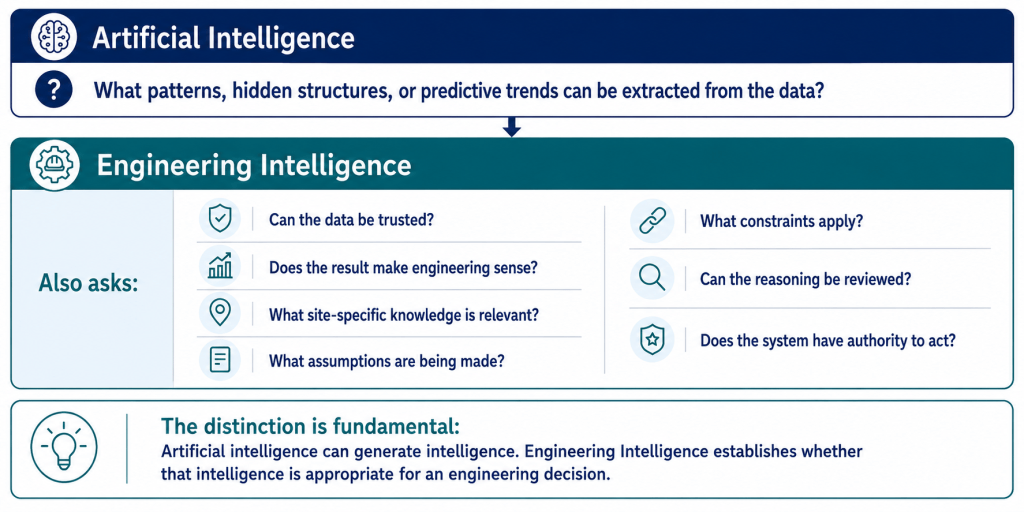
Artificial intelligence is an important technological capability. Engineering Intelligence is a broader engineering discipline.
AI can help recognize patterns, estimate difficult-to-measure variables, detect anomalies, forecast changing conditions, optimize complex systems, interpret large bodies of information, and generate decision alternatives.
Engineering Intelligence determines how those capabilities should be used responsibly within an engineering decision.
Engineering Intelligence Strengthens Human Expertise
Engineering Intelligence is not intended to eliminate engineers, operators, technicians, scientists, maintenance personnel, or other responsible professionals.
It is intended to strengthen their ability to make consistent, informed, and defensible decisions in increasingly complex operating environments.
Human expertise remains essential for defining objectives, establishing acceptable limits, validating assumptions, interpreting unusual conditions, evaluating consequences, approving changes, defining authority, intervening when required, and accepting organizational responsibility.
Computational intelligence can support engineering judgment. It does not eliminate engineering responsibility.
Engineering Intelligence Is Technology-Independent
Engineering technologies will continue to change.
AI models, sensor technologies, automation platforms, and software architectures will evolve. Engineering Intelligence is designed around principles that should remain valid as those technologies change.
The fundamental questions remain:
- Is the information trustworthy?
- Is the decision grounded in appropriate engineering knowledge?
- Can the reasoning be understood and reviewed?
- Are constraints explicit?
- Is authority properly governed?
- Is accountability preserved?
This technology independence allows Engineering Intelligence to incorporate innovation without making trust dependent on any particular vendor, algorithm, model, sensor technology, or software platform.
The Founding Charter of Engineering Intelligence
McC AI Group, Inc. established The Founding Charter of Engineering Intelligence to define the principles, purpose, and long-term direction of the discipline.
The Charter is founded on a simple belief:
The future of critical infrastructure depends upon trusted engineering decisions.
It defines Engineering Intelligence around four fundamental elements:
- Verified Information
- Domain Knowledge
- Transparent Reasoning
- Governance
The Charter provides a foundation for advancing Engineering Intelligence through research, engineering practice, education, technological development, and collaboration.
[ Read the Founding Charter ]
From Discipline to Implementation
Engineering Intelligence defines the discipline.
The Engineering Intelligence Platform provides the operational framework through which McC AI Group applies these principles in facility-specific applications.
[ Explore the Engineering Intelligence Platform ]
Closing Statement
Critical infrastructure does not simply need more data, more artificial intelligence, or more automation.
It needs a disciplined way to determine which information can be trusted, which engineering knowledge should be applied, how conclusions are reached, what constraints must apply, and when decisions should be authorized.
That is the purpose of Engineering Intelligence.
Engineering Intelligence transforms advanced computational capability into trusted engineering decisions through Verified Information, Domain Knowledge, Transparent Reasoning, and Governance.
 McC AI Group, Inc.