

OperationsAI
An Engineering Intelligence Platform Module
Providing Facility-Specific Operational Intelligence for Engineering Intelligence
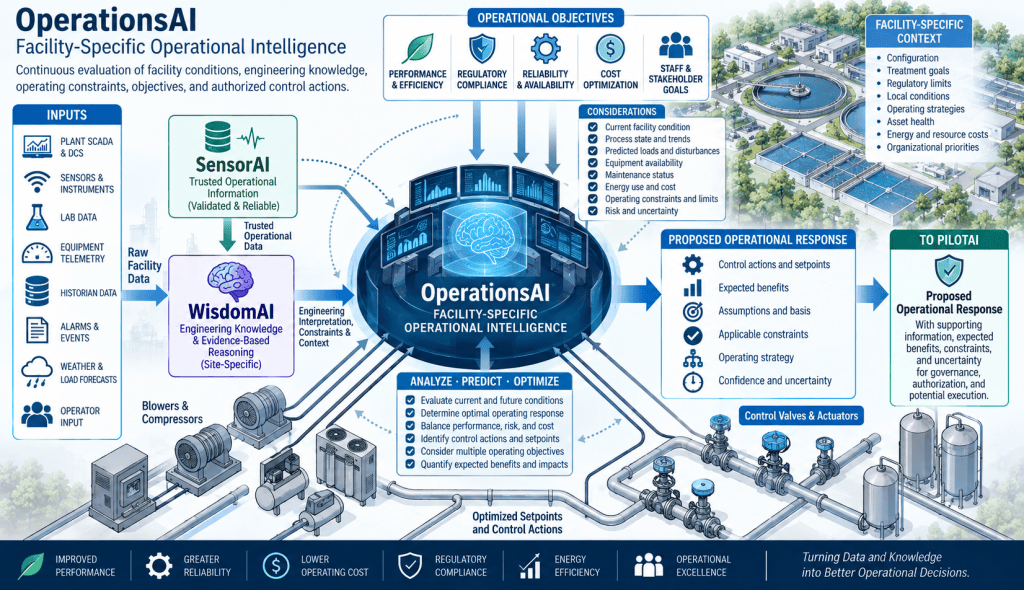
OperationsAI defines the operational objectives, process and equipment relationships, information requirements, predictive methods, optimization strategies, engineering constraints, and operational logic required for each facility-specific Engineering Intelligence application.
Beginning with the facility’s actual operational need, OperationsAI establishes what the application must accomplish and how the facility should respond under current and anticipated operating conditions.
During application development, OperationsAI helps define the requirements for SensorAI, WisdomAI, and PilotAI. During runtime, it uses trusted operational information together with site-specific engineering knowledge and evidence-based reasoning to determine the appropriate operational response.
Facility-specific models. Engineering-based optimization. Governed operational intelligence.
1. The Facility-Specific Operational Challenge
Critical-infrastructure facilities may perform similar functions, but they rarely operate under identical conditions.
Differences in process configuration, equipment, instrumentation, control systems, regulatory requirements, operating practices, environmental conditions, and organizational priorities can significantly affect how operational decisions should be made.
A solution developed for one facility therefore cannot simply be transferred to another without evaluating its site-specific conditions.
OperationsAI begins with the actual operational problem and the facility environment in which that problem must be solved.
Facility-Specific Factors
Process Configuration
Process layout, flow paths, treatment or production stages, equipment arrangement, and operating modes affect facility behavior.
Equipment and Instrumentation
Sensors, analyzers, actuators, controllers, equipment capacities, and maintenance conditions determine what can be measured, evaluated, and controlled.
Operational Objectives
Facilities may prioritize different combinations of reliability, energy performance, treatment or production performance, asset protection, safety, and regulatory compliance.
Engineering and Regulatory Constraints
Operational responses must remain within equipment limits, process requirements, permit conditions, safety requirements, and approved organizational policies.
Available Information
The quality, frequency, coverage, and reliability of operational information vary among facilities.
Organizational Authority
Facilities differ in how operational decisions are reviewed, approved, implemented, overridden, and documented.
2. What OperationsAI Is
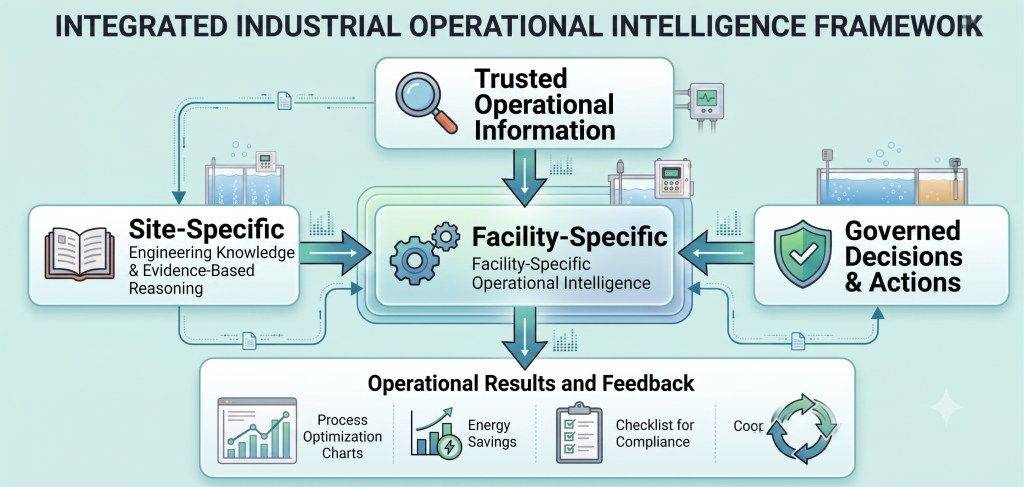
OperationsAI is the Facility-Specific Operational Intelligence module of the Engineering Intelligence Platform.
It converts an identified operational need into a facility-specific engineering application by defining the objectives, process and equipment relationships, required information, predictive and optimization methods, engineering constraints, operational responses, and governance requirements needed to address that need.
OperationsAI is not a universal controller or a generic optimization model. Each implementation is developed around the facility, application, operating objectives, infrastructure, information, engineering requirements, and approved boundaries.
OperationsAI determines how the facility should operate under current and anticipated conditions—within defined engineering and operational constraints.
Why McC AI Group Developed Engineering Intelligence
Critical infrastructure facilities increasingly use sensors, automation, historical data, analytical models, optimization tools, AI, and digital twins. These technologies can provide substantial value, but they address different parts of the operational problem.
The engineering challenge extends beyond collecting data, modeling the facility, or identifying an optimized condition. Before a recommendation becomes an operational decision or action, the facility must also determine:
- Can the information be trusted?
- What engineering knowledge applies?
- What do the available conditions and evidence mean?
- What response is appropriate for this facility?
- What constraints, safeguards, and authority govern that response?
McC AI Group developed Engineering Intelligence to address this broader decision-to-action challenge.
Engineering Intelligence connects:
Trusted Information → Engineering Knowledge → Evidence-Based Reasoning → Operational Intelligence → Governed Automation
Together, these functions provide a structured path from facility information to technically supported and governed operational decisions and actions.
Beyond Digital Twins: McC AI Group’s Engineering Intelligence
Digital twins can provide valuable representations of facilities, equipment, processes, and operating conditions. They may support visualization, simulation, forecasting, and evaluation of operational alternatives.
Engineering Intelligence addresses the broader question:
Given the facility’s current or anticipated condition, what should be done—and within what engineering, operational, and organizational boundaries may it be done?
A digital twin may therefore serve as an important modeling or simulation resource within an Engineering Intelligence application. OperationsAI can use such capabilities together with trusted operational information, site-specific engineering knowledge, objectives, process and equipment relationships, predictive and optimization methods, and engineering constraints to determine an appropriate operational response. PilotAI then governs whether and how a proposed decision or action may proceed.
Digital Twin = Map · Engineering Intelligence = Navigator
The map represents the facility. The navigator determines how to proceed using trusted information, engineering knowledge, current conditions, objectives, constraints, and governing authority.
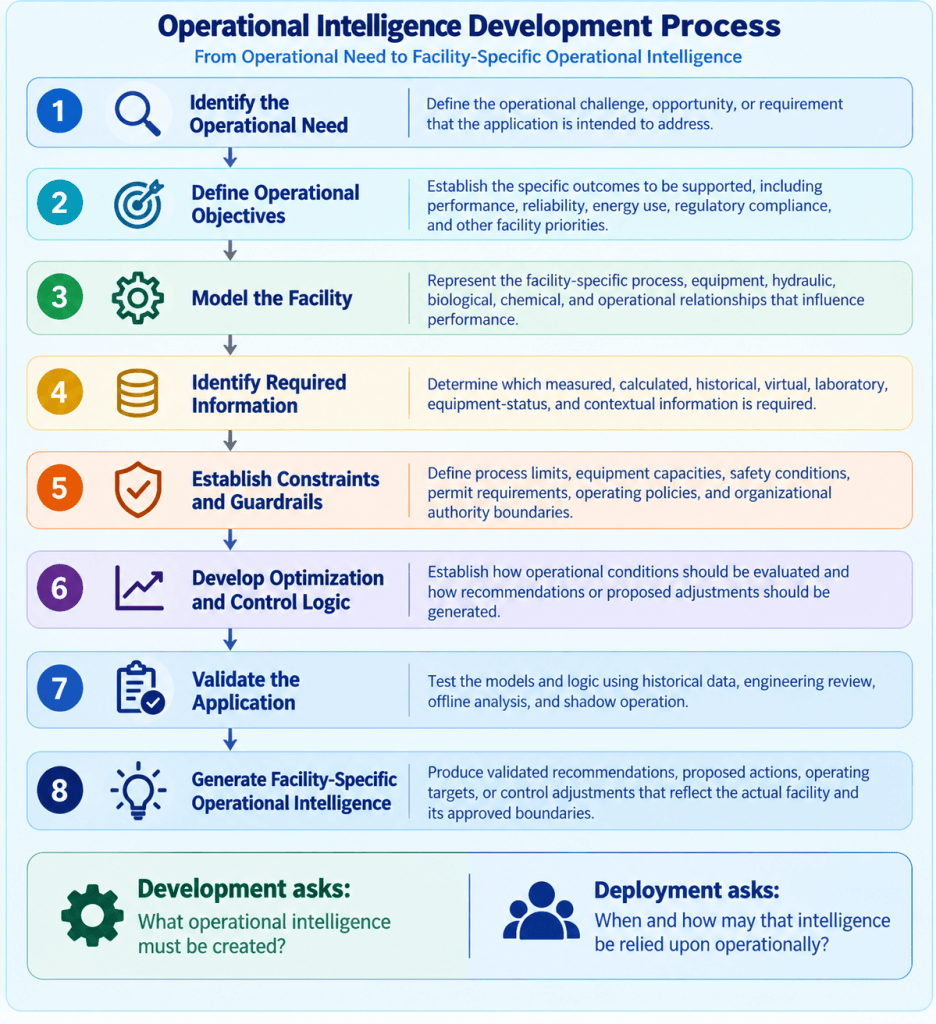
3. From Operational Need to Operational Intelligence
OperationsAI begins with the engineering problem rather than with a preconfigured software package.
The development process identifies the operational outcome to be supported, establishes the relevant engineering relationships, determines the information required, defines applicable constraints, and develops the predictive, optimization, and operational logic needed for the application.
A generic optimization model cannot reliably represent every facility. Engineering Intelligence must begin with a facility-specific understanding of the process, objectives, constraints, and operating environment.
4. What OperationsAI Does
OperationsAI converts a facility-specific operational need into structured operational intelligence.
Operational Objectives
Defines the measurable outcomes the application is intended to support.
Process and Equipment Relationships
Represents the facility-specific relationships influencing operational performance.
Required Information
Identifies the measured, calculated, historical, virtual, laboratory, equipment-status, and contextual information required for reliable evaluation.
Engineering Constraints
Establishes process, equipment, safety, regulatory, operational, and organizational boundaries.
Predictive and Optimization Logic
Develops facility-specific methods for anticipating conditions and evaluating appropriate operational responses.
Operational Response
Determines recommendations, operating targets, proposed adjustments, or other responses appropriate to current and anticipated conditions.
Governance and Authority
Defines the governance requirements associated with proposed decisions and actions.
Continuous Evaluation
Uses operational results and changing conditions to support continued evaluation and adjustment.
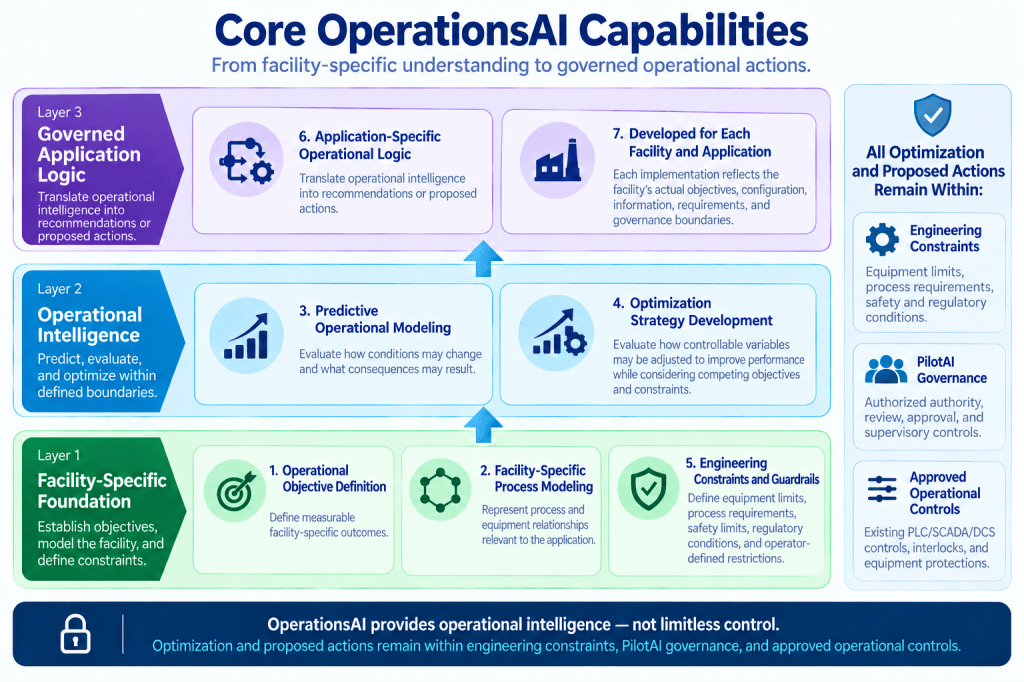
5. Core OperationsAI Capabilities
Operational Objective Definition
Defines measurable facility-specific outcomes such as process stability, energy performance, treatment or production performance, equipment reliability, regulatory performance, and asset protection.
Facility-Specific Process Modeling
Represents the physical, biological, chemical, hydraulic, mechanical, thermal, electrical, equipment, and operational relationships relevant to the application.
Models may combine first-principles engineering, empirical relationships, historical information, statistical methods, machine learning, or hybrid approaches.
Predictive Operational Modeling
Evaluates how facility requirements and operating conditions may change and what consequences may result.
Optimization Strategy Development
Evaluates how controllable variables may be adjusted to improve performance while considering competing objectives and constraints.
Optimization does not occur outside approved engineering and governance boundaries.
Engineering Constraints and Guardrails
Defines applicable equipment limits, rates of change, process requirements, safety limits, regulatory conditions, information-confidence requirements, and operator-defined restrictions.
Application-Specific Operational Logic
Translates operational intelligence into recommendations or proposed actions such as operating targets, equipment adjustments, process-mode changes, load distribution, sequencing, or requests for operator review.
OperationsAI does not independently determine unlimited authority. Proposed actions remain subject to PilotAI governance and approved operational controls.
Developed for Each Facility and Application
Each implementation reflects the facility’s actual operational objectives, process configuration, equipment, instrumentation, operating history, engineering requirements, existing controls, regulatory obligations, and governance boundaries.
6. OperationsAI Within the Engineering Intelligence Platform
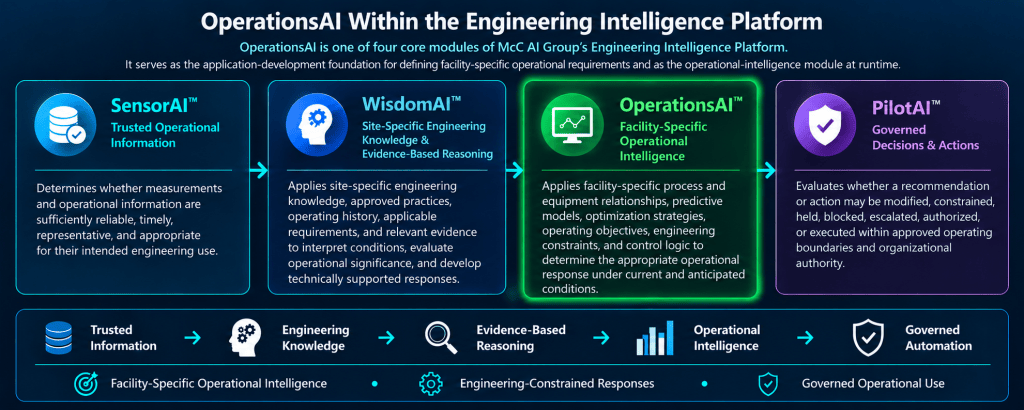
OperationsAI is one of four core modules of McC AI Group’s Engineering Intelligence Platform. It serves as the application development foundation for defining facility-specific operational requirements and as the operational intelligence module at runtime.
SensorAI™ — Trusted Operational Information
Determines whether measurements and operational information are sufficiently reliable, timely, representative, and appropriate for their intended engineering use.
WisdomAI™ — Site-Specific Engineering Knowledge & Evidence-Based Reasoning
Applies site-specific engineering knowledge, approved practices, operating history, applicable requirements, and relevant evidence to interpret conditions, evaluate operational significance, and develop technically supported responses.
OperationsAI™ — Facility-Specific Operational Intelligence
Applies facility-specific process and equipment relationships, predictive models, optimization strategies, operating objectives, engineering constraints, and control logic to determine the appropriate operational response under current and anticipated conditions.
PilotAI™ — Governed Decisions & Actions
Evaluates whether a recommendation or action may be modified, constrained, held, blocked, escalated, authorized, or executed within approved operating boundaries and organizational authority.
Integrated Platform Relationship
OperationsAI defines the operational objectives, requirements, models, constraints, and logic for the application.
SensorAI determines whether the required operational information can be trusted. WisdomAI provides the site-specific engineering knowledge and evidence-based reasoning needed to interpret conditions. OperationsAI uses these inputs to determine the appropriate operational response. PilotAI evaluates whether and how the proposed decision or action may proceed.
Operational results are returned as feedback for continued evaluation and adjustment.
7. Integration With Existing Facility Infrastructure
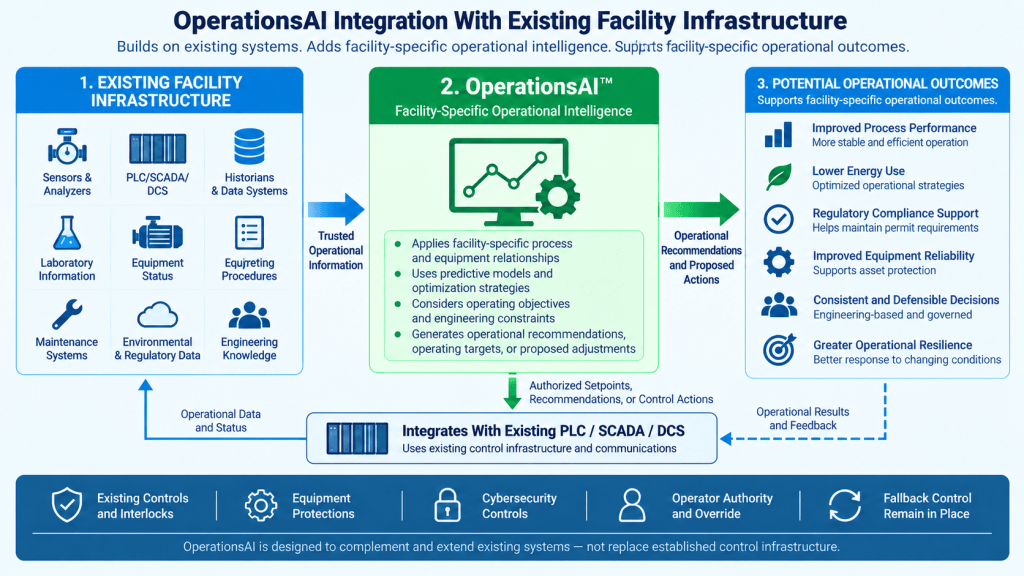
OperationsAI is designed to integrate with suitable existing instrumentation, automation, information systems, engineering resources, and control infrastructure, in accordance with the requirements of the facility-specific application.
Depending on the application, integration may include sensors and analyzers, PLCs, SCADA or distributed control systems, process historians, laboratory information, equipment status signals, maintenance systems, engineering models, operating procedures, environmental and regulatory records, edge computing systems, enterprise data platforms, and existing control applications.
Integration requirements depend on the facility, application, available information, and existing interfaces.
Any gaps in instrumentation, connectivity, information quality, or control interfaces are identified during facility evaluation.
When suitable instrumentation, information quality, connectivity, and control interfaces are available, implementation can normally proceed without new process hardware or major physical modifications.
OperationsAI is intended to complement and extend existing systems—not replace established operational infrastructure without an engineering basis.
8. Current and Potential OperationsAI Applications
OperationsAI is an application development and runtime operational intelligence capability that can be configured to meet facility-specific operational needs.
AerationAI and AerationAI-SND are current wastewater-treatment applications developed using the OperationsAI framework. They demonstrate how facility-specific process relationships, predictive methods, operating objectives, engineering constraints, and operational logic can be combined to determine an appropriate operational response.
The same OperationsAI approach can be applied to other operational problems in which facilities must determine what to do, when to do it, and within what engineering boundaries.
Current OperationsAI Applications
AerationAI™: AerationAI provides Real-Time Dynamic Aeration Optimization for a broader range of biological wastewater treatment and water recycling applications.
It seeks to provide the aeration required for reliable biological treatment while reducing unnecessary energy use.
AerationAI-SND™: AerationAI-SND extends this foundation to low-DO operating conditions intended to support simultaneous nitrification and denitrification where the facility and biological process are suitable.
Illustrative Applications Beyond Aeration
OperationsAI can be developed for other facility-specific operational needs, including:
Pumping & Hydraulic Operations
Optimize pump selection, sequencing, flow distribution, and operating targets within facility-specific hydraulic, equipment, energy, and reliability constraints.
Chemical Feed & Treatment Optimization
Determine chemical-feed strategies using treatment objectives, process conditions, measured response, and approved operating boundaries.
Process Loading & Capacity Management
Anticipate changing hydraulic or process loads and identify appropriate responses before treatment, equipment, or capacity constraints are reached.
Equipment Coordination & Asset Operation
Coordinate pumps, blowers, valves, treatment units, and other assets while considering process requirements, equipment availability, efficiency, and redundancy.
Energy & Demand Management
Evaluate operating strategies that reduce energy use or peak demand while preserving treatment, production, reliability, safety, and regulatory requirements.
Abnormal-Condition Response
Identify changing or unusual operating conditions and develop technically supported responses within established engineering constraints and safeguards.
Multi-Objective Operational Optimization
Balance treatment or production performance, energy, chemicals, equipment utilization, capacity, reliability, and operating cost.
Integrated Process Coordination
Coordinate operational responses across interconnected unit processes when changes in one part of the facility affect upstream, downstream, or facility-wide performance.
These examples illustrate potential OperationsAI application classes rather than currently deployed McC AI Group products. Each application would require facility-specific development, validation, engineering constraints, and authorization before operational use.
9. Future OperationsAI Applications
Additional OperationsAI applications may be developed on a facility- and application-specific basis for other critical-infrastructure operational needs.
Potential applications may span water and wastewater, energy and utilities, oil, gas and petrochemicals, chemical and process industries, manufacturing, transportation, environmental infrastructure, and other regulated or mission-critical facilities.
Future implementations will not assume that a single generic model can represent every facility. Each application requires evaluation of its operational need, relationships among processes and equipment, available information, engineering constraints, infrastructure, and governance requirements.
10. Performance Validation Before Expanding Authority
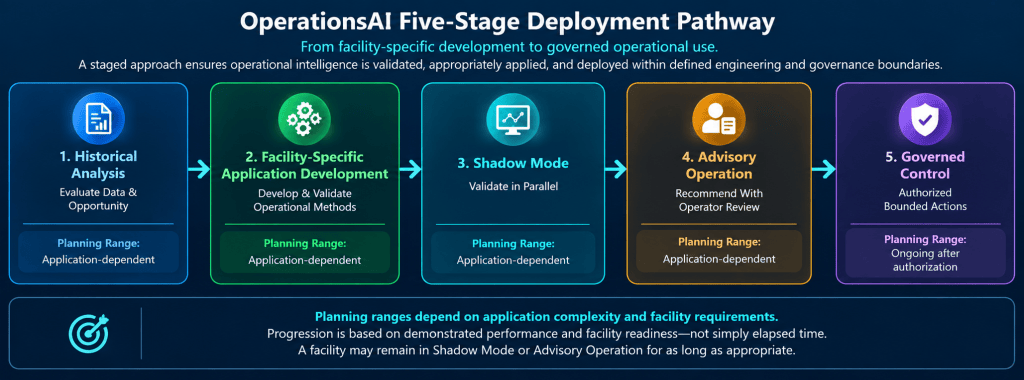
OperationsAI should progress toward operational authority only after its facility-specific models, operational recommendations, information requirements, engineering constraints, and performance have been evaluated under relevant operating conditions.
Validation may include comparison of predicted and observed facility behavior, assessment of information reliability, evaluation of proposed operational responses, confirmation of engineering constraints and safeguards, and review of performance across representative conditions.
Application-Specific Development Requirements
OperationsAI is a platform module that supports many applications, so application development requirements and planning ranges may vary substantially depending on application complexity and facility requirements.
11. Operational Value
OperationsAI translates facility-specific operational models and methods, trusted information, optimization logic, and engineering constraints into practical operational value. Its value is application-specific and should be evaluated against the facility’s defined objectives, operating conditions, and validated performance. Its value is application-specific and should be evaluated against the facility’s defined objectives, operating conditions, and validated performance.
Facility-Specific Optimization
OperationsAI evaluates operational alternatives using the facility’s actual process configuration, equipment relationships, operating objectives, information, and engineering constraints rather than relying on generic optimization assumptions.
Improved Operational Consistency
OperationsAI provides a consistent engineering basis for evaluating operating conditions and developing recommendations, helping reduce unnecessary variation in how similar operational situations are assessed and addressed.
Better Use of Existing Information
OperationsAI brings together trusted operational information, process and equipment relationships, operating history, engineering knowledge, and other relevant facility information so existing data can contribute more directly to operational decisions.
Reduced Dependence on Individual Experience
OperationsAI captures facility-specific operational relationships, objectives, constraints, and validated methods in a structured operational-intelligence framework, helping preserve important engineering and operational knowledge beyond individual personnel.
Technically Supported Engineering Basis
OperationsAI connects recommendations and proposed actions to facility-specific models, applicable engineering relationships, operating objectives, constraints, and validated information, providing a more technically supported basis for operational decisions.
Governed Operational Authority
OperationsAI recommendations and proposed actions remain subject to defined engineering constraints, PilotAI governance, approved operational controls, and organizational authority. Operational authority can therefore be introduced progressively and bounded according to demonstrated performance and facility readiness.
12. Governance and Deployment Safeguards
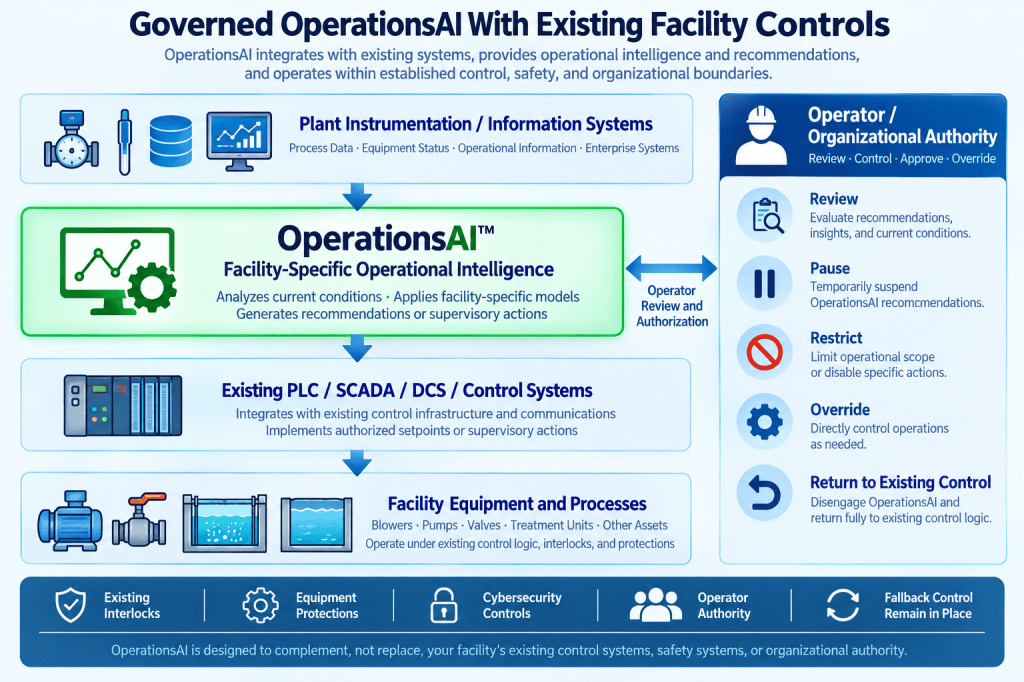
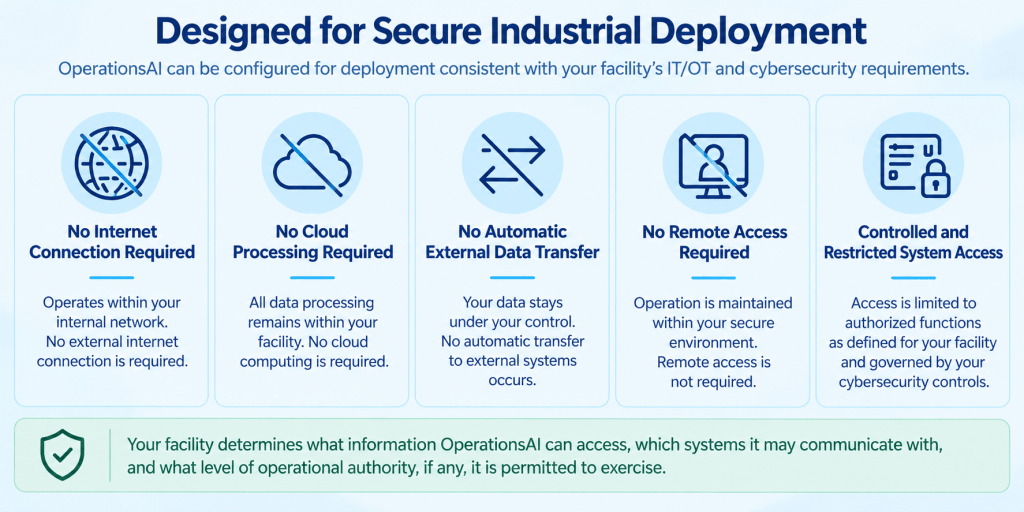
OperationsAI is designed to improve facility-specific operational intelligence without removing the protections already governing facility operation.
Where OperationsAI interfaces with operational systems, existing interlocks, equipment protections, cybersecurity controls, approved operating procedures, fallback provisions, and operator authority remain part of the deployment architecture.
The level of operational authority is established for the specific application and facility. OperationsAI recommendations or proposed actions do not inherently receive unrestricted control authority.
13. Proprietary Technology and Intellectual Property
OperationsAI incorporates proprietary and patent-pending technologies for facility-specific operational modeling, prediction, optimization, engineering constraints, operational logic, and governed operational use.
OperationsAI is designed to translate facility-specific operating objectives, process and equipment relationships, facility-specific operational models and methods, engineering constraints, and validated information into operational intelligence appropriate for current and anticipated facility conditions.
Its protected technical value is not based on a single generic optimization or AI model. It integrates facility-specific operational requirements, engineering knowledge, predictive and optimization methods, operating constraints, and governed decision-making within a deployable Engineering Intelligence application.
Additional implementation methods, facility-specific models, optimization methods, control strategies, validation procedures, configuration practices, and deployment methodologies remain proprietary.
14. OperationsAI Technology Evaluation
An initial OperationsAI evaluation examines the facility’s operational needs, objectives, process and equipment relationships, available information, existing controls, and opportunities for improved facility-specific operational intelligence.
Evaluation may consider:
- Operational Need — Problems, inefficiencies, variability, recurring operating challenges, or opportunities requiring improved operational decisions.
- Operational Objectives — Performance, reliability, energy, treatment, production, maintenance, safety, regulatory, or other facility-specific objectives.
- Facility and Process Relationships — Relevant processes, equipment, interactions, constraints, and anticipated operating conditions.
- Information and Existing Controls — Available operational information, instrumentation, historians, PLC/SCADA/DCS systems, and current control strategies.
- Priority Applications — Opportunities where prediction, optimization, operational guidance, or governed control could provide meaningful value.
15. Performance Qualification and Implementation Readiness
OperationsAI performance should be established using actual facility information, engineering analysis, historical operating conditions, model validation, and prospective operational evaluation rather than assumptions based solely on generic models or results from other facilities.
Qualification may consider model performance, process-response behavior, information confidence, operational objectives, engineering constraints, integration requirements, operator review, and validation across representative operating conditions.
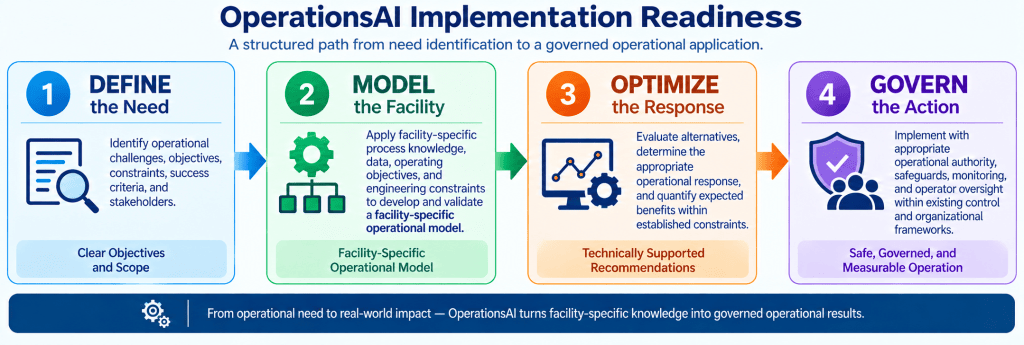
Implementation readiness is evaluated through four areas:
a. Facility and Operational Assessment
Evaluate the operational problem, objectives, process and equipment configuration, existing controls, operating history, engineering constraints, and performance requirements.
b. Information and Knowledge Assessment
Identify the trusted operational information, site-specific engineering knowledge, operating practices, applicable requirements, and contextual information required by the application.
c. Model and Integration Assessment
Evaluate facility-specific operational modeling, predictive and optimization requirements, engineering constraints, operational logic, PLC/SCADA/DCS integration, cybersecurity requirements, safeguards, and compatibility with existing infrastructure.
d. Pilot Validation
Establish a facility-specific validation pathway through historical evaluation, application development, Shadow Mode, and—where appropriate—Advisory Operation or Governed Control.
OperationsAI should not assume that models, operating relationships, or performance demonstrated at one facility will automatically transfer to another.
16. Technology and Deployment Partnerships
OperationsAI applications can be evaluated, developed, validated, and deployed through collaboration with critical-infrastructure operators, engineering organizations, control-system integrators, equipment and technology providers, research organizations, and qualified implementation partners.
Each engagement is structured around the facility’s operational objectives, existing infrastructure, available information, engineering knowledge, process and equipment constraints, cybersecurity requirements, and approved level of operational authority.
17. Explore OperationsAI for Your Facility
OperationsAI begins with the operational need—not with a preconfigured software package.
An initial discussion can identify where facility-specific operational intelligence may provide practical value and whether further evaluation of the facility is appropriate.
Understand the need. Model the facility. Validate the response. Govern the operation.
 McC AI Group, Inc.