

SensorAI
Trusted Operational Information for Engineering Intelligence
Providing Trusted Operational Information for Engineering Intelligence.
SensorAI™ is McC AI Group’s proprietary, patent-pending information-integrity and advanced sensing technology for critical infrastructure. It forms the Trusted Information layer of the Engineering Intelligence Platform and is engineered to determine not merely what instrumentation reports, but whether operational information is sufficiently trustworthy for the engineering or operational decision that depends on it.
SensorAI applies advanced engineering and computational algorithms—including multi-source validation, sensor-integrity assessment, drift, bias and anomaly detection, process-response consistency analysis, facility-specific modeling, virtual and inferred sensing, and confidence-based information qualification—to transform raw operational data into source-aware, trusted operational information.
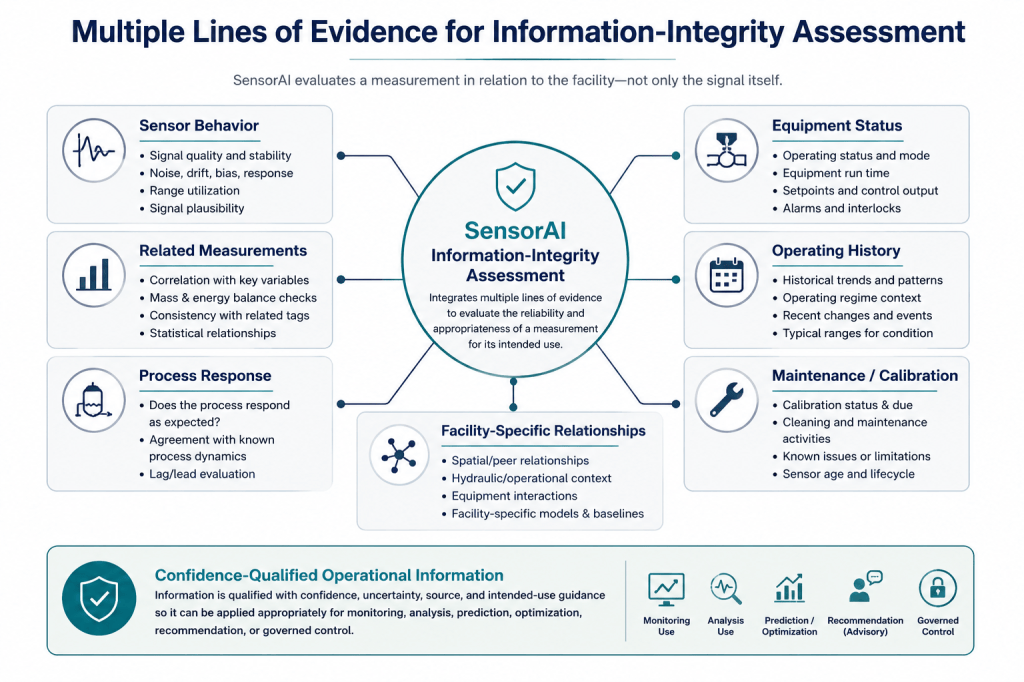
Unlike conventional monitoring or sensor-diagnostic systems that may evaluate a signal largely in isolation, SensorAI can evaluate measurements in relation to process conditions, equipment status, related measurements, operating history, maintenance conditions, facility-specific behavior, and validated engineering relationships. This multi-evidence approach helps distinguish actual process change from measurement degradation and other information-integrity problems.
SensorAI is designed to complement existing instrumentation, automation, historian, and asset-management systems. It strengthens the engineering value of information already available while preserving source visibility, uncertainty, human and organizational authority, and the distinction among measured, inferred, qualified, restricted, and unavailable information.
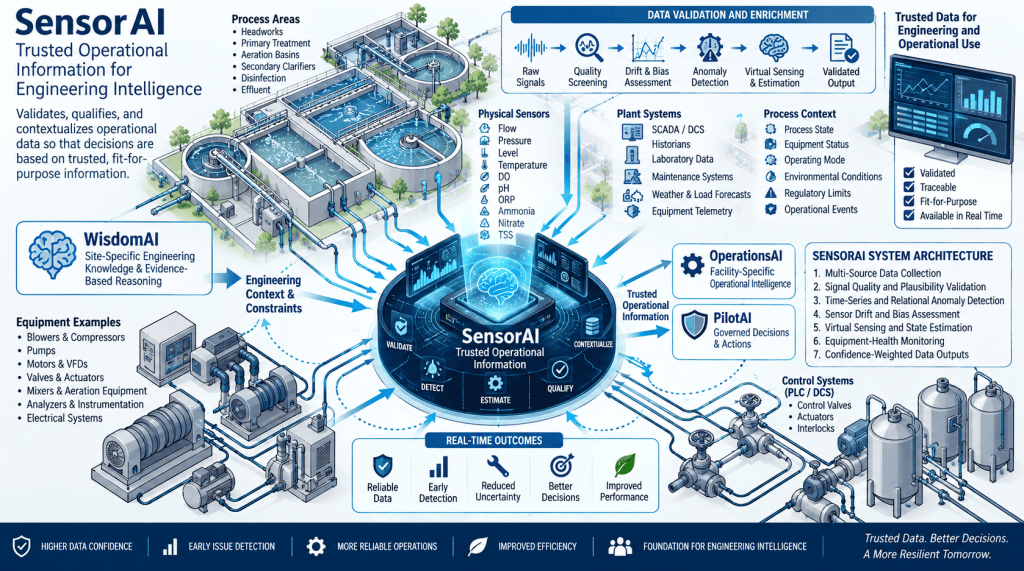
Trust is fit-for-purpose, source-aware, explainable, and bounded by the consequence of use.
SensorAI does not simply ask whether a sensor is working. It determines whether the information is sufficiently trustworthy for the engineering decision that depends on it.
Advanced algorithms · Multi-source validation · Facility-specific modeling · Virtual sensing · Confidence qualification · Fit-for-purpose information governance
Why Trusted Information Matters
Critical infrastructure increasingly depends on measurements and operational information to support optimization, maintenance, engineering analysis, alarms, recommendations, and automated action. The quality of the decision therefore depends not only on whether data are available, but on whether those data remain sufficiently trustworthy for the intended purpose.
- Better optimization depends on trustworthy measurements and process information.
- Better maintenance depends on knowing whether the apparent problem is the instrument, the equipment, the process, or the communication path.
- Governed automation depends on knowing when information should—and should not—be allowed to influence higher-authority action.
The Operational-Information Challenge
Critical infrastructure increasingly depends on sensors, analyzers, connected equipment, automation systems, and operational databases. More data, however, does not automatically create more reliable information.
In real facilities, measurements can be affected by fouling, drift, calibration conditions, communication problems, maintenance activity, spatial variability, changing operating modes, and other site-specific factors. A signal may continue to look reasonable even when it is no longer sufficiently representative for the intended decision.
The engineering challenge is therefore not simply to collect more data. It is to determine which information is sufficiently reliable, timely, representative, and appropriate for the intended use.
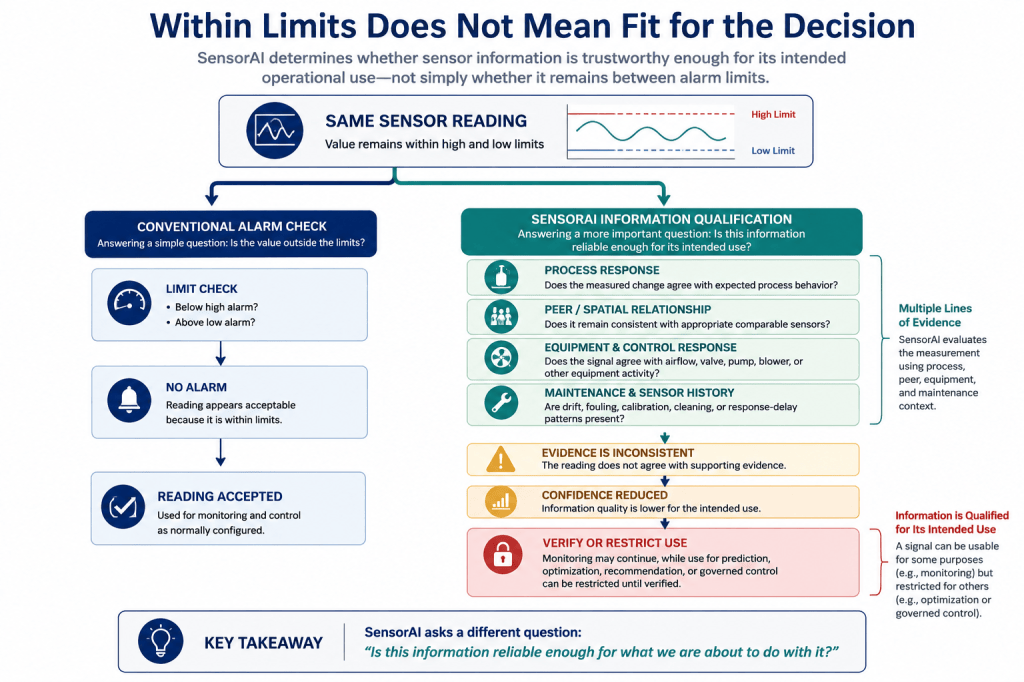
The most difficult sensor problems may not look like failures. A plausible but misleading signal can continue to influence operators, optimization algorithms, alarms, or automated control.
What SensorAI Is
SensorAI is a proprietary, patent-pending information-integrity and advanced sensing technology that combines engineering algorithms, statistical and data-driven methods, facility-specific models, process and equipment context, and virtual sensing to establish the trustworthiness and permitted use of operational information.
Its algorithms evaluate signals not in isolation, but in relation to the physical process, connected equipment, related measurements, operating conditions, historical behavior, maintenance state, and validated engineering relationships. The result is not simply a fault indication; SensorAI produces source-aware, confidence-qualified operational information that can be used appropriately for monitoring, engineering analysis, maintenance, prediction, optimization, advisory recommendations, and—in approved applications—governed operational control.
Where suitable validated relationships are available, SensorAI may also generate virtual or inferred information to support continuity, cross-checking, or approved operational purposes. Such information remains explicitly identified by source, confidence, intended use, and authority limits rather than being silently treated as equivalent to a validated physical measurement.
Advanced Technology Behind SensorAI
- Multi-source signal validation and engineering consistency analysis
- Sensor drift, bias, fouling, response-delay, and anomaly detection
- Process-response and equipment-state consistency assessment
- Facility-specific baseline, relationship, and operating-regime modeling
- Peer and spatial comparison where engineering relationships justify comparison
- Virtual and inferred sensing using validated facility-specific relationships
- Confidence, uncertainty, source, and provenance qualification
- Fit-for-purpose information-use and authority assessment
- Early identification of plausible but operationally misleading measurements and degrading information relationships
These methods operate as an integrated information-integrity layer—not as isolated diagnostic tools—to determine what information can be trusted, for what purpose, and with what level of authority.
What SensorAI Does
SensorAI converts raw operational data into trusted operational information through four high-level functions:
1. Evaluate Information Quality
Assesses whether available measurements and operational signals are sufficiently reliable and suitable for the intended monitoring, engineering, maintenance, prediction, or control purpose.
2. Interpret Information in Context
Considers measurements together with relevant process conditions, equipment status, operating history, maintenance conditions, and facility-specific behavior.
3. Support Continuity When Information Is Limited
Where appropriate and validated, supports alternative or inferred information for monitoring, advisory use, cross-checking, or other site-approved purposes when physical measurements are unavailable or uncertain.
4. Provide Trusted Information to Engineering Intelligence
Supplies qualified operational information, alerts, and source-aware status to downstream Engineering Intelligence capabilities and authorized personnel.
The central question is not only “What does the instrument report?” but “Can this information be trusted for this engineering or operational purpose?”
What Makes SensorAI Different
Not Just Sensor Fault Detection
Conventional sensor diagnostics commonly ask whether an instrument has failed, drifted, exceeded a predefined threshold, or stopped communicating. SensorAI addresses a broader engineering question: can the information be trusted for the specific decision that is about to depend on it? Rather than depending on a single diagnostic rule or black-box model, SensorAI can combine multiple forms of evidence and engineering context to qualify both information confidence and permitted use.
Depending on the application, SensorAI can evaluate information using multiple forms of evidence, including measurement behavior, relationships with related measurements, equipment operating status, process response, operating history, maintenance and calibration conditions, spatial or peer relationships where appropriate, and validated physical, statistical, or engineering relationships.
Information Is Qualified for Its Intended Use
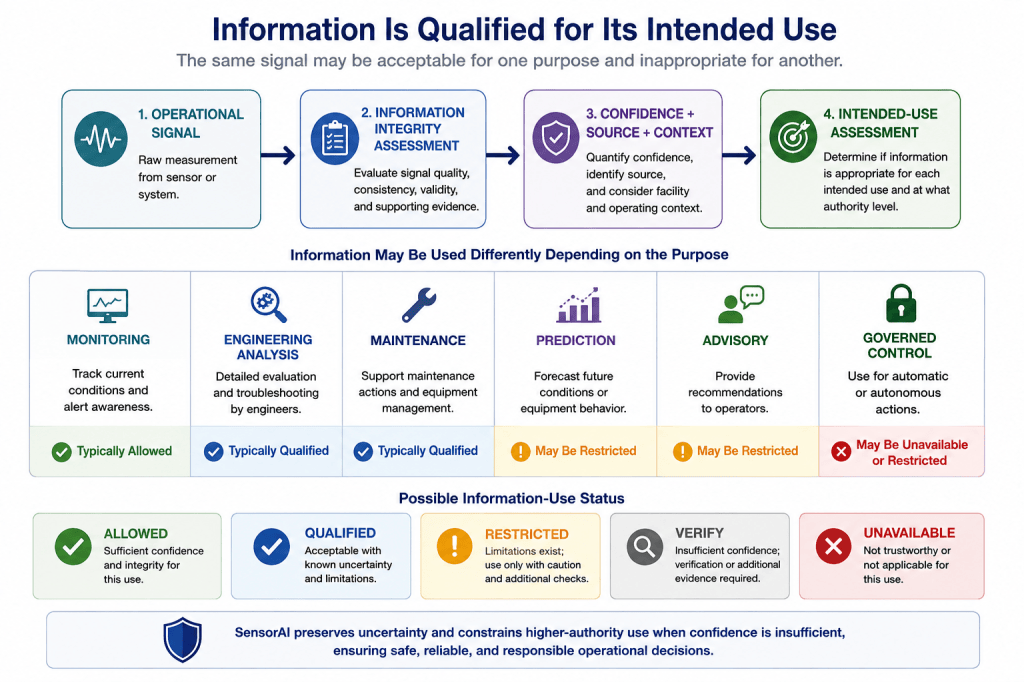
Operational information does not always need to be treated as either completely valid or completely failed. Depending on the application and consequence, information may remain suitable for general awareness while being restricted from higher-authority recommendations or control.
SensorAI therefore evaluates information according to its intended engineering use and consequence. A measurement may be acceptable for monitoring yet not sufficiently reliable for prediction, optimization, automated recommendation, or governed control. This source-aware approach allows organizations to preserve useful visibility without concealing uncertainty.
The question is not simply whether a signal exists. It is what that signal can safely and appropriately be used for.
Core SensorAI Capabilities
1. Advanced Sensing
Uses relevant existing sensors, analyzers, connected equipment, control systems, historians, and other approved information sources to improve operational awareness. The objective is not indiscriminate expansion of instrumentation, but the effective use of information relevant to the engineering purpose.
2. Virtual and Inferred Information
Can support estimates of difficult, unavailable, or temporarily unreliable variables using validated facility-specific relationships where appropriate. Inferred information remains identified and is used only within approved application boundaries.
Virtual sensing can provide an independent, model-based estimate of an operational variable using validated relationships among available process and equipment information. The purpose is not to invisibly replace a physical sensor, but to provide an additional line of evidence for cross-checking, continuity, anomaly assessment, and confidence qualification.
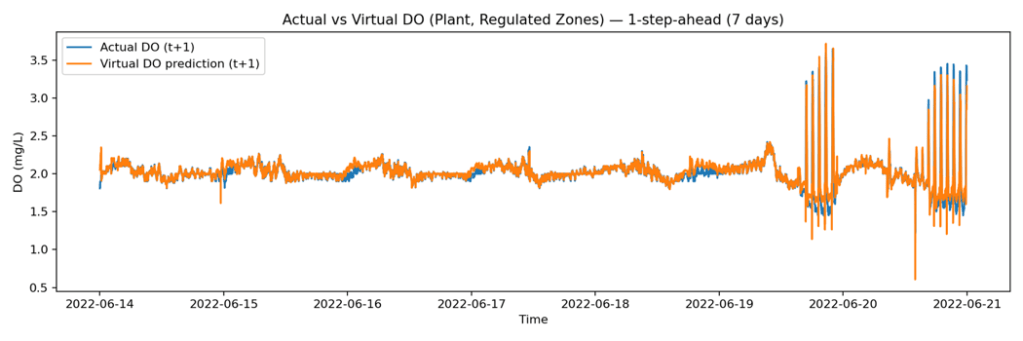
Example of Virtual DO performance. Measured dissolved oxygen and one-step-ahead Virtual DO estimates are compared over a seven-day operating period. The objective is not simply prediction accuracy; validated virtual information can provide an additional line of evidence for assessing information integrity and continuity.
Controlled information continuity with uncertainty preserved—not an unqualified replacement of the physical measurement.
3. Sensor and Information Integrity
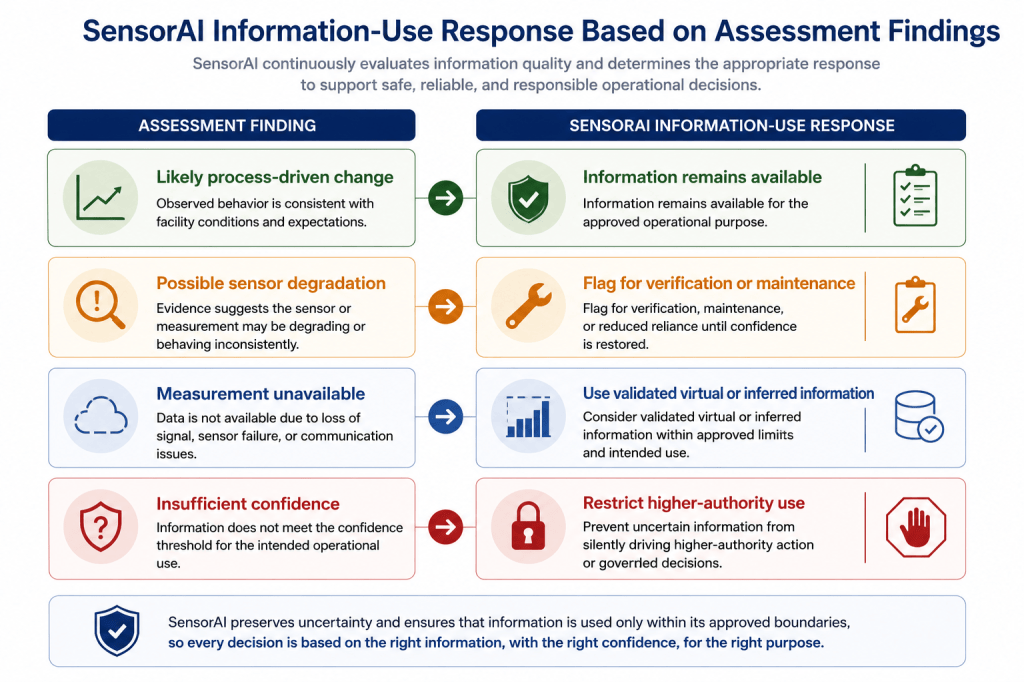
Helps identify conditions suggesting that a measurement may require verification, maintenance, restriction, or reduced reliance before it influences consequential decisions.
4. Asset and Process Awareness
Connects sensing information with equipment and process behavior to support early identification of abnormal patterns, deteriorating performance, inspection needs, and maintenance priorities.
5. Facility-Specific Intelligence
Industrial facilities do not behave identically. SensorAI can establish site-, process-, asset-, train-, basin-, zone-, or equipment-specific relationships and normal operating behavior where appropriate. Qualification criteria can therefore reflect the actual instrumentation, operating modes, process dynamics, equipment configuration, and engineering constraints of the facility rather than relying solely on universal thresholds.
6. Traceable Information Qualification
SensorAI is designed to preserve why information has been qualified, restricted, inferred, or flagged for verification. Depending on the implementation, supporting evidence can include sensor trends, related measurements, process consistency, equipment status, operating history, maintenance conditions, and applicable engineering relationships.
Trust should be explainable—not merely assigned as a score.
How SensorAI Supports Engineering Intelligence
SensorAI provides the trusted operational information foundation for Engineering Intelligence applications. Its capabilities are selected and configured according to the information requirements, operating environment, and consequence of each implementation.
AerationAI
SensorAI can validate and qualify dissolved oxygen, airflow, influent flow and loading indicators, blower power, equipment status, and other operational information used to determine and adjust plant-, train-, basin-, and zone-specific airflow requirements. It helps prevent predictive aeration from acting on measurements that appear plausible but are no longer sufficiently reliable for the intended use.
AerationAI-SND
Low-DO operation places greater importance on information reliability because the margin between adequate treatment and insufficient oxygen can be narrow. SensorAI can support AerationAI-SND through DO-confidence evaluation, qualification of nutrient- and loading-related information, detection of delayed or unreliable signals, process-response consistency checks, and virtual or inferred indicators where appropriate.
OperationsAI
SensorAI supplies confidence-qualified process, equipment, and instrumentation information that OperationsAI can use for performance assessment, optimization, equipment-health evaluation, abnormal-condition assessment, and operational decision support.
WisdomAI
SensorAI supplies trusted operational information that WisdomAI can interpret in conjunction with site-specific engineering knowledge, operating history, equipment relationships, approved procedures, standards, permits, and other authoritative information.
PilotAI
SensorAI provides information-quality, confidence, and source status that PilotAI can consider when determining whether a recommendation or action may be authorized, modified, constrained, held, deferred, blocked, escalated, or executed within approved operating boundaries and authority. Loss of information confidence can therefore become an explicit governance condition rather than an unrecognized source of control risk.
SensorAI strengthens the trusted-information foundation of AerationAI, AerationAI-SND, OperationsAI, WisdomAI, PilotAI, and other Engineering Intelligence applications.
Integration With Existing Systems
SensorAI is designed to complement existing instrumentation and information infrastructure rather than require wholesale replacement. Depending on the implementation, it may work with sensors and analyzers, PLC/SCADA or distributed control systems, historians, asset and maintenance systems, laboratory and operational databases, edge devices, and approved enterprise information systems.
Integration scope is facility-specific and depends on available information, communication architecture, cybersecurity requirements, operational priorities, and approved implementation boundaries.
Designed for Existing Industrial Control Environments
SensorAI can be configured to operate within facility-approved industrial and information-system architectures. Depending on implementation requirements, deployment can support local or edge processing, existing network boundaries, controlled data exchange, cybersecurity and access-control requirements, and existing operator and engineering authority.
SensorAI does not require unrestricted access to plant control systems in order to provide information-integrity capabilities.
Start With the Information the Facility Already Has
SensorAI is designed to extract greater engineering value from suitable existing instrumentation and operational information. Additional instrumentation may be recommended when necessary, but wholesale sensor or automation replacement is not the starting assumption.
Operational Value
1. Reduced Information Blind Spots
Helps personnel distinguish information that is reliable, uncertain, unavailable, or locally unrepresentative.
2. Fewer Faulty Responses
Helps prevent questionable information from silently driving unnecessary alarms, ineffective responses, or inappropriate automated actions.
3. Improved Maintenance Prioritization
Provides information that can help focus inspection, cleaning, calibration, repair, replacement, or additional engineering review where it is most needed.
4. Improved Operational Resilience
Where validated and appropriate, alternative information can preserve limited visibility during maintenance, analyzer downtime, communication interruption, or instrument failure.
5. Greater Confidence in Advanced Automation
Strengthens the information foundation required for predictive applications, recommendations, and governed control.
6. Protection of Existing Investments
Increases the usefulness of existing instrumentation and automation while avoiding unnecessary wholesale replacement.
Better decisions begin with information that is not only available, but trusted and appropriate for its intended use.
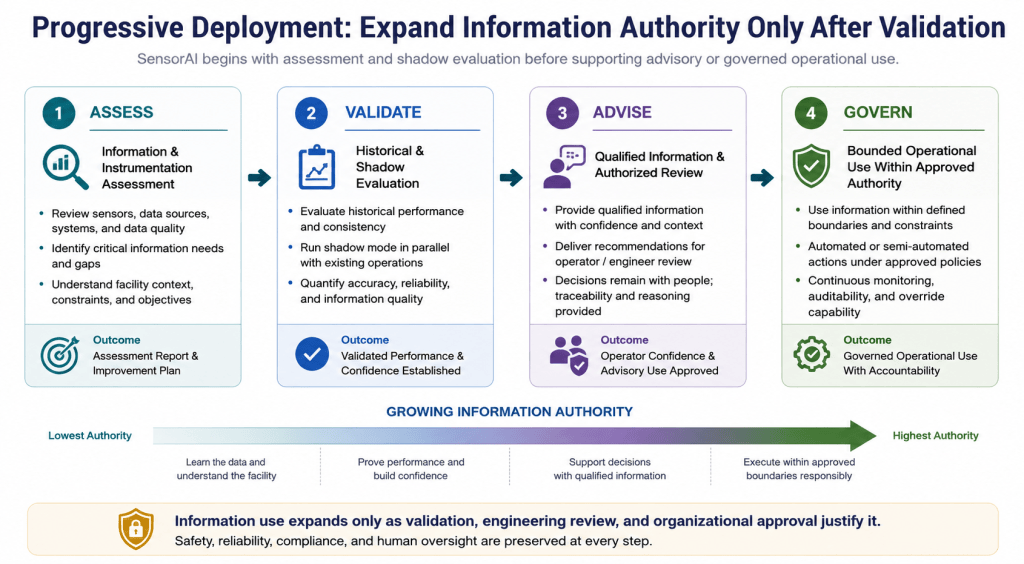
Progressive Deployment
SensorAI may be introduced progressively according to the organization’s instrumentation, information quality, operational priorities, and intended level of use.
1. Information and Instrumentation Assessment
Review existing sensors, analyzers, data systems, maintenance information, critical measurements, and intended applications.
2. Historical and Shadow Evaluation
Evaluate information quality and system behavior using historical and real-time information without affecting operational decisions.
3. Advisory Use
Provide qualified information, integrity indications, and maintenance guidance for review by authorized personnel and application systems.
4. Governed Operational Use
Following validation and organizational approval, trusted and qualified information may support predictive applications, recommendations, or bounded supervisory use within approved limits.
SensorAI Within the Engineering Intelligence Platform
Engineering Intelligence is the discipline of generating trusted decisions for critical infrastructure by connecting reliable operational information with engineering knowledge, explainable reasoning, and governed action.
- SensorAI — Trusted Information: determines whether operational information is sufficiently reliable, timely, representative, and appropriate for its intended engineering or operational purpose.
- WisdomAI — Engineering Knowledge & Explainable Reasoning: determines what trusted information means in a site-specific engineering context, why a condition may be occurring, and what response should be considered.
- OperationsAI — Operational Intelligence: applies trusted information and engineering reasoning to process performance, equipment condition, optimization, and operational decision support.
- PilotAI — Governed Automation: determines whether a recommendation or action may be authorized, modified, constrained, held, blocked, escalated, or executed within approved operating boundaries and authority.
Trusted Information → Engineering Knowledge → Explainable Reasoning → Operational Intelligence → Governed Automation
Wastewater Applications
AerationAI and AerationAI-SND apply these Engineering Intelligence capabilities to wastewater aeration optimization and low-DO/SND operation. SensorAI provides the trusted operational information required for their prediction, adjustment, validation, and governed operation.
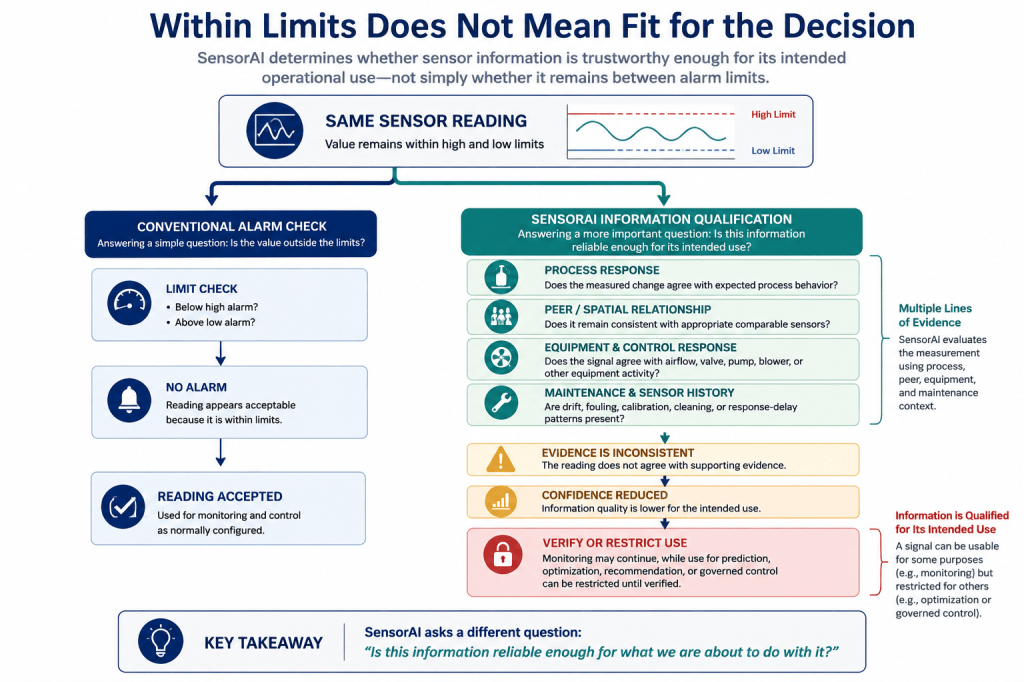
Example: A Measurement Changes—But Why?
A dissolved-oxygen measurement begins declining. A conventional system may simply report the lower DO value. SensorAI can evaluate whether the change is consistent with airflow, loading, related basin measurements, equipment status, recent maintenance, sensor behavior, and expected process response.
Proprietary Technology and Intellectual Property
SensorAI incorporates proprietary algorithms, engineering models, validation architectures, virtual sensing methods, confidence qualification logic, and information governance methods, all covered by published and pending patent applications and supported by proprietary engineering know-how.
Its technical value lies not in any single AI model, anomaly detector, sensor diagnostic, or virtual sensor. The value lies in the integrated transformation of raw operational data into source-aware, confidence-qualified, fit-for-purpose information suitable for engineering analysis, predictive applications, optimization, advisory recommendations, and governed operational use.
Additional facility-specific models, validation practices, configuration methods, operating-envelope logic, deployment methodologies, and implementation methods remain proprietary. Together, these elements allow SensorAI to function as a defensible engineering-information layer between plant data sources and consequential decisions.
Performance Qualification
SensorAI performance is facility- and application-specific. Its effectiveness depends on the quality and availability of source information, instrumentation condition, appropriate validation, facility context, system integration, and continued engineering and maintenance support.
SensorAI should not be presented as eliminating the need for physical instrumentation, qualified maintenance, calibration, engineering review, or organizational responsibility.
Evaluate SensorAI for Your Organization
Implementation begins with an assessment of the organization’s instrumentation, operational information, information systems, asset priorities, and intended Engineering Intelligence applications.
1. Instrumentation and Information Assessment
Review available sensors, analyzers, equipment signals, historians, databases, communication systems, and maintenance information.
2. Operational-Information Assessment
Identify which measurements and information sources are critical for monitoring, engineering analysis, maintenance, prediction, and authorized control.
3. Integrity and Continuity Assessment
Evaluate where information-quality problems, gaps, or difficult-to-measure conditions may limit operational visibility or decision quality.
4. Integration Discussion
Define how SensorAI could complement existing instrumentation, PLC/SCADA systems, historians, asset-management platforms, maintenance systems, and application-level controls.
5. Pilot Validation
Establish a facility-specific pathway beginning with historical and shadow evaluation before progressing to advisory or governed operational use.
Validate the information. Qualify the uncertainty. Strengthen every decision that follows.
 McC AI Group, Inc.