

AerationAI™
Site-Specific Aeration-Optimization Software for Existing Plant Infrastructure
Predictive Aeration Optimization for Reliable Treatment and Lower Energy Use
AerationAI™ is McC AI Group’s proprietary, patent-pending aeration-optimization technology for biological wastewater treatment. It combines advanced engineering and computational algorithms, plant-specific predictive modeling, adaptive process-response evaluation, trusted operational information, engineering safeguards, and governed supervisory control to determine the aeration required as plant conditions change.
AerationAI is designed to integrate with suitable existing plant information, PLC/SCADA systems, historians, blowers, variable-frequency drives, airflow-control devices, and biological-treatment infrastructure. Rather than treating a fixed dissolved-oxygen setpoint as the sole operating objective, AerationAI anticipates aeration requirements, evaluates actual DO and process response, and determines whether an airflow adjustment is appropriate within the site-specific treatment, equipment, information quality, process stability, cybersecurity, and operating boundaries.
The objective is not minimum airflow. It is the airflow required for reliable biological treatment—no more and no less—as operating conditions change..
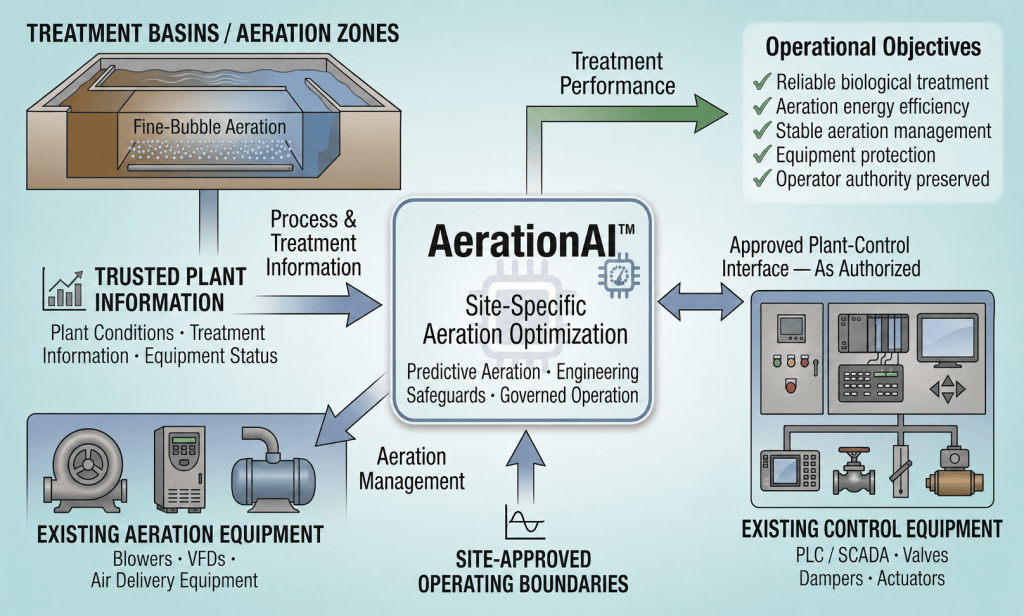
What AerationAI Is
AerationAI is a site-specific predictive and governed aeration-optimization application.
It is not simply a replacement DO controller, nor a generic AI model layered on top of SCADA.
AerationAI uses available plant information and proprietary site-specific engineering methods to:
- Anticipate changing aeration requirements
- Evaluate biological and process response
- Determine whether an airflow adjustment is appropriate
- Apply treatment and equipment safeguards
- Respect approved operating boundaries
- Operate within facility-approved authority
The result is not merely an airflow calculation.
It is a governed engineering decision that can support operator recommendations or, when specifically authorized, bounded supervisory action through an approved plant-control interface.
Predict the Requirement. Validate the Information. Understand the Response. Govern the Action.
Why AerationAI Is Different
Many aeration-control systems can respond to DO.
The more important engineering question is:
How much aeration does this particular biological process actually need under the present conditions—and are the information, engineering safeguards, and approved authority sufficient to support the adjustment?
AerationAI addresses this question through several interacting capabilities.
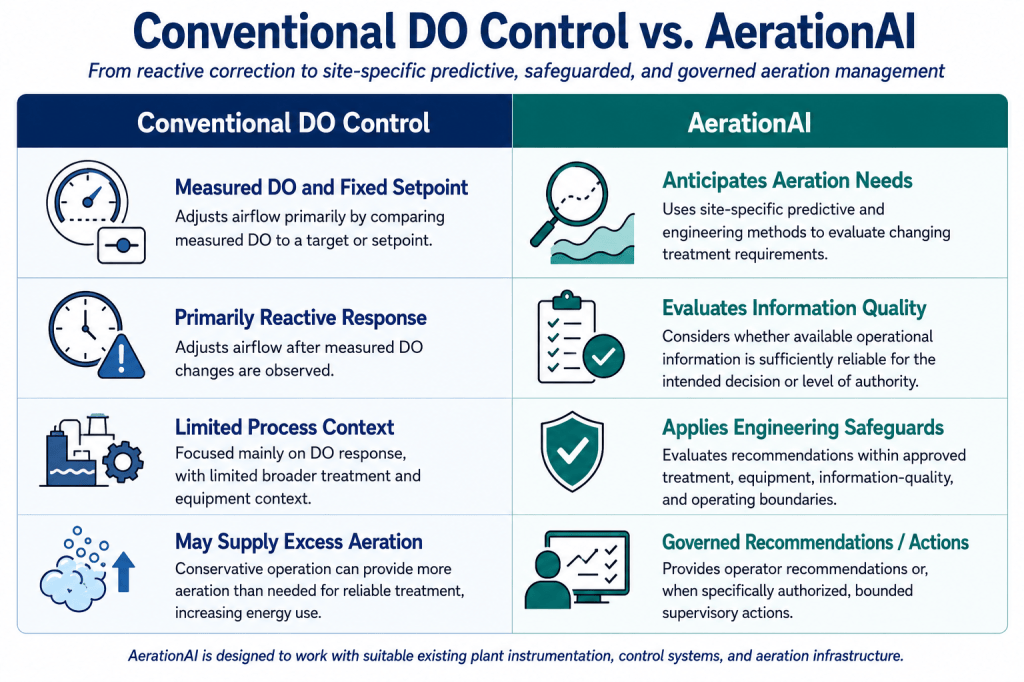
Predictive Rather Than Solely Reactive
Conventional DO control primarily responds after measured DO has moved away from a target.
AerationAI anticipates changing aeration requirements so that potential airflow needs can be evaluated before relying solely on a significant DO deviation.
DO remains essential feedback—but it is evaluated within the broader process context rather than used as the only basis for every aeration decision.
Site-Specific Rather Than Generic
Wastewater treatment facilities differ in loading, biological conditions, hydraulics, basin configuration, aeration equipment, instrumentation, operating practices, and treatment objectives.
AerationAI is therefore configured and validated for the individual facility and, where appropriate, individual basin or aeration zone rather than applying a universal aeration model.
Response-Aware Rather Than Repeatedly Reactive
Aeration changes do not produce an instantaneous biological or DO response.
AerationAI considers how the process responds following aeration changes rather than repeatedly adjusting airflow before the effect of a previous action can be adequately evaluated.
This supports more stable operation and reduces unnecessary control movement.
Information-Aware Rather Than Blindly Trusting Every Signal
Optimization quality depends on information quality.
AerationAI can use Engineering Intelligence capabilities to determine whether available operational information is sufficiently reliable for the intended prediction, recommendation, or level of control authority.
Questionable information can result in a more conservative decision rather than being allowed to independently drive consequential control action.
Constraint-Aware Rather Than Optimizing Airflow in Isolation
The mathematically lowest airflow is not necessarily an acceptable operating condition.
AerationAI evaluates optimization within approved treatment, mixing, equipment, information-quality, process-stability, operating, and organizational boundaries.
Governed Rather Than Unbounded
AerationAI does not determine its own operational authority.
The facility determines what information AerationAI can access, what it may recommend, and what—if anything—it may control.
It is a governed engineering decision that may be recommended, constrained, held, blocked, or—when specifically authorized—implemented through an approved plant-control interface.
A recommendation is not automatically an authorization.
Beyond Conventional DO Control
Dissolved oxygen remains one of the most important measurements in biological wastewater treatment.
The limitation is not DO measurement itself.
The limitation is relying on DO feedback alone to represent a biological process whose oxygen requirements and measured response change with operating conditions.
Biological oxygen requirements may change before the resulting effect is fully reflected in the measured DO signal. At the same time, measured DO may respond with delay to changes in aeration and process conditions.
A controller that reacts only after DO has changed substantially may therefore respond later than desirable.
A controller that responds too aggressively to every small DO movement may also create unnecessary airflow changes before the process has adequately responded.
AerationAI addresses both problems by combining:
Predictive aeration + process-response evaluation + engineering safeguards + governed authority
The objective is not to ignore DO.
It is to use DO as part of a broader engineering assessment of what the process requires.
What AerationAI Does
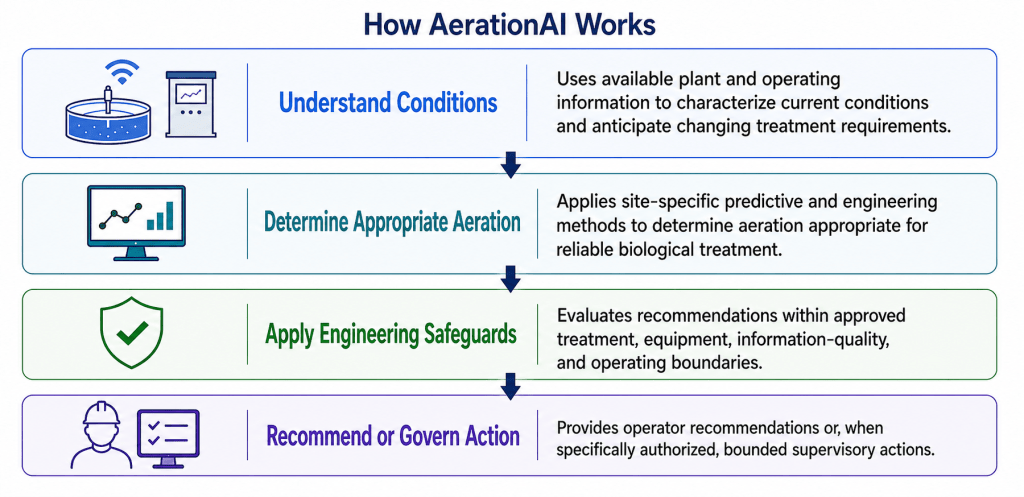
AerationAI converts available plant information into site-specific aeration recommendations and governed operational actions through four high-level functions.
Understand Current and Anticipated Conditions
AerationAI uses available plant and operating information to characterize current conditions and anticipate changing treatment requirements.
Determine Appropriate Aeration
Proprietary site-specific predictive and engineering methods determine the aeration appropriate for reliable biological treatment as operating conditions change.
Apply Engineering Safeguards
Proposed recommendations are evaluated against approved:
- Treatment requirements
- Equipment limitations
- Information quality
- Process safeguards
- Operating boundaries
- Facility authority
Recommend or Govern Action
Depending on the approved deployment stage, AerationAI can provide operator recommendations or bounded supervisory actions while treatment, equipment, energy, and operational performance continue to be evaluated.
Understand. Predict. Protect. Govern.
Site-Specific Predictive and Adaptive Methods
AerationAI applies proprietary site-specific predictive and engineering methods to anticipate aeration requirements and evaluate whether observed process response supports a change in airflow.
The methods are configured and validated for the individual facility using available:
- Operating information
- Treatment performance
- Equipment characteristics
- Historical behavior
- Process conditions
- Approved engineering requirements
AerationAI does not depend on one universal predictive model.
Its purpose is to establish a site-appropriate basis for aeration decisions while retaining treatment protection and facility-approved authority.
Implementation methods, model structures, response characterization, configuration practices, and decision logic remain proprietary to McC AI Group.
Trusted Information Before Optimization
AerationAI can use SensorAI™ capabilities to determine whether critical operational information is sufficiently reliable for the intended prediction, recommendation, or level of control authority.
When information becomes uncertain, AerationAI can respond conservatively by:
- Restricting recommendations
- Requesting verification
- Reducing operational authority
- Holding the current condition
- Preventing questionable information from independently driving a control decision
Questionable information should not carry the same decision authority as trusted information.
This approach is particularly important when biological treatment decisions depend on measurements that may be affected by instrumentation condition, maintenance, process variability, or communication problems.
Engineering Safeguards and Governed Control
AerationAI optimization operates within approved engineering and operational boundaries.
Depending on the facility, these may include broad categories such as:
- Biological-treatment requirements
- Mixing requirements
- Equipment capability
- Process stability
- Information quality
- Treatment-performance requirements
- Existing plant safeguards
- Operator-defined restrictions
- Approved operational authority
Optimization therefore does not mean searching for the lowest mathematical airflow without regard to treatment, equipment, instrumentation, or operational requirements.
Treatment reliability comes before energy optimization.
Why AerationAI Is Better
- Reduced Unnecessary Aeration: AerationAI seeks to reduce periods when more aeration is supplied than required for reliable treatment.
- Energy reduction is pursued by reducing unnecessary aeration—not by compromising biological treatment requirements.
- More Predictive Operation: AerationAI anticipates changing aeration requirements rather than relying solely on correction after a significant DO deviation has already occurred.
- Better Representation of the Biological Process: AerationAI considers DO within the broader context of treatment requirements, operating conditions, process behavior, and available plant information. This provides a more complete basis for deciding whether an airflow change is actually warranted.
- More Stable Aeration Management: Process-response evaluation helps reduce unnecessary repeated adjustments while the effect of a previous aeration change is still developing.
- Trusted Operational Information: Critical plant information can be evaluated before being allowed to influence consequential optimization decisions.
- Site-Specific Optimization: AerationAI reflects the characteristics and requirements of the individual facility rather than assuming one universal wastewater aeration strategy.
- Energy and Treatment Co-Optimization: Aeration energy is evaluated together with treatment performance, process stability, and available effluent-quality information. Aeration efficiency is not optimized independently of treatment reliability.
- Explainable Decisions: Operators and engineers can understand the engineering basis for recommendations, restrictions, alerts, and governed actions without requiring access to proprietary model internals.
- Reduced Dependence on Continuous Operator Adjustment: AerationAI can continuously perform repetitive aeration evaluation while preserving operator and engineering authority over consequential decisions.
- Existing Infrastructure Compatibility: When suitable instrumentation, operational information, connectivity, and interfaces are available, AerationAI can normally be deployed without new process equipment or major physical plant modifications.
- Progressive Adoption: A facility can obtain value through Historical Analysis, Shadow Mode, or Advisory Operation without granting automated control authority.
- Facility-Controlled Authority: The facility determines what AerationAI can access, recommend, and control.
AerationAI Within the Engineering Intelligence Platform
AerationAI is a wastewater-treatment application built on McC AI Group’s Engineering Intelligence architecture.
Engineering Intelligence transforms operational information into trusted, explainable, and governed engineering decisions.
Within AerationAI:
- SensorAI™ — Trusted Operational Information: Determines whether operational information can be trusted.
- WisdomAI™ — Engineering Knowledge and Explainable Reasoning: Determines what the information means in engineering context and what response should be considered.
- PilotAI™ — Governed Decisions and Actions: Determines what recommendation or action is allowed within approved operating boundaries and authority.
Together:
- Trusted Information → Engineering Knowledge → Explainable Reasoning → Governed Decisions and Actions
Designed to Work With Existing Plant Infrastructure
AerationAI is designed to integrate with instrumentation and control infrastructure already available at wastewater treatment facilities.
When suitable instrumentation, operational information, connectivity, and control interfaces are available, deployment can normally proceed without new process hardware or major physical plant modification.
Available plant information may include broad categories such as:
- Plant flow and loading information
- Aeration and treatment measurements
- Equipment operating information
- Treatment and effluent results
- Historical operating records
- Operator and engineering information
Additional information may improve site-specific evaluation when available.
Exact requirements are facility-specific.
McC AI Group begins with what the facility already has and identifies any material information, instrumentation, or integration gaps during the initial assessment.
AerationAI begins with the plant infrastructure and information already available.
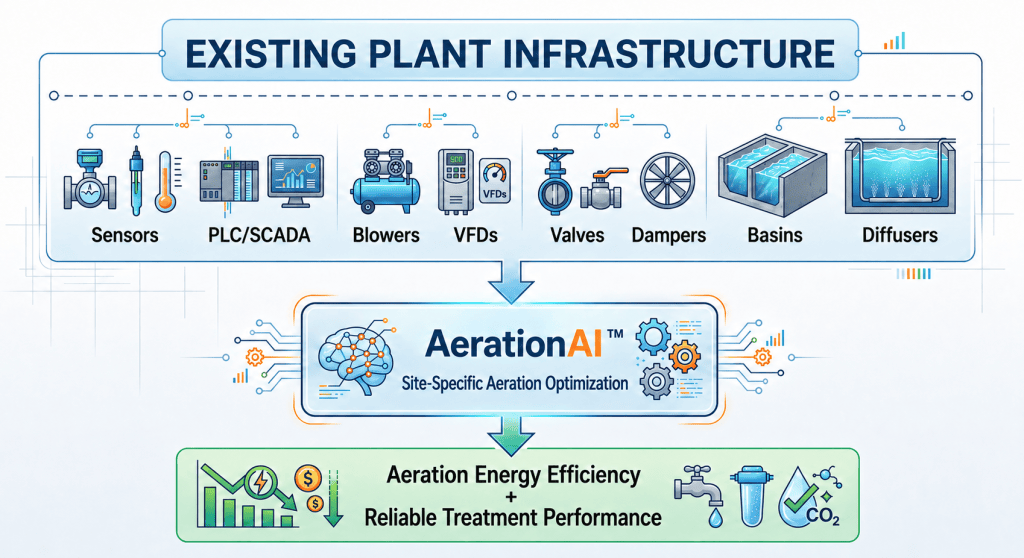
Integration With Existing Plant Systems
AerationAI operates as a supervisory Engineering Intelligence layer above suitable existing plant instrumentation, automation, and aeration equipment.
Depending on deployment stage and facility authorization, AerationAI may provide:
- Aeration recommendations
- Operator guidance
- Operational alerts
- Treatment-performance information
- Energy-performance information
- Governed supervisory actions
- Decision and performance records
Exact inputs, outputs, and interfaces are defined site by site.
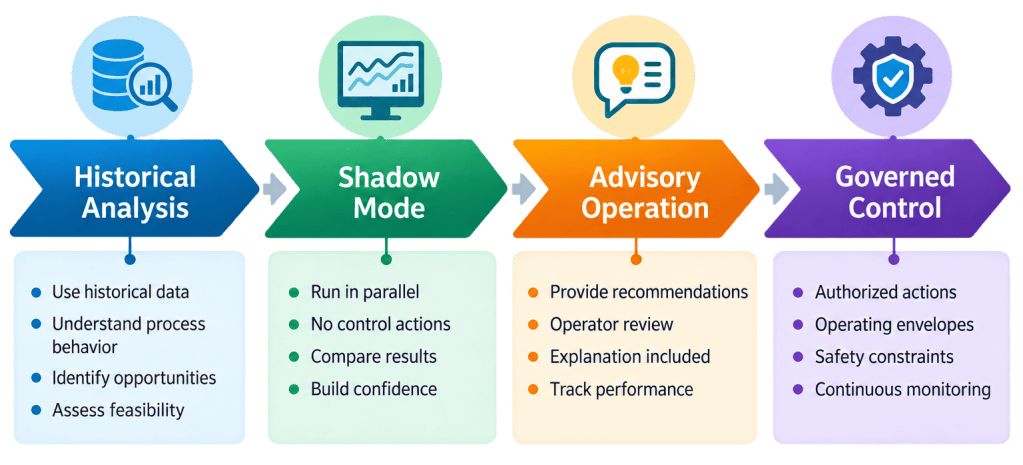
Progressive Governed Deployment
AerationAI does not require a facility to move directly from conventional control to automated optimization.
Operational authority is introduced progressively.
Evaluate first. Demonstrate performance. Validate prospectively. Expand authority only when the facility accepts the evidence.
Historical Analysis: Evaluate Data & Opportunity
Available historical information is used to understand facility operation, establish performance baselines, identify aeration opportunities, evaluate information quality, and determine readiness for prospective evaluation.
No plant-control connection is required.
A facility can therefore evaluate the initial AerationAI opportunity using exported historical information.
Shadow Mode: Validate in Parallel
AerationAI operates alongside the existing plant-control strategy without changing physical plant operation.
Recommendations and system behavior are compared with actual plant conditions and operator experience.
AerationAI has no write authority during this stage.
Advisory Operation: Recommend With Operator Review
Following successful Shadow Mode evaluation and facility approval, validated recommendations are presented to plant personnel for review.
Operators retain responsibility for deciding whether and how recommendations are implemented.
During Advisory Operation, AerationAI recommends and explains. The operator decides and acts.
Governed Control: Authorized Bounded Actions
Only after successful validation and explicit facility approval may AerationAI execute specifically authorized supervisory actions through an approved control interface.
Operational authority remains bounded by site-approved treatment, equipment, operating, cybersecurity, and organizational requirements.
The facility determines the authority AerationAI receives. AerationAI does not determine its own authority.
Progression Between Stages
Progression is based on demonstrated performance and facility readiness—not simply elapsed time.
A facility may remain indefinitely in Historical Analysis, Shadow Mode, or Advisory Operation if that best meets its needs.
Progression is not automatic. Governed Control is not required for a facility to obtain value from AerationAI.
Designed for Secure Industrial Deployment
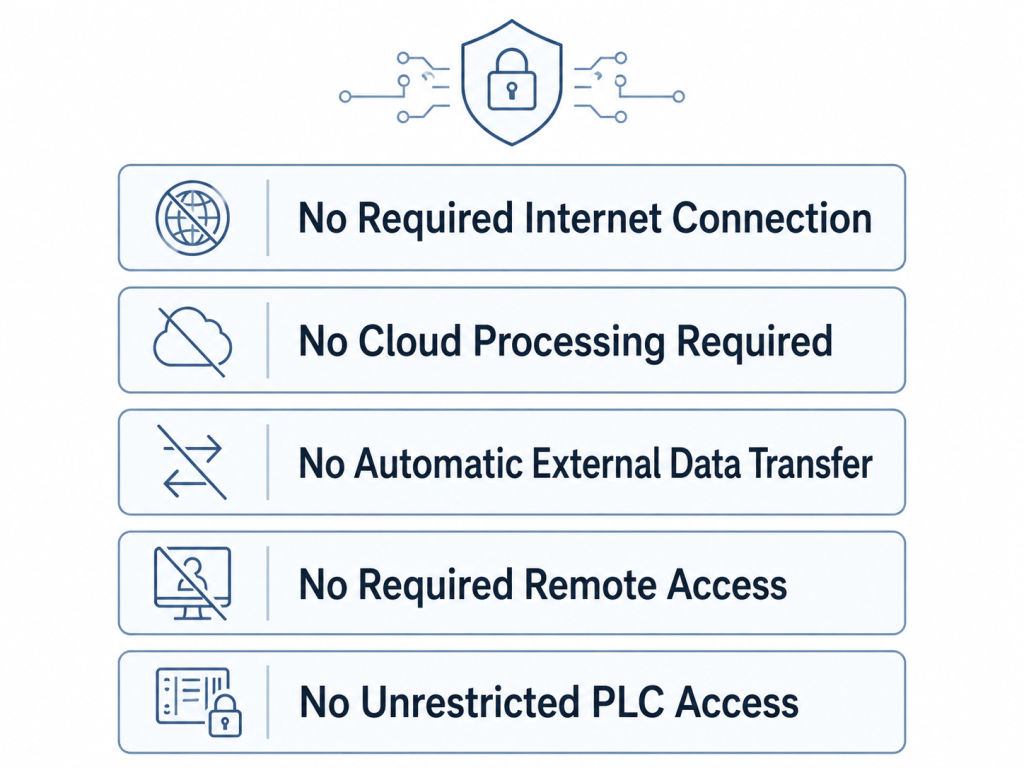
AerationAI is designed for local-first deployment within the facility’s approved computing environment.
Its essential optimization functions can operate locally without requiring plant operating information to be transferred to an external cloud service.
Depending on the approved architecture:
- No required Internet connection
- No cloud processing required
- No automatic external data transfer
- No required remote access
- No unrestricted PLC access
Any external communication pathway, if used, must be separately documented, configured, and authorized according to the facility’s IT/OT cybersecurity requirements.
Control-system access is limited to the minimum level required for the approved deployment stage.
The facility determines what information AerationAI can access and what level of operational authority, if any, it receives.
Existing Plant Control Is Preserved
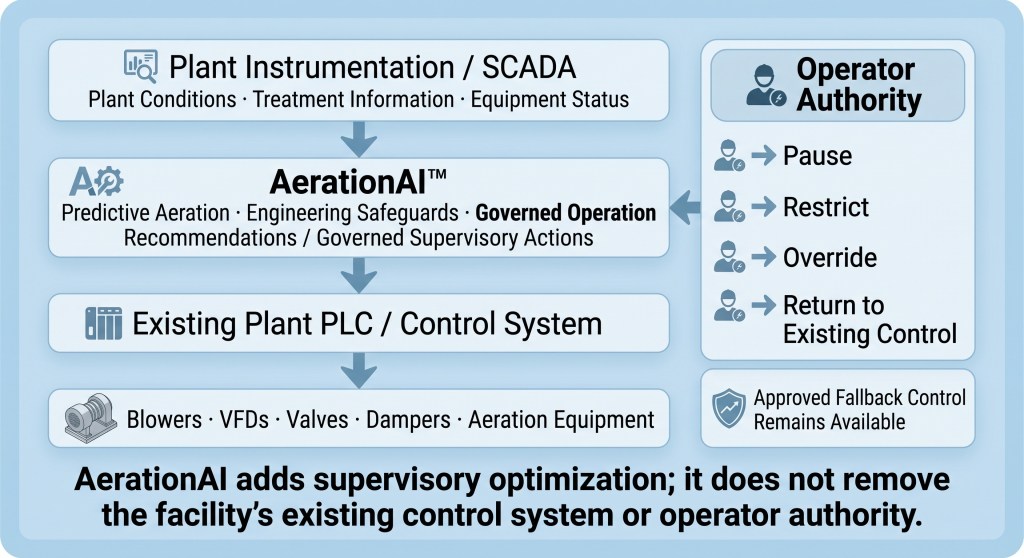
AerationAI operates as a supervisory optimization layer.
It does not require elimination of the facility’s existing PLC-based aeration-control strategy.
Existing plant control, interlocks, alarms, protective functions, and operator authority remain available according to the approved site configuration.
Authorized personnel can:
- Pause AerationAI
- Reject or defer recommendations
- Restrict operational authority
- Override governed actions
- Return to existing plant control
- Apply approved manual or temporary operating restrictions
Existing plant control is preserved. Authorized personnel remain in authority.
Loss or deactivation of AerationAI should not require interruption of biological treatment.
Continuous Performance Evaluation
AerationAI implementation does not end when recommendations or governed actions begin.
Performance continues to be evaluated against actual plant operation using available:
- Energy information
- Aeration information
- Treatment performance
- Equipment performance
- Operational conditions
- Operator interventions
- Decision records
Performance should be evaluated against an agreed facility-specific baseline and relevant operating conditions.
AerationAI performance should be judged using site-specific operating evidence—not generic energy-savings assumptions.
Start With Historical Analysis
A facility does not need to install active control software to determine whether AerationAI may provide value.
The initial assessment can begin with exported historical plant information.
McC AI Group can evaluate:
- Existing Aeration Performance: Current aeration behavior, treatment performance, equipment operation, and operating practices.
- Aeration-Optimization Opportunity: Whether historical operation indicates periods of unnecessary aeration or opportunities for improved operating efficiency.
- Treatment Protection: Whether lower-aeration conditions remain compatible with treatment objectives and available performance information.
- Information Quality: Whether available operational information provides an adequate basis for site-specific evaluation.
- Pilot Readiness: Whether existing instrumentation, information, systems, and connectivity support progression to Shadow Mode.
Evaluate the opportunity first. Connect to the plant only when the facility is ready.
See AerationAI Using Real Plant Operation
AerationAI can be demonstrated using accelerated replay of historical plant operation.
Plant personnel can observe how recommendations change as actual operating conditions change—without AerationAI affecting physical plant operation.
The demonstration can show the relationship among:
- Plant conditions
- Aeration recommendations
- Engineering safeguards
- Treatment response
- Information quality
- Approved operating authority
A representative historical period can be replayed at an accelerated rate, allowing meaningful operating changes to be examined during a focused demonstration.
The purpose is not simply to show a dashboard.
It is to show how AerationAI interprets operating conditions and develops governed aeration guidance using real plant information.
AerationAI™ and AerationAI-SND™
AerationAI and AerationAI-SND share a site-specific, predictive, and governed Engineering Intelligence foundation, but they address different treatment objectives.
AerationAI™
AerationAI provides predictive aeration optimization for a broad range of activated-sludge and water-recycling applications.
Its objective is to provide the aeration required for reliable biological treatment while reducing unnecessary energy use.
AerationAI-SND™
AerationAI-SND extends this foundation to the more demanding low-DO conditions associated with simultaneous nitrification and denitrification.
It applies specialized biological safeguards and governed low-DO operation to support reliable nitrogen removal while reducing unnecessary aeration where plant conditions are suitable.
AerationAI optimizes aeration broadly. AerationAI-SND governs the narrow biological boundary required for low-DO nitrogen removal.
Proprietary Technology
AerationAI incorporates proprietary algorithms and engineering methods protected through published and pending patent applications.
Its value is not based on a single generic AI model.
AerationAI combines site-specific predictive methods, engineering knowledge, information quality, operational safeguards, and governed decision authority within a deployable wastewater aeration application.
Additional implementation methods, site-specific models, response characterization, configuration practices, validation procedures, and deployment methodologies remain proprietary to McC AI Group.
Performance Qualification
Actual energy, treatment, maintenance, and operational benefits are facility-specific and should be established against an agreed operating baseline.
Performance can depend on factors including:
- Process configuration
- Influent characteristics
- Biological condition
- Seasonal operation
- Aeration-system performance
- Equipment condition
- Instrumentation and information quality
- Existing control strategy
- Treatment objectives
- Approved operational authority
McC AI Group does not assume that results from one facility will automatically transfer to another.
Performance claims should be based on documented, facility-specific validation.
Evaluate AerationAI for Your Facility
No two wastewater treatment facilities have identical operating conditions, equipment, information systems, treatment objectives, or control constraints.
AerationAI is therefore evaluated and validated site by site.
Facility and Process Assessment
Review treatment configuration, aeration infrastructure, instrumentation, operating history, equipment, treatment objectives, and existing controls.
Information and Integration Assessment
Review available operational information, plant instrumentation, PLC/SCADA interfaces, historian access, cybersecurity requirements, existing safeguards, and material information gaps.
Historical Opportunity Assessment
Evaluate whether historical operation provides evidence of unnecessary aeration or opportunities for improved aeration efficiency while protecting treatment.
Pilot Validation
Define a site-specific pathway beginning with Historical Analysis and Shadow Mode before progressing, where appropriate, to Advisory Operation or Governed Control.
Technology and Deployment Partnerships
McC AI Group welcomes discussions with:
- Municipal wastewater treatment facilities
- Industrial wastewater facilities
- Consulting engineers
- Control-system integrators
- Equipment manufacturers
- Engineering contractors
- Research organizations
- Qualified technology and commercialization partners
Each engagement is structured around the facility’s treatment objectives, existing infrastructure, available information, engineering constraints, cybersecurity requirements, and approved level of operational authority.
Understand the facility. Validate the opportunity. Protect treatment. Govern the operation.
 McC AI Group, Inc.