

SensorAI
Trusted Operational Information for Engineering Intelligence
Providing Trusted Operational Information for Engineering Intelligence.
SensorAI transforms raw sensor data into trusted operational information through proprietary and patent-pending sensing, virtual sensing, sensor integrity management, and asset monitoring.
By validating, qualifying, reconstructing, and continuously monitoring operational data, SensorAI establishes the reliable information foundation required for engineering analysis, operational decisions, and governed control.
More data does not necessarily create more reliable information. In harsh physical environments, sensors can foul, drift, degrade, lose responsiveness, or continue transmitting plausible values even when they no longer reflect actual conditions. When unreliable data are accepted without qualification, they can create false confidence and lead to flawed alarms, recommendations, or automated actions.
SensorAI serves as the foundational information-integrity layer for Engineering Intelligence applications, including AerationAI and AerationAI-SND.
As a core module within McC AI Group’s proprietary, patent-pending Engineering Intelligence Platform, SensorAI helps organizations determine not only what their instruments are reporting, but also whether the available information is sufficiently reliable, timely, and representative for its intended engineering or operational use.
SensorAI complements existing instrumentation, automation, historian, and asset-management systems. It strengthens the value of available information while preserving source visibility, engineering review, human oversight, and organizational control.
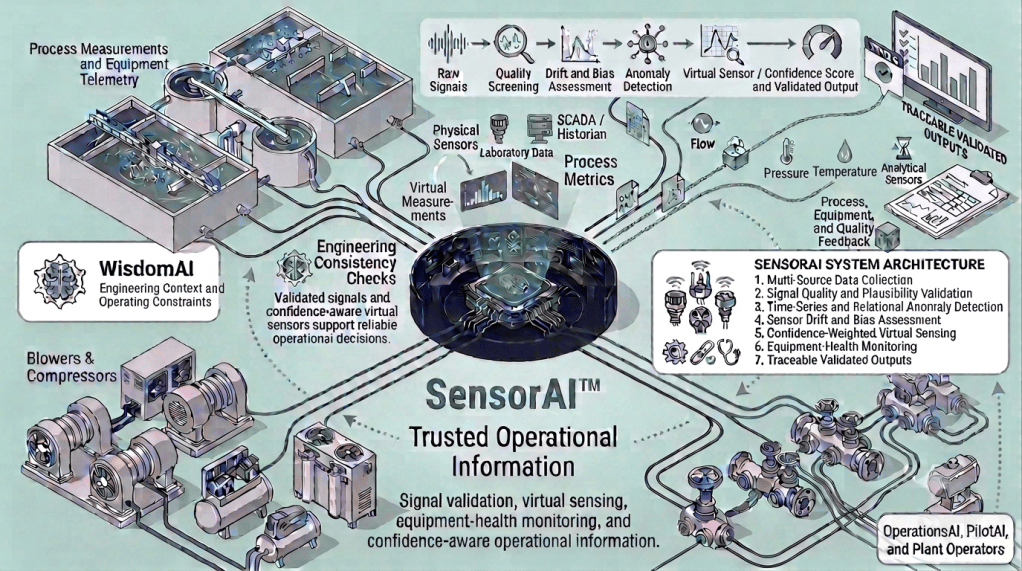
Trusted sensing. Reliable information. Continuous operational awareness.
1. The Operational-Information Challenge
Critical infrastructure increasingly depends on sensors, analyzers, connected equipment, and automated systems. Yet collecting and displaying more data does not automatically create trustworthy operational information.
Sensor Degradation
Sensors can foul, drift, wear out, lose responsiveness, or be affected by calibration errors, environmental conditions, aging, or process interference.
A degraded sensor may not fail visibly. It may continue to transmit a stable and apparently reasonable value even when the measurement no longer reflects the actual process or asset condition.
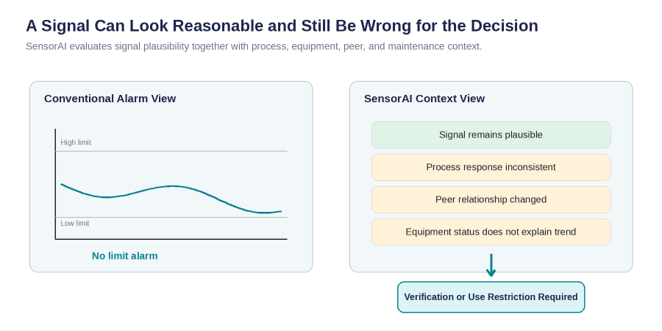
SensorAI evaluates whether a measurement is reliable and appropriate for its intended engineering use—not simply whether the displayed value appears reasonable.
Missing or Unavailable Measurements
Important variables may be difficult, costly, or impractical to measure continuously.
Physical measurements may also become unavailable during cleaning, calibration, maintenance, communication loss, instrument failure, analyzer downtime, or sampling-system interruption.
These gaps can reduce operational visibility precisely when reliable information is most important.
Local and Fragmented Measurements
A sensor represents a particular location, time, and measurement context.
Spatial variability, imperfect mixing, changing operating modes, hydraulic or transport delays, and disconnected information systems can limit the extent to which a single measurement should be interpreted.
A locally valid signal may not adequately represent an entire basin, process train, asset group, or distributed facility.
False Confidence in Available Data
A precise number displayed on a dashboard may still be degraded, delayed, incomplete, unrepresentative, inconsistent with related information, or unsuitable for the intended decision.
Decisions based on unreliable information can contribute to unnecessary alarms, ineffective responses, equipment stress, wasted energy, process instability, or delayed intervention.
The central challenge is not simply obtaining more data. It is determining which information can be trusted, for what purpose, and with what level of confidence.
2. From Raw Sensor Data to Trusted Operational Information
Raw sensor data indicates what an instrument reported.
Trusted operational information is information an organization can reasonably rely on when evaluating a process, asset, facility, or proposed action.
Beyond Data Collection
Traditional monitoring systems collect, display, transmit, and archive measurements.
SensorAI adds an information-reliability layer that evaluates whether measurements are available, timely, plausible, consistent, representative, and suitable for their intended use.
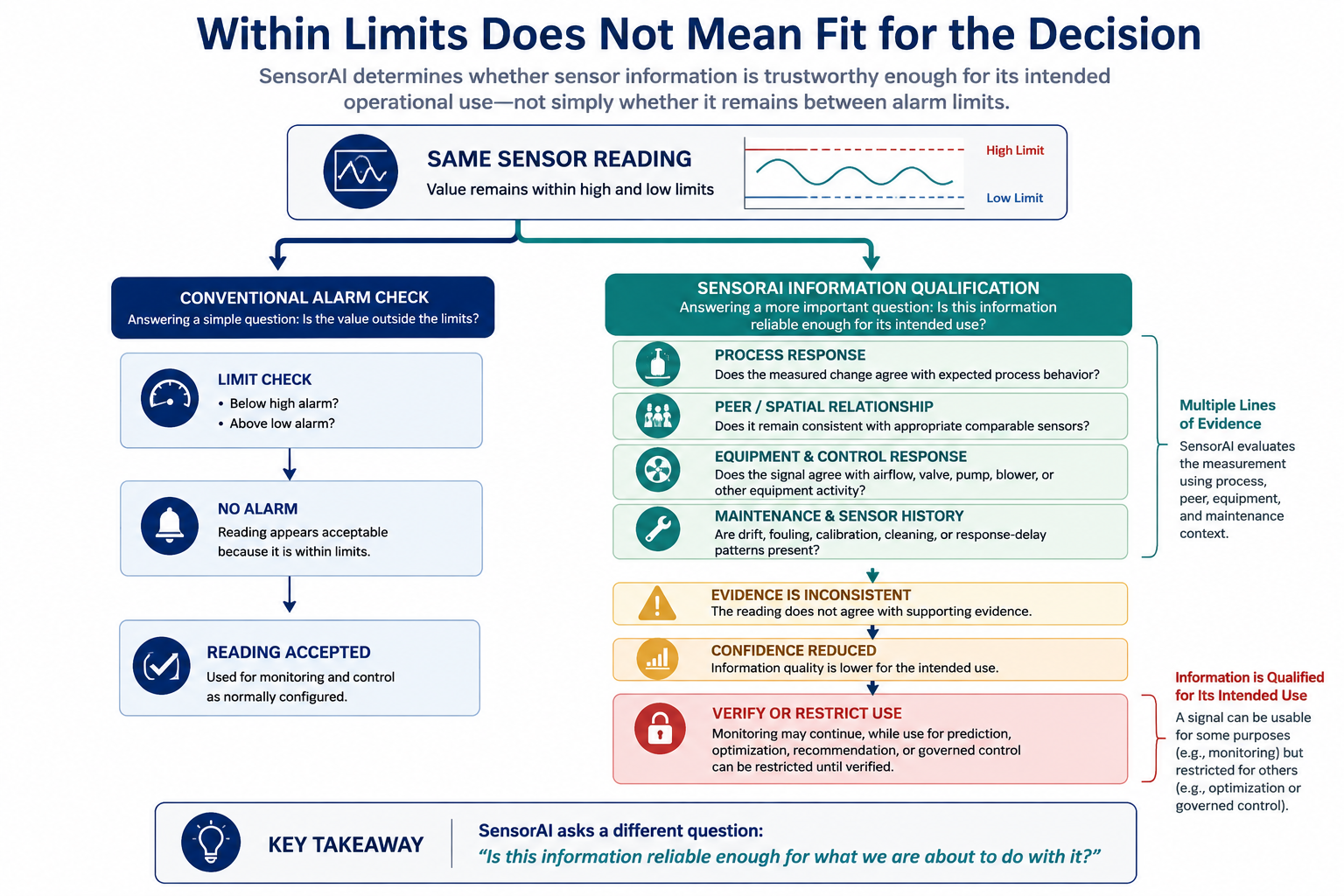
Passing a range or plausibility check does not establish that a measurement is reliable, representative, or suitable for a particular engineering decision.
From Isolated Signals to Operational Context
SensorAI evaluates measurements together with related information, including:
- Process conditions
- Equipment status
- Operating history
- Physical relationships
- Redundant or related measurements
- Current operating modes
- Known maintenance conditions
- Facility-specific behavior
This context helps distinguish actual process change from sensor error, communication problems, or instrument degradation.
From Binary Validity to Qualified Use
Operational information does not need to be treated as either completely valid or completely failed.
Depending on confidence and operational consequence, information may be accepted, qualified, down-weighted, restricted, reconstructed, substituted, referred for inspection, or excluded from higher-consequence operational use.
This allows information to be used according to its demonstrated reliability and intended purpose rather than under an all-or-nothing assumption.
SensorAI determines not only whether information is available, but how confidently and appropriately it may be used.
3. What SensorAI Is
SensorAI is the trusted-information foundation of McC AI Group’s Engineering Intelligence Platform.
It evaluates sensor measurements, analyzer outputs, equipment signals, operational records, and related facility information to determine whether available information is sufficiently reliable, timely, representative, and appropriate for its intended engineering or operational use.
SensorAI combines physical sensing, virtual sensing, sensor integrity evaluation, information qualification, operational context, and asset monitoring while preserving the distinction among measured, reconstructed, inferred, qualified, and unavailable information.
Its purpose is not simply to generate more data. Its purpose is to establish the trusted operational information required for engineering knowledge, evidence-based reasoning, operational intelligence, and governed automation.
4. What SensorAI Does
SensorAI evaluates real-time and historical information from sensors, analyzers, connected equipment, automation systems, historians, and facility databases.
It applies facility-specific methods to:
- Validate measurement quality and availability.
- Detect fouling, drift, latency, noise, flatlining, and inconsistency.
- Compare signals with related process and equipment behavior.
- Estimate unavailable or unreliable variables using validated relationships.
- Assign confidence or suitability for specific operational uses.
- Monitor asset and instrumentation condition over time.
- Generate alerts, qualified information, and maintenance indications.
- Provide trusted operational information to WisdomAI, OperationsAI, PilotAI, and application-level systems.
SensorAI does not simply replace questionable measurements with estimated values. It preserves source identity, confidence, and usage restrictions, enabling personnel and downstream systems to distinguish measured, reconstructed, inferred, and unavailable information.
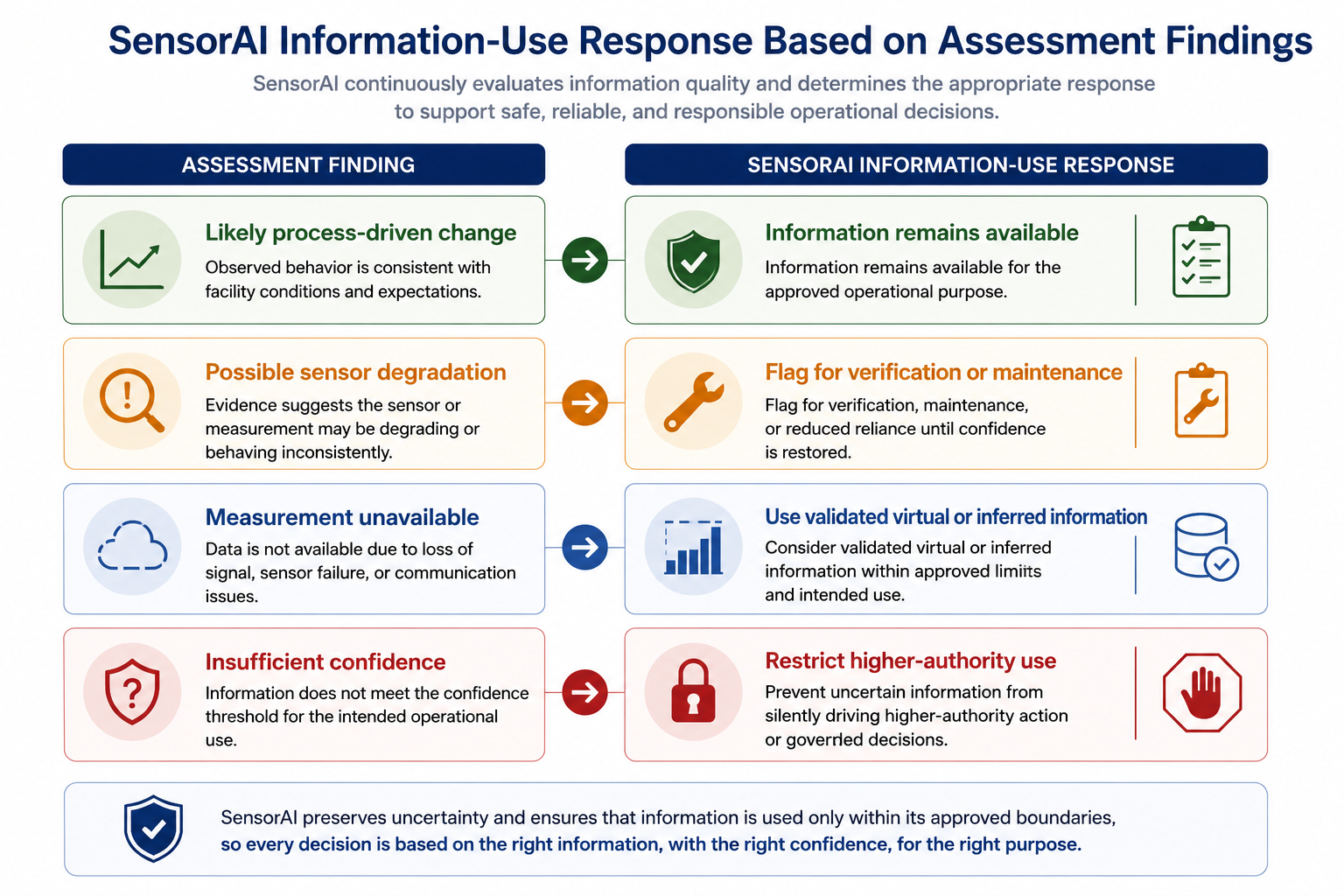
SensorAI converts information-integrity assessment into an appropriate information-use response rather than relying on a simple valid/invalid classification.
5. Core SensorAI Capabilities
Advanced Sensing
SensorAI integrates appropriate physical sensors, analyzers, connected equipment, edge devices, control systems, and facility information sources to improve real-time operational awareness.
Available information may include existing process instrumentation, online analyzers, equipment-status signals, edge-connected devices, distributed sensing, environmental measurements, asset-condition information, and historian and database records.
The objective is not to add instrumentation indiscriminately, but to use the most relevant available information for the intended engineering purpose.
Virtual Sensing
SensorAI can estimate difficult, unavailable, or temporarily unreliable variables using validated related measurements, physical relationships, process behavior, and facility-specific models.
Virtual sensing can support temporary measurement substitution, redundant process awareness, restricted advisory operation, cross-checking of physical sensors, detection of inconsistent measurements, and estimation of difficult-to-measure conditions.
Virtual sensing does not automatically receive the same operational use as a validated physical measurement. Its use depends on model confidence, operating conditions, validation history, intended purpose, and approved application boundaries.
Sensor Integrity
SensorAI evaluates whether a measurement remains reliable over time.
It can identify indications of fouling, calibration drift, abnormal noise, flatlining, delayed response, communication interruption, implausible rate of change, cross-sensor inconsistency, loss of correlation with equipment response, gradual degradation, and contextually inappropriate use.
Sensor-integrity information can be used to reduce confidence, restrict operational use, initiate inspection, or trigger cleaning, calibration, or maintenance.
Asset Monitoring
SensorAI connects sensor information to equipment and infrastructure behavior.
It can help identify repeated abnormalities, deteriorating performance, unusual operating patterns, changing equipment response, loss of efficiency, inspection needs, maintenance priorities, and emerging asset risk.
Asset monitoring extends SensorAI beyond individual instruments by evaluating how sensors, equipment, and process behavior interact.
6. Sensor Confidence and Information Qualification
SensorAI does not evaluate a measurement only by examining the signal itself.
It can evaluate multiple lines of evidence to determine whether information is reliable and appropriate for its intended use.
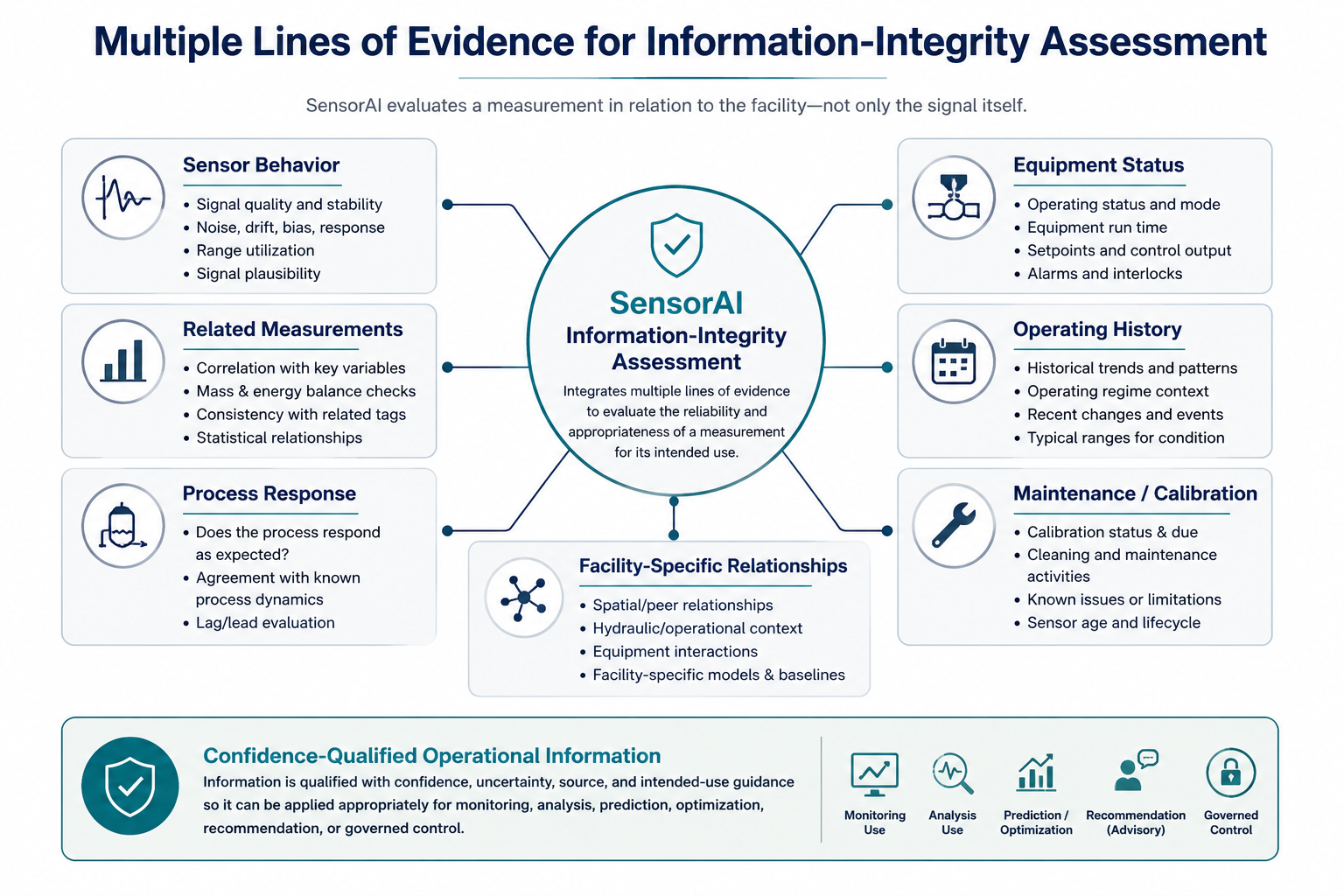
SensorAI evaluates sensor behavior together with related measurements, process response, equipment status, operating history, maintenance and calibration information, and facility-specific relationships.
SensorAI may assign confidence or suitability based on factors including:
- Signal availability
- Noise and variance
- Flatlining
- Rate-of-change behavior
- Historical reliability
- Calibration status
- Maintenance condition
- Agreement with related measurements
- Consistency with equipment response
- Operating-mode compatibility
- Temporal alignment
- Physical plausibility
Confidence is application-specific.
A measurement may be suitable for general monitoring but unsuitable for predictive modeling, automated recommendations, alarm generation, safety-critical decisions, or governed operational actions.
SensorAI therefore qualifies information according to both reliability and intended use.
This distinction is important because the consequences of using uncertain information depend not only on measurement quality but also on what the information is used to support.
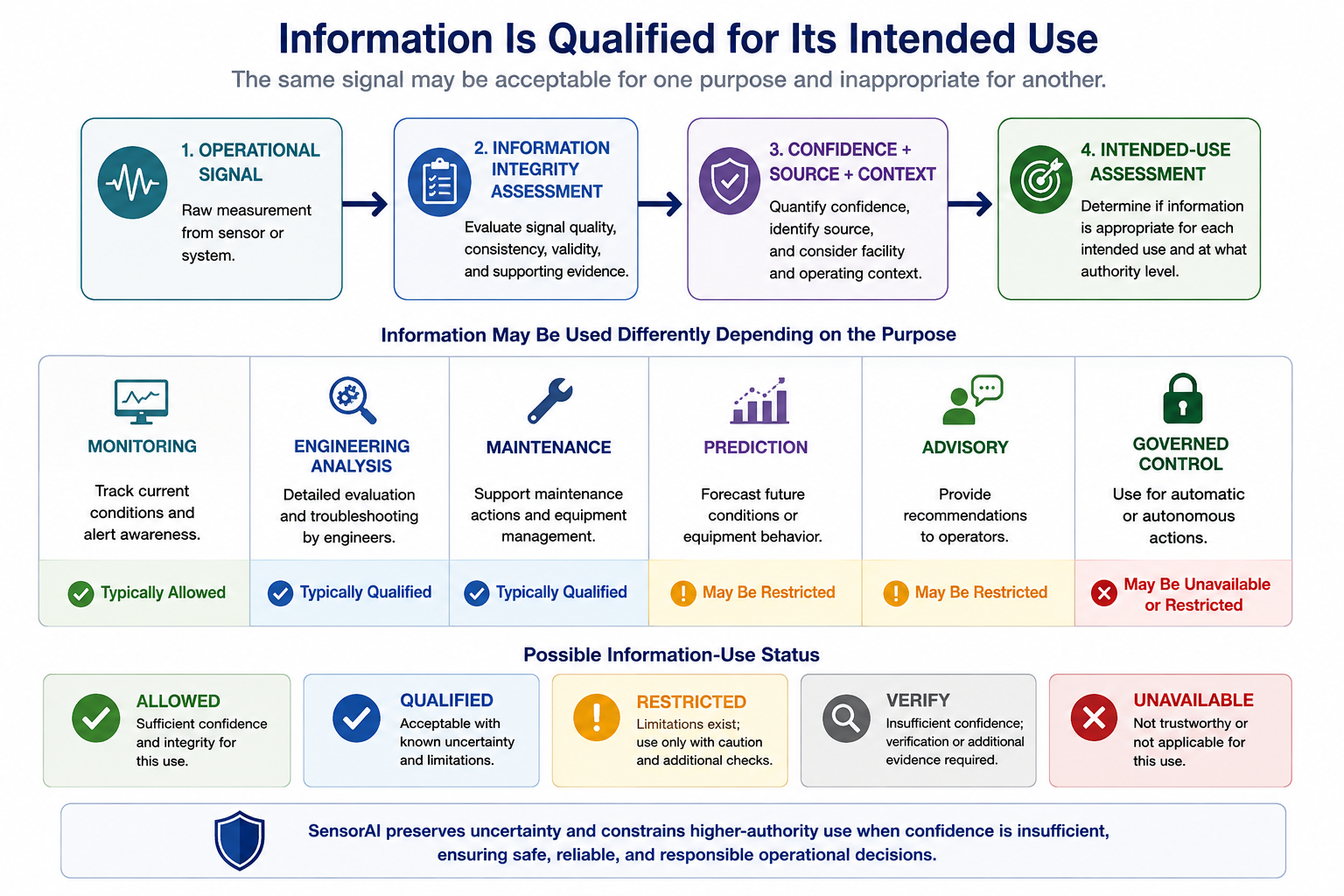
The same information may be appropriate for monitoring or analysis, but may require greater confidence, validation, or restrictions before it is used for prediction, recommendation, or governed operational action.
7. Virtual Sensing and Information Reconstruction
When a physical measurement becomes unavailable or unreliable, SensorAI may use validated facility-specific relationships to estimate the missing or degraded condition.
Depending on the application, methods may draw on physical relationships, statistical relationships, validated corresponding measurements, process behavior, equipment response, historical operating relationships, or combinations of engineering and data-driven methods.
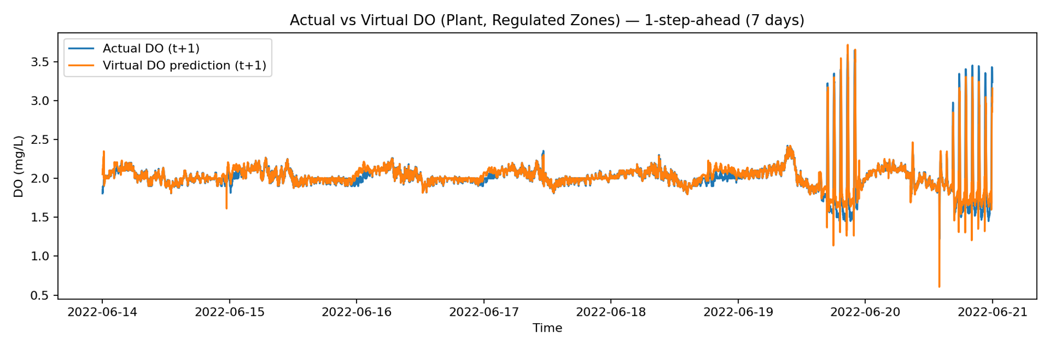
Virtual sensing can preserve qualified operational awareness when a physical measurement becomes unavailable or unreliable, while maintaining visibility of information source, confidence, uncertainty, and applicable use restrictions.
Reconstructed information remains clearly identified as inferred or virtual.
Its operational use may be limited according to confidence, validation history, operating conditions, application requirements, and approved boundaries.
Possible uses include operator awareness, advisory analysis, temporary substitution, maintenance support, model continuity, and other specifically approved operational uses.
Virtual information supplements physical sensing; it does not conceal uncertainty or erase the distinction between measured and estimated values.
8. How SensorAI Supports Engineering Intelligence Applications
SensorAI capabilities can be deployed independently or incorporated into broader Engineering Intelligence applications according to facility information requirements, instrumentation, operating environment, and risk profile.
AerationAI: SensorAI can validate and qualify dissolved oxygen, airflow, influent flow, blower power, equipment status, and other information used to compute and adjust plant- and basin-specific airflow requirements.
AerationAI-SND: SensorAI can support low-DO operation through sensor-confidence evaluation, nutrient-signal qualification, virtual biological risk indicators, and detection of unreliable or delayed measurements.
WisdomAI: SensorAI supplies trusted operational information that WisdomAI can interpret using site-specific knowledge, engineering practices, standards, and operating history.
OperationsAI: SensorAI provides confidence-qualified operational information that OperationsAI uses when evaluating current and anticipated facility conditions, predictive relationships, operating objectives, equipment behavior, and engineering constraints.
PilotAI: SensorAI provides confidence-qualified operational information that PilotAI uses when determining whether an engineering recommendation may be authorized, modified, constrained, deferred, blocked, escalated, or executed.
SensorAI strengthens the information foundation of these and other Engineering Intelligence applications. Its capabilities are selected and configured according to the operational information, instrumentation, and decision requirements of each implementation.
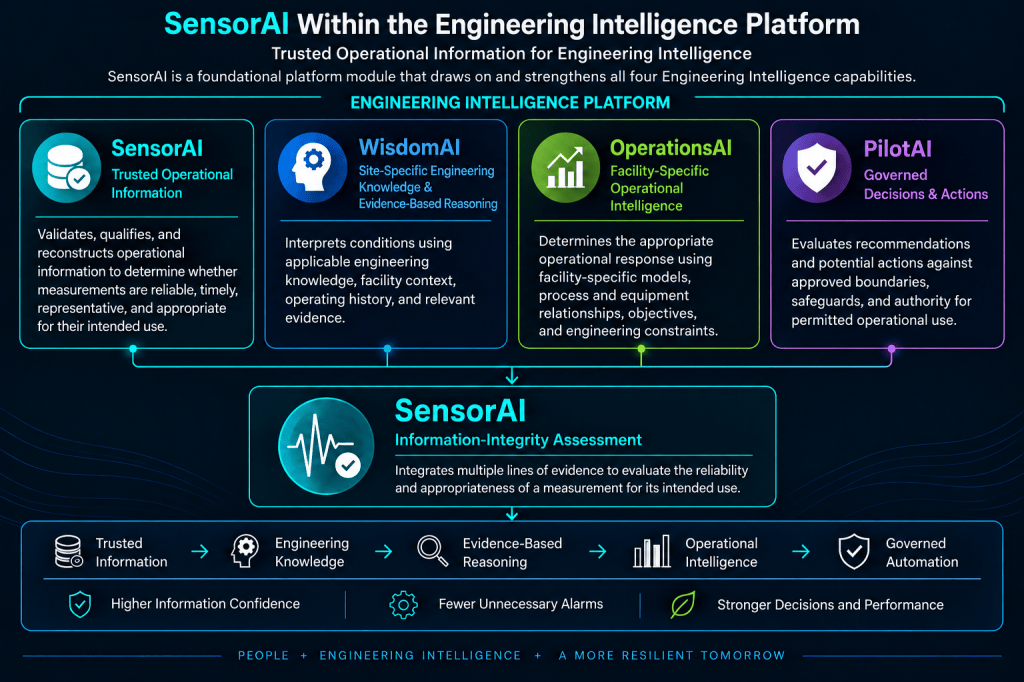
9. SensorAI Within the Engineering Intelligence Platform
SensorAI is the information foundation of McC AI Group’s Engineering Intelligence Platform.
It converts raw operational data into trusted operational information that supports engineering knowledge, evidence-based reasoning, operational intelligence, and governed decisions and actions.
SensorAI™ — Trusted Operational Information
Determines whether measurements and operational information are sufficiently reliable, timely, representative, and appropriate for their intended engineering or operational use.
WisdomAI™ — Site-Specific Engineering Knowledge & Evidence-Based Reasoning
Applies site-specific engineering knowledge, approved practices, operating history, applicable requirements, and relevant evidence to interpret conditions, evaluate operational significance, and support evidence-based reasoning.
OperationsAI™ — Facility-Specific Operational Intelligence
Uses trusted operational information, facility-specific operational models and methods, operating objectives, process and equipment relationships, and engineering constraints to determine appropriate operational responses under current and anticipated conditions.
PilotAI™ — Governed Decisions & Actions
Evaluates whether a recommendation or action may be modified, constrained, held, blocked, escalated, authorized, or executed within approved operating boundaries and organizational authority.
Engineering Intelligence Architecture
Trusted Information → Engineering Knowledge → Evidence-Based Reasoning → Operational Intelligence → Governed Automation
Runtime Pathway
SensorAI → WisdomAI → OperationsAI → PilotAI
10. Integration With Existing Systems
SensorAI is designed to complement suitable existing instrumentation and information infrastructure rather than require wholesale replacement.
It may integrate with sensors and analyzers, PLC and SCADA systems, distributed control systems, plant historians, asset-management systems, maintenance-management systems, laboratory databases, edge devices, equipment controllers, and enterprise information systems.
When suitable instrumentation, information quality, connectivity, and system interfaces are available, implementation can normally proceed without unnecessary replacement of existing systems or major physical modifications.
Integration scope depends on available information, communication architecture, cybersecurity requirements, operational priorities, intended applications, and approved implementation boundaries.
11. SensorAI Outputs
Depending on the application and facility configuration, SensorAI outputs may include:
- Validated measurements
- Confidence-qualified information
- Sensor-integrity alerts
- Drift or fouling indications
- Virtual or reconstructed values
- Data-availability status
- Process or equipment anomaly indications
- Maintenance recommendations
- Asset-condition indicators
- Qualified inputs for WisdomAI and OperationsAI
- Governance-relevant information for PilotAI
- Audit and decision-support records
Outputs retain information about source, confidence, qualification, and applicable restrictions where appropriate.
12. Advantages and Benefits of SensorAI
SensorAI improves the reliability and usefulness of operational information by combining sensor-integrity assessment, confidence qualification, virtual sensing, facility-specific context, and asset monitoring. Its purpose is not simply to identify bad data, but to determine whether information is sufficiently reliable, representative, and appropriate for its intended engineering or operational use.
Reduce Operational Blind Spots
SensorAI helps personnel determine whether measurements are reliable, unavailable, degraded, delayed, or insufficiently representative, improving awareness of the actual information available for operational decisions.
Reduce Faulty Alarms and Inappropriate Responses
SensorAI can identify unreliable or inconsistent information before it contributes to unnecessary alarms, ineffective operator responses, or inappropriate automated actions.
Improve Maintenance Prioritization
Sensor-integrity and asset-condition information can help personnel identify where inspection, cleaning, calibration, repair, replacement, or further engineering evaluation should be prioritized.
Improve Operational Resilience
Confidence-qualified virtual information and source-aware monitoring can preserve appropriate operational visibility during maintenance, analyzer downtime, communication interruption, or instrument failure.
Increase Confidence in Advanced Automation
Predictive, optimization, and automated systems depend on reliable inputs. SensorAI helps prevent degraded or inappropriate measurements from silently influencing recommendations, operational intelligence, or governed actions.
Protect and Strengthen Existing Investments
SensorAI increases the usefulness of suitable existing instrumentation, automation, historian, and asset-management systems while helping avoid unnecessary wholesale replacement.
Improve Decision Confidence and Consistency
SensorAI provides a systematic basis for determining whether operational information is sufficiently reliable and appropriate for its intended engineering use, supporting more consistent and technically defensible decisions.
Performance and operational benefits are facility-specific and should be established through documented validation.
Visual treatment: Use the same two-column card format as AerationAI and AerationAI-SND, with the seventh card spanning the full width on desktop.
13. Applications Supported by SensorAI
SensorAI can support Engineering Intelligence applications across critical infrastructure and regulated facilities.
Applications may include aeration optimization, low-DO nutrient removal, water and wastewater treatment, pump and blower monitoring, energy-system optimization, equipment-condition assessment, environmental compliance monitoring, distributed infrastructure supervision, industrial process control, and maintenance and reliability programs.
Within AerationAI and AerationAI-SND, SensorAI evaluates whether process, equipment, DO, airflow, nutrient, and related measurements are sufficiently reliable for prediction, recommendation, governance, or control.
Better decisions begin with information that is not only available, but trusted, qualified, and appropriate for its intended use.
14. Performance Validation Before Expanding Authority
SensorAI is introduced progressively so that operational use of information expands only after confidence, performance, readiness, and facility approval have been demonstrated.
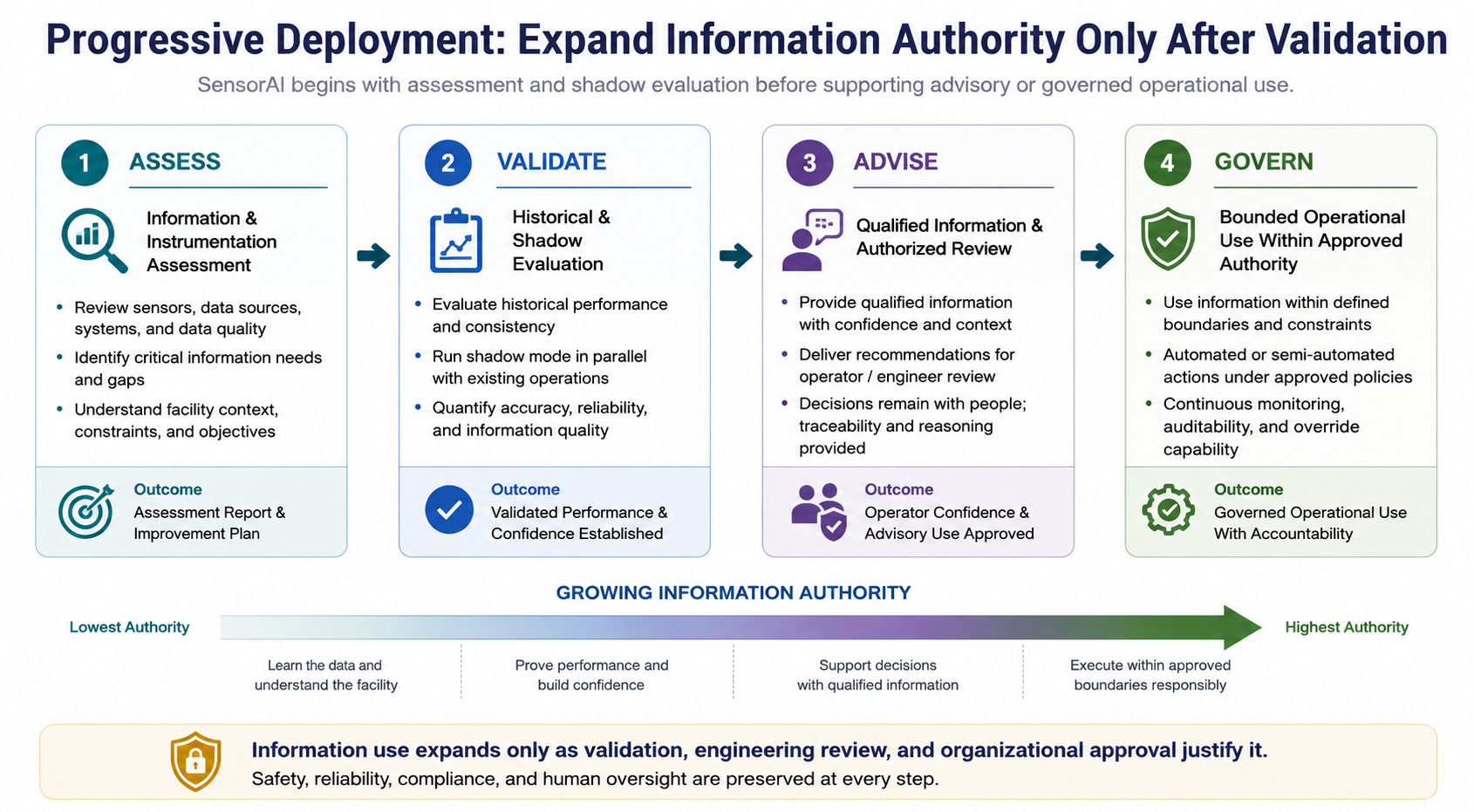
SensorAI progresses from historical evaluation through prospective validation and advisory use to specifically authorized bounded operational use. Progression depends on demonstrated performance and facility readiness—not simply elapsed time.
a. Historical Analysis — Evaluate Data & Opportunity
Review instrumentation, historical information, sensor behavior, data quality, operating context, failure modes, and information requirements. Develop and evaluate facility-specific confidence, integrity, and virtual-sensing methods.
b. Shadow Mode — Validate in Parallel
Evaluate measurements, information confidence, sensor-integrity conditions, and virtual-sensor outputs alongside existing operations without affecting existing plant control.
c. Advisory Operation — Recommend With Operator Review
Provide qualified information, sensor-integrity alerts, confidence status, and maintenance or verification recommendations to authorized personnel and downstream applications.
d. Governed Control — Authorized Bounded Actions
Where specifically approved, allow trusted and confidence-qualified information to support bounded operational decisions or supervisory actions within defined safeguards, information requirements, cybersecurity controls, and organizational authority.
Operational use of information expands only as validation, confidence, readiness, and organizational approval justify it.
15. Proprietary Technology and Intellectual Property
SensorAI incorporates proprietary and patent-pending technologies for evaluating, qualifying, and managing the reliability of operational information used in Engineering Intelligence applications.
SensorAI is designed to determine whether sensor measurements and other operational information are sufficiently reliable, representative, timely, and appropriate for their intended engineering use.
Its proprietary technical value extends beyond conventional sensor alarms, data-quality checks, or individual fault-detection methods. SensorAI integrates information reliability, operational context, engineering relationships, uncertainty, and intended use to transform operational data into trusted information suitable for engineering analysis, operational intelligence, and governed decisions.
Additional algorithms, information validation methods, facility-specific relationships, virtual sensing methods, configuration practices, validation procedures, and implementation methodologies remain proprietary.
16. SensorAI Technology Evaluation
An initial SensorAI evaluation examines the operational information required by the facility, the reliability of existing instrumentation and information sources, and where improved information confidence could strengthen engineering decisions and operational performance.
Evaluation may consider:
- Instrumentation and Information — Available sensors, analyzers, equipment signals, historians, databases, maintenance information, and other operational information.
- Information Reliability — Known or suspected measurement problems, missing information, inconsistent signals, calibration and maintenance concerns, and other information-quality risks.
- Operational Significance — Decisions, controls, analyses, or workflows that depend on reliable operational information.
- Existing Infrastructure — Instrumentation, PLC/SCADA systems, historians, communication systems, and other available integration pathways.
- Priority Applications — Areas where improved information confidence could strengthen monitoring, troubleshooting, optimization, maintenance, or governed operational decisions.
17. Performance Qualification and Implementation Readiness
SensorAI performance should be established using actual facility information and prospective evaluation rather than assumptions based solely on sensor specifications, generic models, or performance at other facilities.
Qualification may consider measurement reliability, sensor-integrity behavior, information confidence, virtual-sensor performance, operational context, integration requirements, and validation across representative operating conditions.
Implementation readiness is evaluated through four areas.
a. Instrumentation and Information Assessment
Review available sensors, analyzers, equipment signals, historians, databases, communication systems, maintenance records, and operational information requirements.
b. Sensor Integrity and Operational Context Assessment
Evaluate historical behavior, fouling, drift, calibration patterns, missing information, latency, inconsistency, failure modes, operating conditions, and relationships with relevant process and equipment behavior.
c. Information Validation and Integration Assessment
Evaluate the information-validation requirements of the intended application, opportunities to supplement unavailable or unreliable information where technically appropriate, and interfaces with existing instrumentation, historians, PLC/SCADA systems, asset-management platforms, and downstream Engineering Intelligence applications.
d. Pilot Validation
Establish a facility-specific pathway through Historical Analysis and Shadow Mode, followed where appropriate by Advisory Operation or Governed Control.
SensorAI should not assume that sensor behavior, information relationships, or validation performance demonstrated at one facility will automatically transfer to another.
Performance claims should be based on documented, facility-specific validation.
VALIDATE the Information → QUALIFY the Uncertainty → STRENGTHEN the Decision
18. Technology and Deployment Partnerships
SensorAI can be evaluated and deployed through collaboration with facility operators, engineering organizations, technology providers, and qualified implementation partners.
Potential partners and users include:
- Municipal wastewater treatment facilities
- Industrial wastewater facilities
- Consulting engineers
- Control-system integrators
- Equipment manufacturers
- Engineering contractors
- Research organizations
- Qualified technology and commercialization partners
Each engagement is structured around the facility’s instrumentation, operational-information requirements, existing infrastructure, engineering context, cybersecurity requirements, intended applications, and approved level of operational authority.
19. Explore SensorAI for Your Facility
Organizations interested in SensorAI can begin with a focused evaluation of existing instrumentation, operational information, sensor reliability, information gaps, intended applications, integration requirements, and the decisions that depend on trusted information.
The evaluation can identify where improved information confidence, sensor integrity monitoring, virtual sensing, or asset monitoring could strengthen engineering analysis, operational decisions, maintenance, and governed applications.
Implementation can then proceed progressively through Historical Analysis, Shadow Mode, Advisory Operation, and, where validated and specifically authorized, Governed Control.
Understand the information. Validate its reliability. Qualify uncertainty. Strengthen every decision that follows.
 McC AI Group, Inc.