

AerationAI™
Standalone, Site-Specific Aeration-Optimization Software
Predictive Aeration Optimization for Reliable Treatment and Lower Energy Use
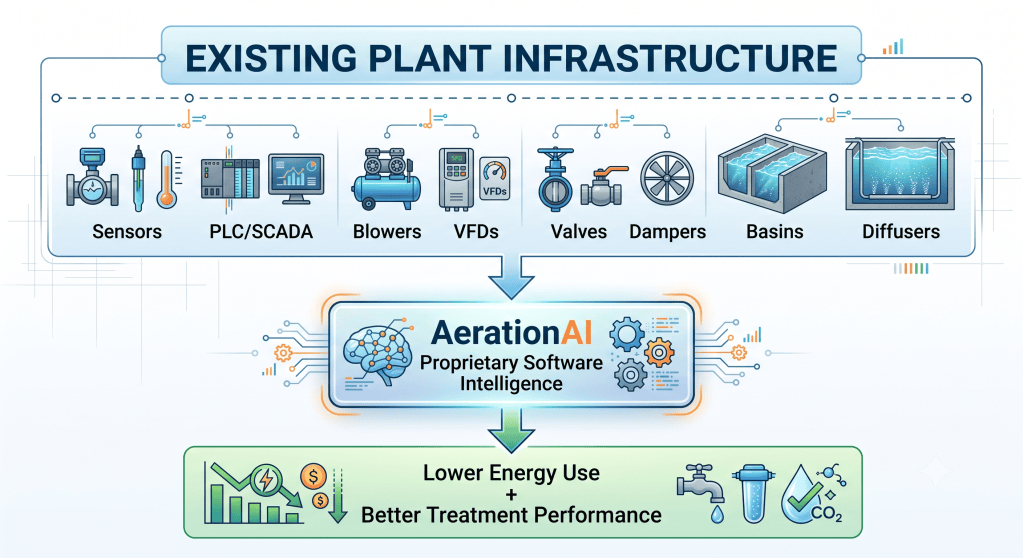
AerationAI is a standalone wastewater aeration-optimization software application that works through a facility’s existing plant data, PLC/SCADA systems, blowers, variable-frequency drives, valves, and aeration infrastructure.
AerationAI combines site-specific predictive tools, trusted operational information, dynamic airflow-to-DO response modeling, engineering constraints, and governed control to determine how much airflow is supportable as plant conditions change.
Rather than simply reacting to a fixed dissolved-oxygen setpoint, AerationAI predicts baseline aeration requirements, evaluates the direction and dynamics of process response, and adjusts airflow within plant-specific treatment, equipment, information-confidence, and operating boundaries.
The objective is not simply to reduce airflow. It is to provide the airflow needed for reliable biological treatment—no more and no less—as operating conditions change.
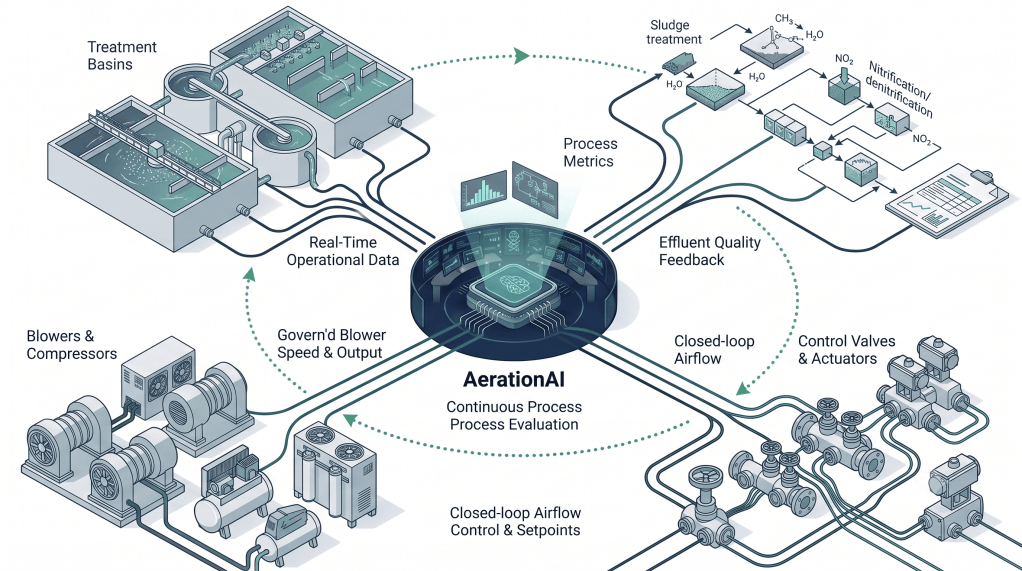
The Limitation of Fixed DO Setpoints
Dissolved oxygen remains one of the most important measurements for biological wastewater treatment. However, conventional aeration control commonly relies on DO feedback after a process change has already begun affecting the basin.
Changes in organic and ammonia loading, hydraulic conditions, biological activity, temperature, and process operation can alter oxygen demand before the resulting effect becomes fully visible at the DO probe.
The measured DO response may also be delayed by:
- basin hydraulics and mixing;
- oxygen-transfer dynamics;
- biological response;
- probe response time;
- transmitter filtering;
- PLC or SCADA signal processing.
A controller that reacts only after DO has moved substantially may therefore respond later than desirable. Conversely, a controller that reacts too frequently to small DO changes may chase measurement noise or repeatedly change airflow before the effect of the previous adjustment has had time to appear.
AerationAI addresses both problems by combining predictive airflow estimation with response-aware DO feedback.
Predict the aeration requirement. Observe the process trajectory. Allow the previous action time to work. Correct only when the evidence supports another adjustment.
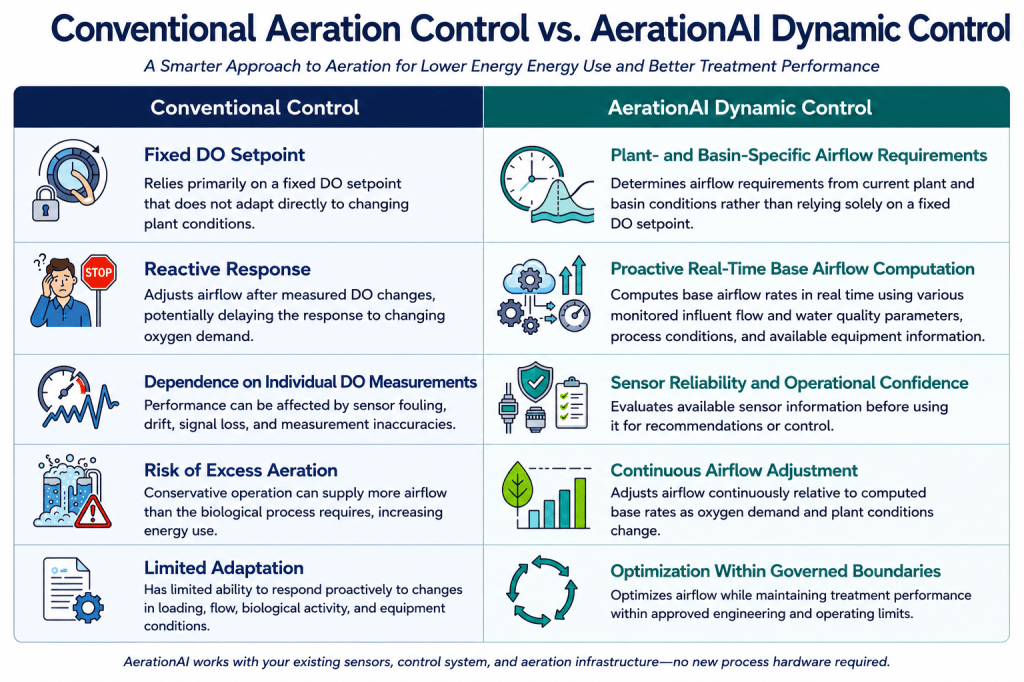
What AerationAI Does
AerationAI develops a plant- and basin-specific representation of aeration demand from historical operating data, treatment performance, equipment characteristics, and site operating constraints.
During operation, AerationAI combines the resulting predictive model with available current plant information to determine the supportable airflow for each controlled basin or aeration zone.
The system evaluates not only the current DO value, but also:
- the direction and persistence of the DO trend;
- recent airflow changes;
- the expected DO response to those changes;
- influent-flow behavior;
- basin and equipment status;
- sensor reliability;
- treatment objectives;
- operating constraints; and
- previous control actions.
This allows AerationAI to distinguish between a condition that requires additional airflow and one in which the process is simply still responding to a previous adjustment.
How AerationAI Works
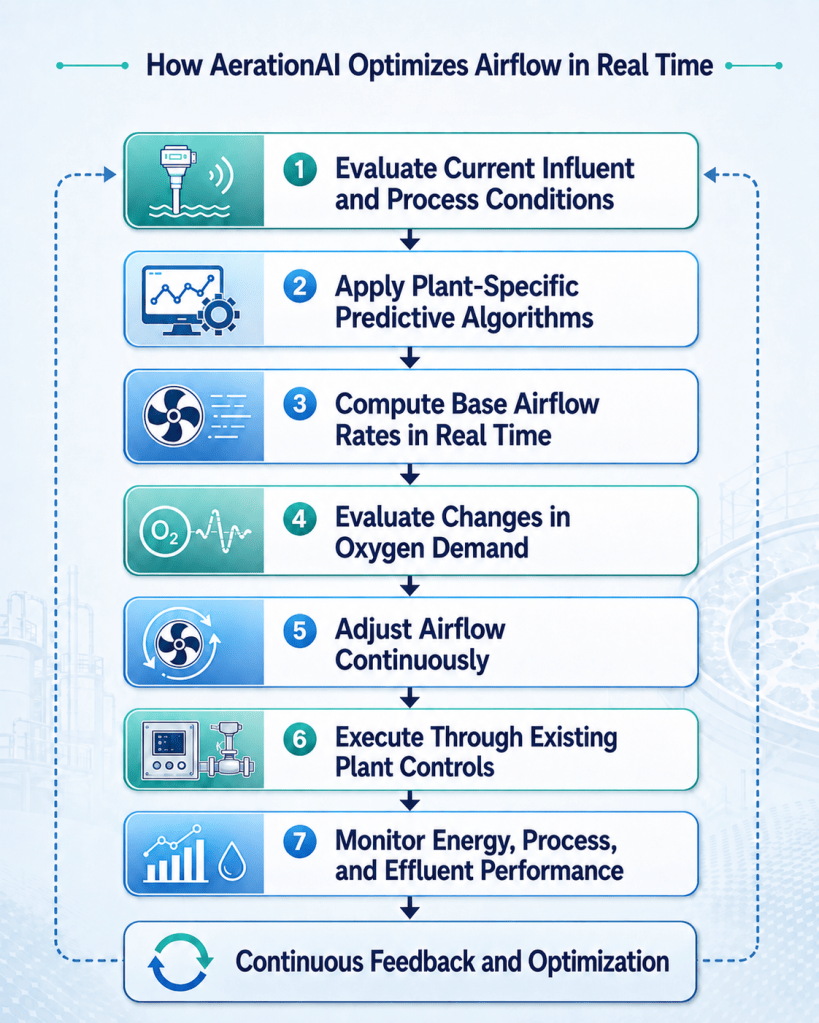
1. Establish the Site-Specific Operating Model
Historical plant information is used to characterize relationships among loading, influent flow, DO, airflow, treatment performance, basin configuration, equipment operation, and energy use.
These relationships form the basis for plant- and basin-specific predictive airflow models.
2. Validate Operational Information
Available DO, airflow, flow, equipment-status, and related signals are evaluated for plausibility, consistency, reliability, and suitability for the intended decision.
Questionable information can reduce control authority, trigger verification, or cause AerationAI to hold rather than act.
3. Predict Aeration Requirements
AerationAI uses site-specific predictive tools to calculate baseline airflow requirements under the current operating condition.
Historical organic and ammonia loading relationships are incorporated into the site model even when real-time BOD, COD, or ammonia measurements are not available.
4. Evaluate the Dynamic Process Response
AerationAI evaluates:
- current DO;
- DO trend and rate of change;
- measured airflow;
- recent airflow adjustments;
- influent-flow trend; and
- the learned airflow-to-DO response characteristics of the individual basin or zone.
5. Apply Engineering Guardrails
Proposed airflow adjustments are evaluated against plant-specific operating envelopes, equipment capability, minimum mixing requirements, treatment objectives, sensor confidence, rate limits, deadbands, and approved operating authority.
6. Recommend or Execute
Depending on the authorized deployment stage, AerationAI may:
- calculate in Shadow Mode;
- provide an operator recommendation;
- hold or constrain a proposed action; or
- execute a bounded supervisory adjustment through an approved plant-control interface.
7. Verify the Response
After an airflow adjustment, AerationAI evaluates whether the DO trajectory is responding within the expected time window before determining whether another adjustment is justified.
8. Continue Learning and Performance Evaluation
Measured performance is compared with expected performance to refine site-specific response relationships and improve future aeration decisions.
SensorAI + AerationAI: Trusted Information Before Optimization
Aeration optimization is only as reliable as the information used to make the decision.
SensorAI supports AerationAI by evaluating whether critical operational measurements remain sufficiently trustworthy for optimization and control.
For DO and airflow measurements, this may include:
- signal-range and plausibility checks;
- abnormal rate-of-change detection;
- spike and dropout detection;
- frozen-signal detection;
- same-zone peer comparison;
- airflow-response consistency;
- process-response consistency;
- cleaning and maintenance recognition;
- virtual-sensor comparison where appropriate; and
- confidence assessment.
AerationAI can then modify its operating authority according to information confidence.
A questionable DO signal should not have the same authority as a validated DO signal.
Advanced Predictive Tools and Airflow Optimization
AerationAI does not depend on a single prediction method.
It combines multiple site-specific predictive and dynamic tools to determine both the expected airflow requirement and whether current process behavior supports an adjustment.
Site-Specific Predictive Airflow
Historical operating information is used to develop predictive relationships among:

These proprietary site-specific models, including Golden Key predictive methods where applicable, establish the expected airflow requirement under changing plant conditions.
DO Trajectory Modeling
AerationAI evaluates the direction, persistence, and rate of DO change, rather than waiting only for DO to cross a fixed control boundary.
A developing decline can therefore be recognized before the absolute DO concentration becomes critically low.
Likewise, a recovering DO trajectory can indicate that a previous airflow increase is beginning to work even while DO is still temporarily declining.
Dynamic Airflow-to-DO Response
Every aeration basin and zone can respond differently after airflow changes.
AerationAI characterizes site-specific response parameters such as:
- airflow-delivery delay;
- time until a DO response first becomes detectable;
- expected change in DO trajectory;
- principal DO-response period; and
- settling behavior.
This enables AerationAI to recognize an important distinction:
DO may still be declining because oxygen demand remains too high—or because the previous airflow adjustment has not yet had sufficient time to become measurable.
The system is designed to distinguish between these conditions.
Response-Aware Airflow Adjustment
Following a significant airflow change, AerationAI can temporarily enter a response-evaluation state.
During this period, calculations continue, but unnecessary additional airflow changes can be withheld while the expected process response develops.
If the DO trajectory deteriorates sufficiently that a treatment boundary may be approached before the expected response occurs, a bounded earlier intervention can still be considered.
This helps prevent repeated control actions from accumulating before the effect of the first action becomes visible.
Influent Flow as Context—not an Automatic Loading Signal
AerationAI uses influent flow as an important hydraulic indicator but does not automatically assume:
Higher Flow = Higher Oxygen Demand
For example, wet-weather infiltration and inflow can increase hydraulic flow while diluting wastewater strength.
AerationAI therefore interprets influent-flow changes together with:
- DO trajectory;
- measured airflow;
- predicted airflow;
- recent control actions; and
- site-specific historical behavior.
A flow increase accompanied by deteriorating DO behavior may support evidence of increased oxygen demand.
A flow increase accompanied by stable or improving DO may indicate a predominantly hydraulic or dilution event and should not automatically trigger additional aeration.
Designed to Work With Existing Plant Infrastructure
AerationAI is designed to use the instrumentation and control infrastructure already available at wastewater treatment facilities.
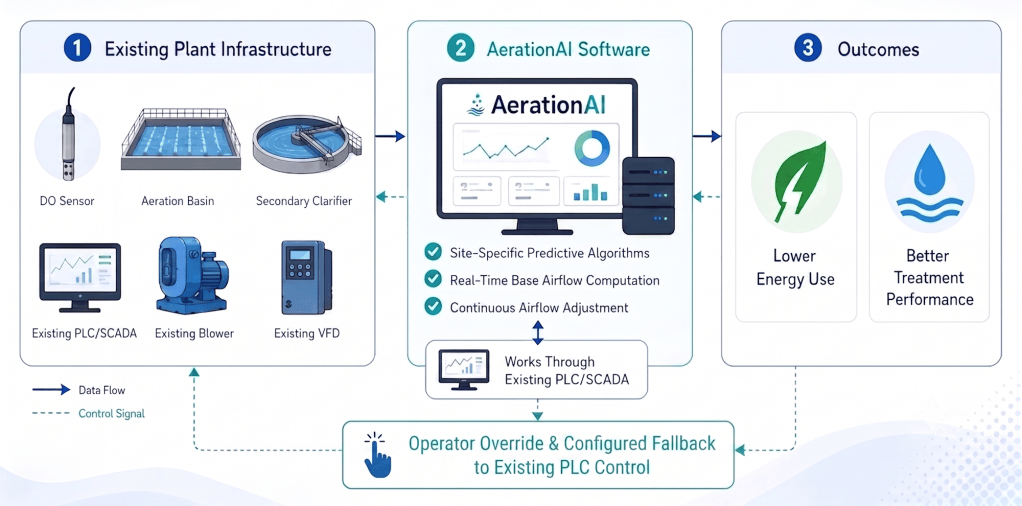
When suitable instrumentation, operational data, connectivity, and control interfaces are available, deployment can normally proceed without new process hardware or major physical plant modifications.
Typical existing information includes:
- basin or zone DO;
- basin or zone airflow;
- influent flow;
- blower operation;
- equipment operating status; and
- historical treatment-performance data.
Additional Information When Available
- blower kW
- valve position
- header pressure
- wastewater temperature
- RAS
- rainfall
- faster sensor data
Real-time BOD, COD, or ammonia analyzers are not required for basic AerationAI aeration optimization.
Any instrumentation, data-quality, timing, or connectivity gaps are identified during the initial site assessment.
Engineering Constraints and Governed Control
AerationAI optimization occurs within defined engineering and operational boundaries.
Depending on the facility, these may include:
- minimum airflow for mixing;
- maximum zone airflow;
- blower operating limits;
- valve and header-pressure constraints;
- minimum and maximum DO operating envelopes;
- treatment-performance requirements;
- airflow-change deadbands;
- hysteresis;
- ramp-rate restrictions;
- response-aware hold periods;
- sensor-confidence requirements;
- equipment availability;
- interlocks; and
- operator-defined restrictions.
Optimization therefore does not mean searching for the mathematically lowest airflow without regard to treatment or equipment.
AerationAI seeks the lowest supportable airflow within the plant’s approved engineering and operating envelope.
Better Performance With Less Unnecessary Aeration
AerationAI is designed to reduce unnecessary airflow while maintaining the treatment performance and operating stability required by the facility.
- Lower Unnecessary Airflow: Identifies conditions in which the biological process can be supported with less aeration than current operation provides.
- More Responsive Aeration: Uses predictive airflow and DO trajectory information to recognize changing process demand without waiting solely for a large DO deviation.
- More Stable Adjustments: Accounts for the normal airflow-to-DO response time before repeatedly changing airflow, reducing the potential for unnecessary control-action stacking and oscillation.
- Improved Sensor Confidence: Evaluates whether DO and related signals are sufficiently trustworthy before allowing them to influence optimization.
- Better Operational Visibility: Shows operators the basis for recommendations, the information being used, the applicable constraints, and whether a previous adjustment is producing the expected response.
- Energy and Treatment Co-Optimization: Aeration energy reduction is evaluated together with biological-treatment performance, process stability, and available effluent-quality information.
Aeration efficiency is not optimized independently of treatment reliability.
AerationAI and AerationAI-SND Within the Engineering Intelligence Platform
AerationAI applies McC AI Group’s four core Engineering Intelligence modules to wastewater aeration optimization.
OperationsAI™
Defines facility-specific operational objectives, process models, optimization strategies, information requirements, engineering constraints, and control logic. For wastewater treatment applications, OperationsAI provides the facility-specific operational intelligence supporting AerationAI™ and AerationAI-SND™. For other regulated critical facilities, the OperationsAI application can be configured and named according to the facility type, process, or operational function being optimized.
SensorAI™
Validates signal integrity, generates trustworthy virtual sensors where appropriate, evaluates operational consistency, and monitors sensor and equipment health.
WisdomAI™
Applies site-specific engineering knowledge, explainable reasoning, treatment requirements, operating constraints, and contextual guidance.
PilotAI™
Governs recommendations and operational actions within approved operating envelopes, enabling progressive authority from advisory operation to bounded governed control.
Together, these modules transform plant data into trusted aeration decisions that can be explained, constrained, verified, and progressively authorized.
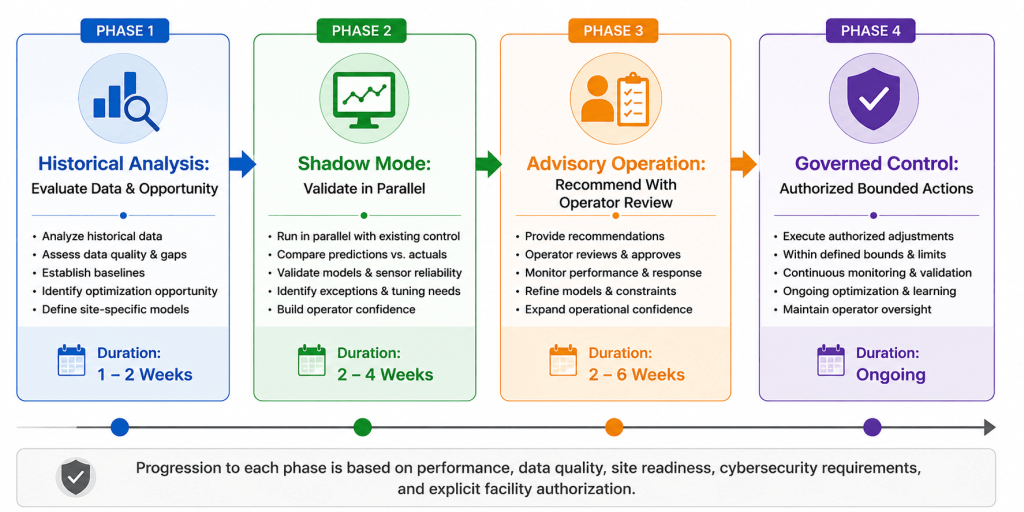
Phased Adoption: Prove Performance Before Expanding Authority
AerationAI does not require a facility to move directly from conventional control to automated AI optimization.
Operational authority is introduced progressively.
Designed for Secure Industrial Deployment
AerationAI is designed for local-first deployment within the facility’s approved computing environment.
Its essential optimization functions can operate locally without requiring plant operating information to be sent to an external cloud service.
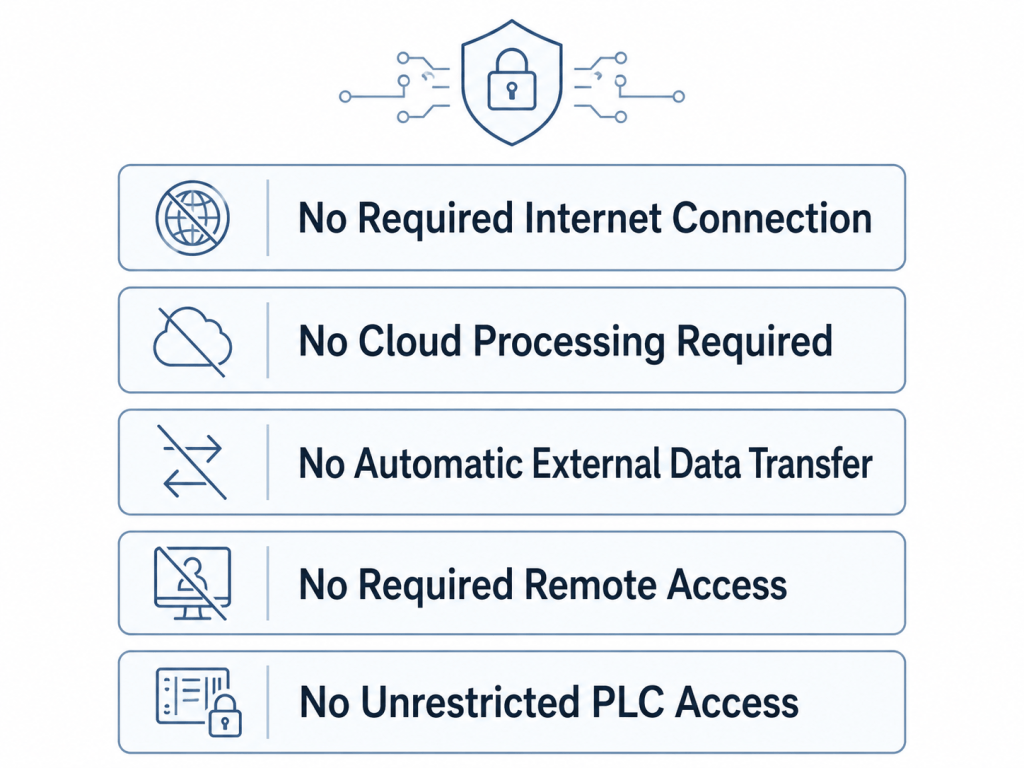
AerationAI can be configured so that normal optimization is performed locally using only explicitly approved plant information.
Any external communication pathway, if used, must be separately documented, configured, and authorized according to the facility’s IT/OT cybersecurity requirements.
Control access is also limited by deployment stage. Historical Analysis requires no control connection. Shadow and Advisory operation can remain read-only. Governed Control requires an explicitly approved and bounded control interface.
The plant determines what information AerationAI can access and what level of operational authority, if any, it receives.
Existing Plant Control Is Preserved
AerationAI operates as a supervisory optimization layer. It does not require elimination of the facility’s existing DO-based PLC control strategy.
The original control logic remains available as a fallback.
Authorized operators can:
- pause AerationAI;
- reject a recommendation;
- restrict its operating authority;
- return a basin or train to conventional automatic control;
- use manual operation where authorized; or
- impose temporary operating constraints.
Loss of AerationAI should not require interruption of biological treatment. The deployment architecture should permit the existing plant-control strategy to resume or continue according to the approved site configuration.
Operator authority and existing plant safeguards remain independent of AerationAI optimization authority.
Instrumentation and Pilot Readiness
AerationAI begins with the information already available at the facility.
Minimum Information for Initial Historical Analysis
Typical minimum information includes:
- timestamped influent flow;
- DO by controlled basin or zone;
- measured airflow by controlled basin or zone;
- basin/train operating status;
- historical treatment-performance information;
- DO probe manufacturer and model;
- airflow meter information;
- blower and diffuser configuration; and
- existing DO/airflow control logic.
Preferred Additional Information
Where available:
- faster-than-one-minute DO data;
- airflow setpoint;
- valve position;
- blower speed;
- blower kW;
- header pressure;
- wastewater temperature;
- RAS information;
- rainfall or wet-weather information;
- instrument-status flags; and
- probe-cleaning or calibration information.
The initial assessment determines which available signals are usable, which require validation, and whether any additional information is necessary for the desired deployment stage.
AerationAI is designed around the instrumentation commonly available at existing wastewater treatment facilities—not around an assumed requirement for extensive new instrumentation.
Start With Historical Analysis
A facility does not need to install active control software to determine whether AerationAI may provide value.
The first step can be completed with exported historical plant data.
McC AI Group can evaluate:
- Existing Aeration Performance: Current DO, airflow, blower energy, basin, and operating behavior.
- Predictive Airflow Opportunity: Plant- and basin-specific airflow requirements compared with historical operation.
- Dynamic Process Response: How individual zones normally respond following airflow increases and reductions.
- Sensor and Information Reliability: Whether critical DO, airflow, and process information is sufficiently reliable for optimization.
- Treatment Protection: Whether lower-airflow historical conditions remained compatible with treatment objectives and effluent performance.
- Energy-Reduction Opportunity: Potential reduction in unnecessary aeration relative to an agreed site-specific baseline.
- Pilot Readiness: Whether the plant has sufficient instrumentation, data quality, and system configuration to proceed to Shadow Mode.
Evaluate the opportunity first. Connect to the plant only when the facility is ready.
See AerationAI Using Real Plant Operation
A demonstration can replay historical plant operation at accelerated speed so that plant personnel can see how AerationAI responds as conditions change.
The demonstration can show:
- measured DO;
- measured airflow;
- predicted airflow;
- DO trajectory;
- sensor confidence;
- operating constraints;
- proposed adjustments; and
- the reason AerationAI recommends, holds, constrains, or blocks an action.
This allows operators, engineers, administrators, and IT personnel to evaluate how AerationAI would behave before expanding its operational authority.
AerationAI™ and AerationAI-SND™
AerationAI provides site-specific predictive aeration optimization for municipal and industrial wastewater treatment facilities.
AerationAI™
Optimizes aeration across activated-sludge and water-recycling treatment systems while balancing treatment performance, energy use, sensor reliability, equipment constraints, and operator authority.
AerationAI-SND™
AerationAI-SND™ extends the AerationAI architecture to controlled low-DO operation for simultaneous nitrification and denitrification, using site-specific low-DO operating envelopes, nutrient-removal models, process-response verification, and governed control.
Evaluate AerationAI for Your Facility
Every wastewater treatment facility has different:
- loading patterns;
- basin hydraulics;
- sensors;
- aeration equipment;
- operating practices;
- treatment requirements; and
- control-system constraints.
AerationAI is therefore developed and validated site by site.
The process begins with the plant information already available and progresses only as technical performance, information reliability, engineering constraints, cybersecurity requirements, operator confidence, and facility authorization support the next stage.
Predict the Requirement. Validate the Information. Understand the Response. Govern the Action.
Integration With Existing Plant Systems
AerationAI operates as a supervisory intelligence layer above existing plant instrumentation, automation, and aeration equipment. It uses available operational data and communicates through established PLC and SCADA infrastructure.
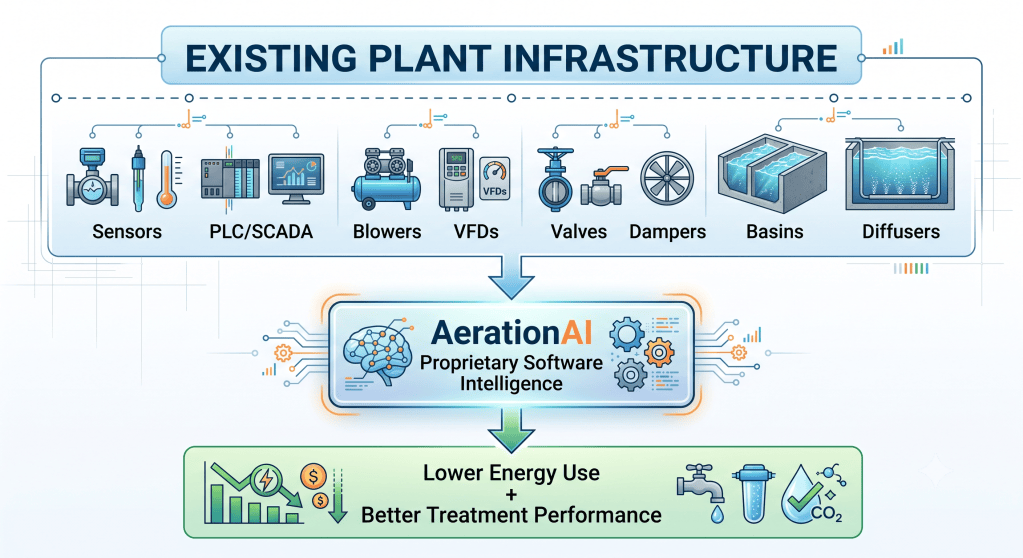
Operational Inputs may include:
- Influent flow and water-quality parameters
- Basin DO and airflow
- Process conditions and basin configuration
- Blower, valve, damper, and VFD information
- Equipment status and operating modes
- Treatment and effluent results
- Alarms, limits, interlocks, and historian data
Recommendations and Control Outputs may include:
- Plant- or basin-specific airflow recommendations
- Dissolved-oxygen guidance
- Blower or VFD operating guidance
- Valve or damper adjustments
- Sensor and process alerts
- Operator dashboards
- Bounded supervisory commands
- Performance and decision records
Exact data requirements are plant-specific. McC AI Group begins with the information already available and identifies any additional data needed during the initial assessment.
Evaluate AerationAI for Your Facility
AerationAI is introduced progressively so that data quality, model performance, engineering constraints, and operator confidence can be evaluated before operational authority expands.
Stage 1 — Historical Analysis & Site-Specific Predictive Algorithm Development
Typical Duration: 1–2 Weeks
Historical and available real-time operating information is used to:
- Evaluate data completeness and quality
- Establish operating and performance baselines
- Identify plant-specific loading and process patterns
- Configure available sensor and control signals
- Document equipment and operating constraints
- Develop plant- and basin-specific predictive algorithms
- Define treatment and energy-performance objectives
Stage 2 — Shadow-Mode Verification
Typical Duraton: 2–4 Weeks
AerationAI operates in parallel with existing control systems without changing plant operation.
During shadow operation:
- Base airflow rates are computed in real time
- Proposed adjustments are generated
- Predictions are compared with measured conditions
- Recommendations are compared with existing operation
- Sensor reliability is evaluated
- Exceptional operating conditions are identified
- Engineering constraints and operating envelopes are verified
- Operators review the recommendations and supporting logic
Stage 3 — Advisory Operation
Typical Duration: 2–6 Weeks
Following successful Shadow Mode verification and facility approval, AerationAI may advance to Advisory Operation.
During this stage, AerationAI evaluates plant conditions in real time and provides site- and zone-specific airflow recommendations for operator review. AerationAI does not independently execute control actions during Advisory Operation.
AerationAI recommendations may consider:
- Predicted site-specific airflow requirements
- Current DO and DO trajectory
- Recent airflow adjustments
- Learned airflow-to-DO response times
- Influent-flow trends and hydraulic conditions
- Sensor reliability and information confidence
- Treatment objectives and operating envelopes
- Equipment capability and process constraints
- Deadbands, hysteresis, and ramp-rate limits
Operators can review, accept, reject, defer, or modify each recommendation based on current plant conditions and operating judgment.
During Advisory Operation:
- Airflow recommendations are generated and explained
- Recommendations are compared with existing plant operation
- Operator decisions and resulting process responses are recorded
- DO response following implemented airflow changes is evaluated
- Predictive and dynamic-response models are further refined
- Sensor-confidence criteria are verified
- Engineering constraints and operating envelopes are confirmed
- Energy-performance opportunities are evaluated together with treatment performance
- Operator experience and feedback are incorporated into the site-specific operating model
A key objective of Advisory Operation is to demonstrate that AerationAI recommendations are technically sound, understandable, operationally practical, and consistent with treatment requirements before any automated control authority is considered.
During Advisory Operation, AerationAI recommends and explains. The operator decides and acts.
Stage 4 — Governed Control
Ongoing After Authorization
Following successful Shadow Mode and Advisory Operation, and only after engineering review, cybersecurity approval, operator acceptance, and explicit facility authorization, AerationAI may advance to Governed Control.
During Governed Control, AerationAI may execute specifically authorized supervisory airflow adjustments through an approved plant-control interface.
Any active control authority remains bounded by site-specific requirements, including:
- Approved DO operating envelopes
- Minimum airflow required for mixing and process protection
- Maximum allowable airflow
- Blower, valve, damper, and VFD operating limits
- Airflow-change deadbands and hysteresis
- Ramp-rate restrictions
- Learned airflow-to-DO response times
- Response-aware hold periods
- Treatment-performance requirements
- Sensor-confidence conditions
- Equipment availability
- Existing PLC interlocks and protective logic
- Operator-defined restrictions
- Cybersecurity requirements
- Operator intervention and override authority
AerationAI continues to evaluate the result of each implemented airflow adjustment before determining whether another change is justified.
For example, if airflow has been increased but the affected aeration zone normally requires several minutes before a DO response becomes detectable, AerationAI can recognize that continued DO decline during the expected response period does not necessarily justify another immediate airflow increase.
This response-aware control helps prevent repeated adjustments from accumulating before the effect of the previous action becomes observable.
The facility’s existing control strategy remains available as the approved fallback, and authorized operators retain the ability to limit, pause, or discontinue AerationAI control.
The facility determines the authority AerationAI receives. AerationAI does not determine its own authority.
Progression Between Stages
Progression from one AerationAI deployment stage to the next is based on demonstrated performance and facility readiness—not simply elapsed time.
Advancement depends on factors such as:
- Data completeness and quality
- Predictive-model performance
- Sensor and instrumentation reliability
- Airflow-to-DO response characterization
- Treatment-process stability
- Verified engineering constraints
- Equipment capability
- Operator confidence
- IT/OT cybersecurity review
- Control-system readiness
- Engineering approval
- Explicit facility authorization
The stated durations are typical planning ranges rather than guaranteed schedules. A facility may remain in Historical Analysis, Shadow Mode, or Advisory Operation for as long as desired.
Progression is not automatic, and Governed Control is not required for a facility to obtain value from AerationAI.
Historical Analysis → Shadow Mode → Advisory Operation → Governed Control
Evaluate → Validate → Recommend → Authorize
Continuous Performance Evaluation
AerationAI monitors:
- Aeration energy use
- Airflow and dissolved-oxygen response
- Basin and blower operation
- Equipment performance
- Treatment-process stability
- Available effluent-quality indicators
- Sensor reliability
- Recommended and executed adjustments
- Operator interventions and fallback events
Energy savings may be estimated against an agreed historical baseline adjusted for flow, organic loading, treatment requirements, seasonal conditions, and other relevant operating factors.
Performance results depend on the facility’s existing equipment, instrumentation, control configuration, treatment requirements, operating variability, data quality, baseline methodology, and authorized deployment stage.
Designed for Secure Industrial Deployment
Cybersecurity is a critical consideration for any software introduced into a wastewater treatment facility or other regulated industrial environment.
AerationAI is designed for local-first deployment within the facility’s approved computing environment. Its essential monitoring, prediction, optimization, and governed-control functions can operate locally without requiring plant operating information to be transmitted to an external cloud service.
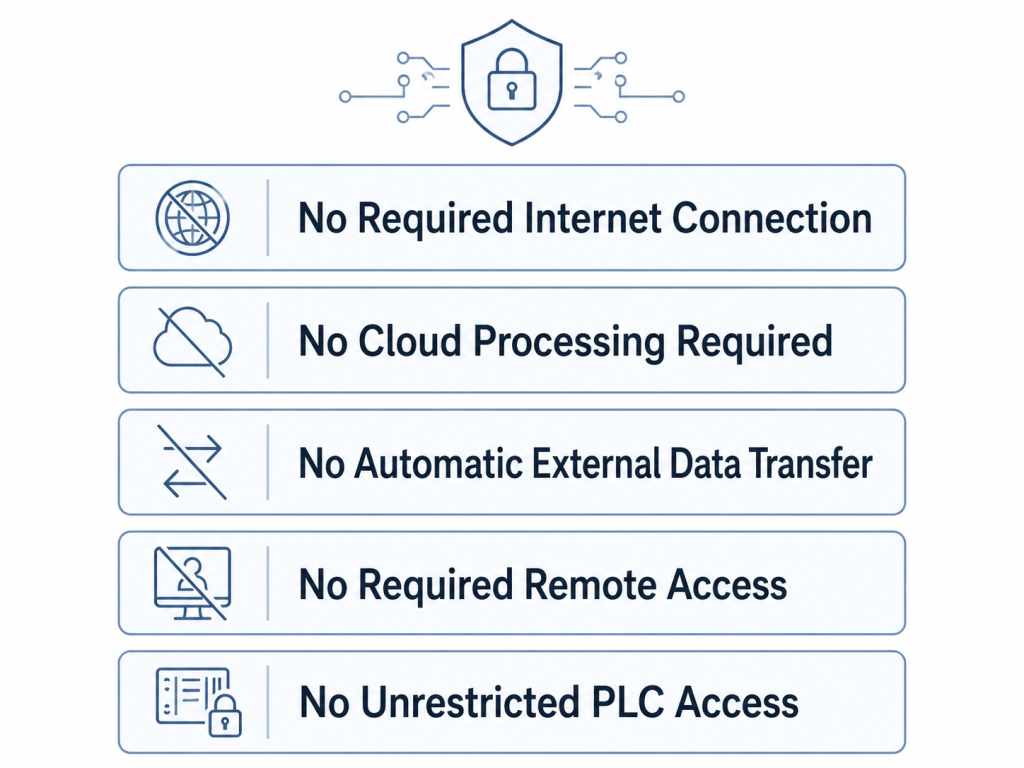
No Required Internet Connection
AerationAI can perform its essential optimization functions without a continuous Internet connection.
The software can operate within the facility’s approved local computing environment using designated plant information and locally executed predictive and optimization algorithms.
No Cloud Processing Required
AerationAI does not require cloud computing to perform its essential aeration-optimization functions.
Plant operating information can remain within the facility’s approved network environment while AerationAI performs prediction, engineering evaluation, and optimization locally.
No Automatic External Data Transfer
AerationAI does not require automatic transmission of plant operating data outside the facility network for normal optimization operation.
Any external communication pathway, if desired for an approved application such as software maintenance or authorized support, should be separately documented, configured, and approved according to the facility’s IT/OT cybersecurity requirements.
No Required Remote Access
Routine AerationAI operation does not require external personnel to maintain a persistent remote connection to the plant control environment.
Remote access, if ever permitted for an approved purpose, remains subject to the facility’s cybersecurity policies, authentication requirements, access controls, and explicit authorization.
No Unrestricted PLC Access
AerationAI does not require unrestricted access to PLCs or other plant-control systems.
Access can be limited to explicitly approved process information and, where Governed Control is authorized, to specifically approved supervisory control variables.
AerationAI is not intended to:
- modify PLC programming without authorization;
- bypass existing interlocks or protective logic;
- change unrelated plant-control functions;
- obtain unrestricted access to PLC registers; or
- independently expand its own operating authority.
During Historical Analysis, no plant-control connection is required.
During Shadow Mode, AerationAI can operate using read-only information and has no active control authority.
During Advisory Operation, AerationAI provides recommendations for operator review and does not independently execute plant-control actions.
Only during Governed Control, and only after engineering review, cybersecurity approval, facility authorization, and operator acceptance, may AerationAI communicate specifically authorized bounded supervisory adjustments through an approved control interface.
Plant-Controlled Access and Authority
The facility determines:
- which plant signals AerationAI can receive;
- which systems AerationAI can communicate with;
- whether communication is read-only or includes authorized control outputs;
- what operating limits apply;
- which actions require operator approval;
- what cybersecurity controls are required; and
- when AerationAI authority may be limited, suspended, or withdrawn.
AerationAI does not determine or expand its own access privileges.
The facility determines what information AerationAI can access and what level of operational authority, if any, it receives.
Existing Plant Control Is Preserved
AerationAI is designed as a supervisory optimization layer above the facility’s existing instrumentation, PLC/SCADA systems, airflow controllers, blower controls, and other established process-control functions.
It does not require elimination of the facility’s existing DO-based or other approved control strategy.
Existing plant-control logic remains available as the approved fallback according to the facility’s control architecture and operating procedures.
Existing Safeguards Remain Authoritative
AerationAI does not replace or bypass existing equipment-protection and safety functions.
Existing PLC and equipment safeguards may continue to enforce requirements such as:
- minimum airflow for mixing or process protection;
- maximum airflow limits;
- blower operating limits;
- motor protection;
- valve or actuator limitations;
- high- and low-DO alarms;
- equipment interlocks;
- emergency shutdown logic;
- manual operating modes; and
- other facility-approved protective functions.
AerationAI recommendations and authorized supervisory adjustments remain subject to these constraints.
Operator Authority Is Preserved
Authorized operators retain the ability to:
- review AerationAI recommendations;
- accept, reject, defer, or modify recommendations during Advisory Operation;
- limit AerationAI operating authority;
- impose temporary operating constraints;
- pause or disable AerationAI;
- return the process to the approved conventional control strategy; and
- use authorized manual operation when required.
Human oversight, operational visibility, intervention authority, and organizational accountability remain integral throughout deployment.
Failure Does Not Require Loss of Plant Control
AerationAI should be configured so that loss or disablement of the optimization software does not require interruption of biological treatment.
If AerationAI becomes unavailable because of a software, computer, communication, or data problem, the facility’s approved fallback control strategy remains available according to the site-specific implementation.
Conceptually:
AerationAI Available
→ Site-specific predictive optimization and governed supervisory control
AerationAI Unavailable
→ Existing approved PLC/operator control remains available
AerationAI therefore supplements the existing control system rather than becoming the sole means by which the aeration process can operate.
Governed Authority Remains Bounded
Even after Governed Control is authorized, AerationAI control authority remains constrained by:
- approved operating envelopes;
- minimum and maximum airflow limits;
- treatment requirements;
- equipment capability;
- sensor-confidence requirements;
- deadbands and hysteresis;
- ramp-rate restrictions;
- response-aware hold periods;
- PLC interlocks;
- cybersecurity requirements; and
- operator intervention authority.
Operator authority and existing plant safeguards remain independent of AerationAI optimization authority.
AerationAI is designed to optimize within the plant’s approved control environment—not to replace the plant’s control authority.
 McC AI Group, Inc.